

3rd Failure of Space One's Kairos Rocket Leaves Japan without Launch Capability
By Reuters | 04 Mar, 2026
The nation's first entirely commercial satellite launch terminated after lift-off, leaving Japan dependent on foreign launches to orbit satellites.
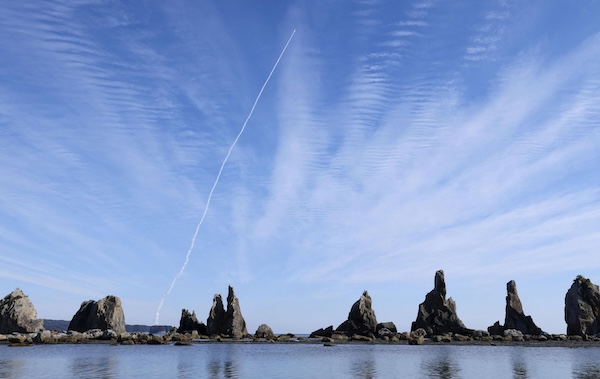
Japan's Space One's small, solid-fueled Kairos rocket rises into the air from Space One's launching pad on the tip of Kii peninsula in Kushimoto town, Wakayama prefecture, Japan December 18, 2024, in this photo taken by Kyodo. Mandatory credit Kyodo/via REUTERS/File Photo
Japan's Space One said its Kairos rocket terminated its flight after lift-off on Thursday, failing to achieve the country's first entirely commercial satellite launch on its third attempt in a row.
The setback dealt a fresh blow to Japan's efforts to establish a domestic launch industry and reduce its reliance on foreign rockets amid rising space-security needs to counter China.
Kairos "terminated the flight after judging that the achievement of its mission would be difficult," the company said in a statement.
The 18-metre (59 ft) solid-propellant small rocket carried five experimental satellites, including from Tokyo-based ArkEdge Space and the Taiwan Space Agency.
Space One, the joint venture backed by optical electronics maker Canon, aerospace giant IHI and other Japanese conglomerates, previously launched two Kairos rockets from its Pacific coast site in 2024 but neither could successfully deploy payloads.
Live footage showed Kairos flying on a wobbly trajectory within two minutes after blasting off from the company's private launch pad, which Shimizu, one of Space One's first shareholders, built on the tip of the Kii peninsula in western Japan in 2021.
Space One is investigating the situation and will host a press conference on Thursday afternoon, it said.
Japan has a dearth of homemade launch vehicles despite expanding defence needs and business opportunities for domestic satellite makers. The country successfully launched only three rockets in 2025, lagging the U.S., China, Russia, France and India, according to the government. Japan aims to boost the annual launch cadence to 30 by the early 2030s.
In December, a launch failure of the state-funded H3 rocket, built by Mitsubishi Heavy Industries, further disrupted the pipeline, spurring satellite firms to tap reliable and affordable U.S. options, mostly Elon Musk's industry-leading SpaceX and Rocket Lab, which has a launch site in New Zealand.
To ease the bottleneck, the government has granted million-dollar subsidies to nascent commercial rocketeers at home, including Space One and ISC. The defence ministry has signed hefty contracts with startups to build a constellation of national security satellites. But no Japanese rocket company has achieved a satellite launch.
Also doubling down on rockets in Japan are carmakers, to establish a space infrastructure that is not reliant on Musk and to repurpose its combustion engine industry amid electrification. Last year, Toyota invested in Interstellar Technologies, the first Japanese company that reached outer space in 2019, while Honda conducted a surprise reusable launch vehicle experiment.
(Reporting by Kantaro KomiyaEditing by Chang-Ran Kim)
© 2026 by Asian Media Group Inc.
Recent Articles
- How the Philippines Went from an Asian Economic Leader to Laggard
- Pakistan May See Economic Dividend from Its Role As Peacekeeper
- KOSPI Plunges Nearly 10% After Regulator Warns on Leveraged ETFs
- Asian Refiners See Little Room for Iranian Oil, Leaving China as Key Buyer After US Waiver
- China Beats US with World's Fastest Non-AI Supercomputer
- Mamdani's Socialist Pull to Be Tested in Tuesday's Primaries
- Chinese Self-Driver Momenta o Launch Hong Kong IPO Next Week
- SpaceX Lost Over $600 Billion in Past 3 Sessions As Nasdaq 100 Sheds over $1 Trillion
- Over 5,000 People Trapped in Myanmar Scam Centers Near Thai Border
- EV Demand Powered Europe Car Market in May, Helping Chinese Brands Grow Share