

Anduril Wants the Next War to Be Fought Like a VR Game
By JL Zhang | 29 Jul, 2026
An impatient Costa Mesa startup is pulling the Defense Department toward an age of distributed warfare.
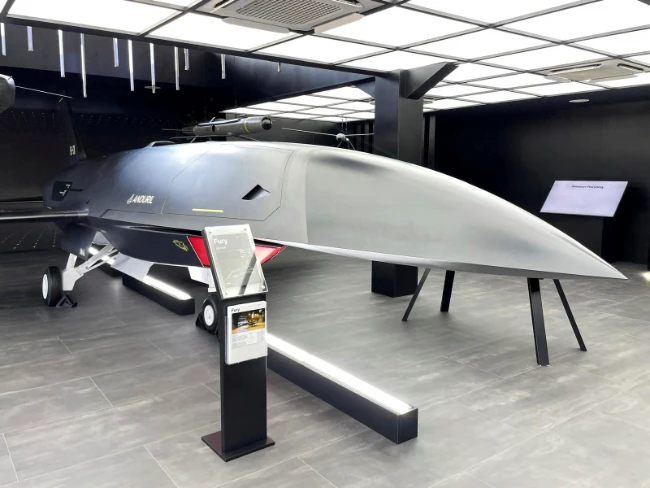
Anduril displays its unmanned combat aircraft "Fury" at the Farnborough International Airshow, in Hampshire, Britain, July 20, 2026. REUTERS/Cassell Bryan-Low
Palmer Luckey first made his name by helping people escape into artificial worlds. His Oculus Rift headset placed users inside computer-generated spaces that felt almost physical.
An Anduril Industries logo is seen at the 55th International Paris Airshow at Le Bourget Airport near Paris, France, June 17, 2025. REUTERS/Benoit Tessier
His second company is applying much the same intuition to environments nobody should mistake for entertainment. Anduril Industries wants soldiers to see a battlefield as a unified, continuously updated digital world populated by friendly units, drones, missiles, sensors and potential targets. Instead of sorting through separate radar screens, radio calls and paper maps, an operator would use one interface to understand what’s happening and direct a network of machines.
U.S. defence technology firm Anduril Industries' branded chalet at the Farnborough International Airshow, in Hampshire, Britain, July 23, 2026. REUTERS/Cassell Bryan-Low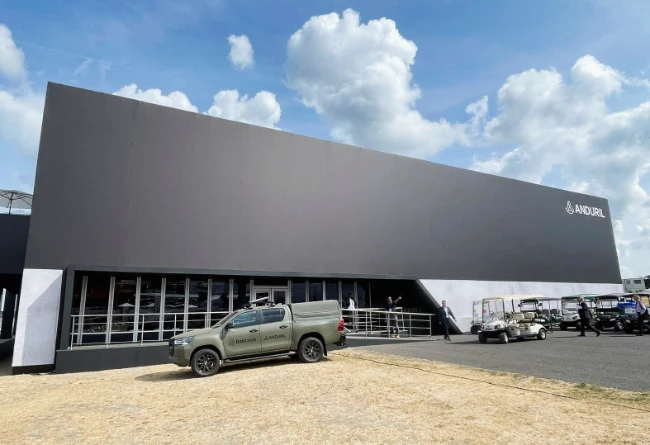
That’s the provocative truth behind the idea that Anduril wants the next war fought like a virtual-reality game. The company isn’t trying to make combat playful. It’s trying to make it visually intuitive, software-driven and fast enough that one person can supervise machines operating across hundreds of miles. Its Lattice platform merges data from distributed sensors, highlights threats and tasks crewed or autonomous systems from laptops, tablets and headsets. Anduril calls the result a “single pane of glass” through which a human can understand and act on a sprawling battlespace.
The Oculus Founder’s Second Act
Luckey founded Anduril in 2017 after Facebook acquired Oculus, but the company wasn’t a solo sequel. Its five founders combined consumer-hardware audacity, venture capital and experience dealing with government customers.
CEO Brian Schimpf, executive chairman Trae Stephens and COO Matt Grimm all brought Palantir experience, while Joseph Chen contributed Oculus-era hardware expertise. Luckey supplied product instinct, political visibility and an open commitment to building weapons for the US and its allies. (Anduril)
The company operates like a group of interlocking startups developing aircraft, missiles, sensors, underwater vehicles and soldier displays. Beneath them sits Lattice, the shared foundation meant to prevent each machine from becoming an isolated product.
A Startup Built Backwards
Traditional defense companies usually begin with a government requirement, then spend years developing to detailed specifications.
Anduril often starts in the opposite direction. It uses venture capital to identify a military problem, develop a product with its own money, demonstrate that it works and then persuade a service to buy it. That’s closer to the consumer-technology model in which a company designs a product before customers have written a formal specification.
The strategy is financially dangerous because factories, aircraft and testing consume cash before production contracts arrive. Private ownership nevertheless lets Anduril spend without protecting quarterly earnings. The company raised $5 billion in May 2026 at a valuation of $61 billion. It says 2025 revenue reached $2.2 billion, while its workforce nearly doubled to about 7,000. It doesn’t disclose a verified profit figure. Reuters reported on July 24 that investors were discussing another round that could eventually value it near $100 billion.
Lattice at the Center
The hardware produces dramatic videos, but Lattice is the product that could make Anduril a genuine challenge to the old defense primes.
Lattice ingests data from sensors and military systems, identifies and tracks objects, and presents operators with a shared picture. It then connects that picture to systems that can jam, intercept or destroy a threat.
The command post begins to resemble a strategy game. Symbols move across a three-dimensional map while software filters thousands of signals into a smaller number of decisions. An operator might confirm a suspicious drone and direct an interceptor toward it. Much of the machine-to-machine coordination happens automatically, while humans are supposed to retain authority over consequential decisions.
A dispersed force can become unmanageable if every radar, drone and launcher requires its own crew, network and control station. Lattice is Anduril’s answer: software that lets a relatively small number of people coordinate far more sensors and unmanned systems.
Distributed Warfare Becomes Doctrine
The Pentagon’s interest in Anduril reflects a broader fear that America’s traditional model of warfare has become too concentrated and expensive.
Aircraft carriers, large bases and centralized command centers remain powerful but conspicuous. Against China, long-range missiles, cyberattacks and electronic warfare could disable critical nodes.
Distributed warfare tries to remove those single points of failure. Sensors, launchers, drones and command nodes are scattered across land, sea and air. They share information through resilient networks and keep operating after parts of the system are destroyed or disconnected. The objective isn’t just to field unmanned weapons. It’s to create a force that can break into smaller pieces without losing its ability to see, decide and strike.
Anduril’s portfolio fits that concept. Sentry and Pulsar detect or disrupt threats; Ghost and ALTIUS drones scout or strike; Roadrunner intercepts aircraft; Barracuda supplies long-range firepower; Ghost Shark operates underwater; and the FQ-44 adds semi-autonomous aircraft alongside crewed fighters.
From Border Towers to the Army’s Nervous System
Anduril started with autonomous border-surveillance towers, proving that commercial sensors and AI could alert agents without constant human monitoring.
In 2022, US Special Operations Command selected Anduril as systems integration partner for a counter-unmanned-systems contract with a ceiling of about $967.6 million. The deeper significance was placing Lattice at the center of a defensive architecture connecting sensors and interceptors.
In March 2026, the Army awarded Anduril a 10-year enterprise contracting vehicle with a maximum potential value of $20 billion. That isn’t guaranteed revenue, but it consolidated more than 120 procurement actions and created a faster route for government organizations to buy Anduril products. An initial $87 million order selected Lattice as a common tactical command-and-control platform for counter-drone defense.
Anduril was also selected to lead the common data foundation for the Army’s Next Generation Command and Control effort. In division-scale exercises, Lattice connected thousands of devices and dozens of applications while reducing some targeting processes from hours to minutes. The role pushes Anduril toward becoming part of the Army’s nervous system rather than merely another drone supplier.
Putting the Interface on the Soldier
The VR comparison becomes literal in Anduril’s work on soldier-worn displays.
Through its Microsoft partnership and EagleEye systems, Anduril is combining augmented-reality displays, night vision, friendly-force locations, targeting information and control of unmanned vehicles in headsets and helmets. A soldier could see teammates’ locations through walls, receive warnings about threats outside direct view and command a drone without looking down at a separate computer.
That could reduce confusion but also create dangerous confidence. A clean icon can conceal an uncertain identification, while networks can be jammed, sensors deceived and AI models confused.
The more game-like warfare becomes on the screen, the more important it is to remember that reality hasn’t become game-like at all. A mistaken click can kill civilians, expose friendly troops or trigger escalation. Moral and legal responsibility can’t be delegated to an elegant interface.
The Factory Behind the Fantasy
Anduril knows software alone won’t transform warfare. Distributed forces require large quantities of hardware, and recent wars have shown how quickly drones and missiles can be consumed.
Its Arsenal-1 complex in Ohio is meant to manufacture different autonomous weapons with common tooling. Its first major product is the FQ-44, while Barracuda emphasizes simplified assembly. The goal is “affordable mass”: systems capable enough to matter but producible enough to be fielded by the hundreds or thousands.
That may be the hardest test. Silicon Valley is excellent at updating software, but aircraft and missiles must survive heat, vibration, weather, jamming and enemy fire. Manufacturing thousands of reliable machines is different from producing compelling prototypes. Anduril will have to master quality control, supply chains, safety and maintenance without becoming the slow bureaucracy it was created to disrupt.
A New Kind of Prime Contractor
Anduril hasn’t displaced Lockheed Martin, Northrop Grumman or RTX. Its revenue is still small beside theirs, many large contract figures are ceilings rather than firm orders, and the Pentagon still directs less than 1 percent of its contract spending to the leading defense startups collectively.
Yet it has changed the argument inside the Defense Department. Anduril has shown that a venture-backed company can enter multiple weapons markets, finance development privately and win roles once reserved for established contractors. More important, it has made software integration, autonomy and mass production feel like parts of one military strategy.
Luckey’s first company invited users to step inside a digital world. His second wants to place a digital world over the real battlefield, then connect every sensor, soldier and autonomous weapon inside it.
That could give US forces the speed and resilience needed for distributed warfare. It could also make war feel deceptively clean to the people directing it. Anduril’s rise will ultimately be judged not by how closely battle resembles a VR game, but by whether its technology improves deterrence and protects troops without allowing the interface to obscure the irreversible consequences of every command.
© 2026 by Asian Media Group Inc.
Recent Articles
- Unitree Prices IPO at $9 Billion Valuation
- AMD Buys Taalas to Expand Bet on AI Inference Chips
- N. Korean Forces Joining Russia's War Against Ukraine in Large Numbers
- S. Korea Province Deploys Drones to Warn Elderly Farmers Amid Heatwave
- Nintendo Operating Profit Jumps 151% on Robust Software Demand, Tariff Refund
- New Left-Wing Media Power Surge of Progressive Candidates
- MAGA Republicans, Democrats Jointly Blame Trump's Tech Ties for AI Inaction
- OpenAI, Anthropic AI Agents Implicated in New Security Breaches
- Iran Threatens to Hit Gulf States If US Launches New Strikes
- Ralph Lauren's Beat Powered by Young Shoppers in Asia, North America
Other Asian Media Group Sites
- AsiaMs.net — Asian American Women's Resource
- AsianSports.net — Asian American Sports and Fitness
- VoxCali.com — Videos and Podcasts for Asian Americans
- MyGoldScene.com — Guide to Asian Entertainment
- AttheBanquet.com — Asian Fine Dining and Hospitality
- EastwardDrive.com — Asian Carbuying Intelligence
- EastTable.com — Modern Asian Food and Culture
- TadkaTable.com — Inside South Asian Cooking
- GoGenerational.com — Diaspora Families Building Wealth