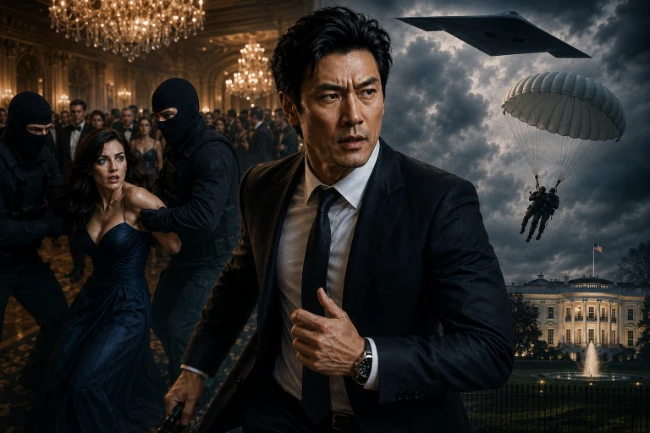

Asian Identity Thriller: Midnight in Karakorum - Pt. 3
By Tom Kagy | 05 Aug, 2026
Chip Garrison develops his own suspicions about the forces behind the kidnapping of the First Lady as she flies toward an unknown fate.
Tom Kagy (00:00)
Hello, this is Tom Kagy with Unconventional Wisdom.
How would the White House respond to the abduction of the First Lady? Of course that depends on who's calling the shots. And it's not clear that the president is in a state of mind to make delicate judgments that go far beyond the first lady's welfare to encompass geopolitical tensions.
Whoever pulled off the unthinkable must be credited with both formidable resources and an utter lack of conventional restraint in the conduct of international affairs.
Of course, the first actor that comes to mind is North Korea's dear leader. After all, he's never been initiated into the international order led by the United States. So why should he be constrained by international norms?
But special aide Chip Garrison isn't so sure. His hunch tells him an entirely different kind of actor is behind the unthinkable caper.
But of course the one person above suspicion is Jack Tang. Not only is he the president's closest friend, but he's been the victim of a gruesome killing.
As we get deeper into the main action, we come to see that not even the First Lady is sure who has put her on a cargo flight and exposed her to some heinous treatment.
Here then are Chapters Three and Four of Midnight in Karakorum.
Chapter THREE
Chip Garrison rarely spent more than a few odd minutes a day in the tiny office assigned him in the West Wing basement, usually while waiting for the President to beep him for their daily briefing. Most of Garrison’s working hours were spent in a secure house just off N Street. As he saw it, he was a second set of eyes and ears to help the President maintain a wraparound view of what was happening in, around and against the White House.
The son of a retired Secret Service agent, Garrison had thrived in the gung ho atmosphere of Virginia Military Institute where he had considered joining the Army’s Special Forces before becoming intrigued by the FBI. At the Baltimore office he had distinguished himself by his canny field work. At the moment he was on loan to the White House. Unlike the Secret Service agents tethered to the President around the clock, Garrison’s duties kept him more at-large.
One thing Garrison hated, no matter where he found himself, was downtime. So he had slipped on the headset and put his feet up on the desk to listen in on the President’s meeting with his staff and FBI Director Hanson, a man Garrison had come to respect while at the Baltimore office. Scanning tapes of the President’s meetings was an important part of Garrison’s job, essential really if he was to be effective as an intelligence aide. The warp and weave of the President’s days hid crises in the making or opportunities to be exploited. The Boss himself was often too caught up in his days to fully digest the information thrown at him from all directions.
Garrison smiled at the abrupt and fractious tone Hanson took with the President and his staff. Sam Hanson didn’t much care whether you were the President or the paperboy. The meeting was ending. Garrison pulled off the headset, patted down the unruly brown hair that was starting to sprout as it dried, and tightened the knot of his tie before going out and trotting up to the Oval Office. Right on cue, he felt his beeper vibrating. Was he a little starstruck, wondered Garrison as he gave a smart salute in passing to Lorraine Walker, the President’s matronly secretary. Or was there something a little special about having the President himself dial your beeper number every morning?
High service was either in the Garrison genes or in the stars, he told himself. At the age of 34, Chip Garrison considered himself the President’s most trusted aide though few outside the White House even knew of his existence. He supposed he was only one of many bright young stars that had flocked to the Taylor administration. He had been told more than a few times that his boyish face was way too young for the deeply cynical expression it habitually wore. It wasn’t flattering, in his opinion, but Garrison wrote it off to the peculiar role he seemed to have taken up in the White House.
At least he had managed to stay in shape, he thought, as he pushed open the President’s door and felt the gratifying pull of his jacket across shoulders that could do justice to a much bigger man.
“Have a seat, Chip,” said the President, turning his swivel chair sideways and leaning back to gaze out at the Rose Garden streaked by the long shadows of late afternoon. “Spill your guts.”
The President had slept poorly, thought Garrison. This morning the Boss’s sandy hair was half its normal volume.
“I’ve developed some intelligence that might shed light on Jack Tang’s murder,” said Garrison, laying a typed sheet on the President’s desk. “As you know, the National Security Agency monitors selected international calls.”
“So what’d Tang do, call his grandma in China?” snapped the President. He had a vague understanding of the NSA’s capabilities in monitoring and recording the millions of calls daily between the U.S. and many foreign countries, especially if they involved the numbers of known foreign operatives or contained sensitive words. It was incredible to contemplate the national security apparatus.
“Everyone but,” said Garrison, his hazel eyes narrowing to drive home the significance of his words. “Tuesday evening, the night before he came to ask you to lift his overseas travel restriction, he used a payphone at San Francisco International to call a South Korean tycoon, a Manchurian warlord and a Taiwanese powerbroker.”
The President sat in stunned silence staring at the rhythmic rising and falling of Garrison’s favorite tie, navy blue with tiny pandas sprawled at all angles. Seeing that a Presidential reaction was unlikely anytime soon, Garrison cleared his throat and pushed on.
“The calls were a bit ambiguous and the NSA had to use a Korean- and a Mandarin-speaking agent to translate the calls,” Garrison continued, slowing down a bit to make sure the President was following. “They appear to have been self-congratulatory in nature and referred to something that had just been publicly announced.”
The President’s eyes took a moment to focus on his aide’s. When they did, Garrison’s were there to lock on them.
“The redeployment of the B-2s,” said the President.
“Apparently.”
“But so what?” said the President, sitting up a bit straighter. His mind seemed to wander, probably back to Palo Alto, where he had gone to law school with Tang. “Tang may have broken a few drug and sex laws but he was no traitor. He passed the California State Bar’s thorough background check, didn’t he? And the FBI’s killer security checks before he was awarded those Pentagon contracts.”
Tang’s team had won his first Pentagon contract a year before Taylor had been elected President, Garrison had learned soon after starting at the White House. Contrary to what some in the press seemed to assume, Tang’s Pentagon contracts weren’t tainted by nepotism, which made him all the more prized as a Taylor campaign contributor.
“Hell, it’s no secret a lot of Asians think we should deploy our stealth bombers to take out the North Korean regime,” said the President. “He’s Asian, some Chinese-Korean mix, in case you couldn’t tell. He has relatives all over Asia. He was probably just killing a few minutes before a flight.”
As he listened to the President, Chip Garrison flashed on the day, some months ago, when he had watched Jack Tang walking with the President along the open passageway connecting the West Wing to the mansion for lunch in the private dining room. It being an important part of Garrison’s job to assess the people who had access to the boss, he had long since stopped feeling awkward about openly observing from a discreet distance, even pulling out his Sunagor 10-30 mini zoom binoculars when necessary. The two old buddies had been laughing about something. Garrison had noted, maybe even shared vicariously in, the conspiratorial glee in their eyes, a couple of boys sharing a superbly off-color joke. What had really captivated Garrison was the difference in their facial coloring. Not the racial difference, the temperamental one. The President’s face was deeply flushed but Tang’s had kept its pale, almost delicate hue, despite his obvious enjoyment of their little joke. A man who kept his best and worst selves hidden, an inner man, Garrison had decided. Not necessarily a suspicious man but a reflexively secretive one. Garrison’s knack for gauging character had contributed immeasurably to his successful FBI career, but in this case he was taking little pleasure in seeing his assessment borne out. Instead, he felt deeply sorry for the boss. He would share no more boyish jokes with the man who had been his best bud for more than 20 years.
Fixing his sober gaze on the President’s, Garrison pressed on, “Just for laughs, NSA did a printout of all foreign calls charged to the same company number during the last four years. In addition to what I just mentioned, they turned up a number in Vladivostok. Even more interesting, the North Korean embassy in Paris, which houses their leading overseas intelligence operation. There was also a number in Seoul that turned up quite a few times.”
“Are they sure it was Tang? It could have been an employee using the same phone card.”
“Aside from the fact that Tang’s company is prohibited by its Pentagon contracts from any overseas business, the NSA has a recording of those calls. They were Tang.”
“Blessed Mother of God,” sighed the President. “The NSA must have warehouses with millions of recordings.”
“More, I’d say.”
“Anything conclusive in the conversations?”
“Polite chitchat with a lot of vague allusions to Chinese and U.S. policy. Cryptic lyrics to some nightingale song that keeps being repeated to the number in Seoul. Nothing classified, but there seems to have been at least one meeting with some of these people, possibly four years ago, before Tang was classified and his overseas travel embargo went into effect. As you know his company makes some kind of deep black military software. Understandably, the Pentagon thinks he has no business talking to the Chinese, Russians, especially North Koreans. Just for that, the Pentagon’s procurement security office might consider him compromised and phase out his company. But there’s more.”
“For Sweet Jesus’ sake,” said the President, still mourning the loss of his closest friend and most valuable campaign contributor.
“Before heading for the airport for the flight to D.C., he pulled a neat little car-switch with his CFO and slipped his Defense Department security tails for nearly four hours. No way to know what he was doing during that time.”
“What about the money from the fundraiser he put on for us?”
“At the moment all we have are suspicions. Business as usual until further notice. We can always return the money later.”
“Another tidbit to keep in mind,” continued Garrison. “Just before your Tuesday night press conference announcing the B-2 redeployment, Lester McDavid called your father-in-law to tell him about the decision. Sounds like it was something Lachapelle cared a great deal about.”
The President’s father-in-law Peyton Lachapelle had been Lester McDavid’s company commander during the Korean War. The two men had remained close. McDavid had been a Marine four-star and Chairman of the Joint Chiefs of Staff before leaving his beloved Corps to answer the President’s somewhat ambivalent call to serve as his National Security Advisor. McDavid was a hero of two wars whom the President had tapped to make up for his own glaring credibility gap with the Pentagon establishment, not to mention a bit of armtwisting from his father-in-law.
“Crazy codger,” muttered the President, meaning Lachapelle. His father-in-law seemed to be foremost among the things the President had come to regret about his failing marriage. Lachapelle had built an oil fortune bigger than god’s, but there was no end to his greed, to hear the President tell it. Frank Taylor seemed to have little sympathy for men like that, though he certainly seemed to understand that a good number of them needed to be cultivated if he were to stay in office—one of the more onerous aspects of leading a capitalist society, it seemed to Garrison.
The President’s face darkened. “Any chance they set up that DMZ fiasco just to provoke a crisis?”
Garrison thought about that. “It’s possible. No way to monitor all of McDavid’s or Lachapelle’s contacts in the Marine Corps. But McDavid’s not a crazy, just looking for a chance to push you into flexing our muscle, like he did Tuesday.”
“He got to me, didn’t he? What’s your assessment of the B-2 redeployment?”
“There’s definitely some risk in sending half our B-2 fleet to Korea, but I don’t see how it can hurt you or the country, especially with the NKs taking GIs prisoner and rattling their sabre. It was a tough decision, Sir, and you made it under advice from your National Security Advisor. Do you have any reason to suspect Lester McDavid’s loyalty?”
“No.”
“Neither do I. Or the FBI for that matter.”
The President was pensive, probably still a bit sore about the McDavid-Lachapelle connection. Then he switched gears, something he did a dozen times a day. “How does Reiner come across?”
“Straight arrow. Works hard, loyal. Good man, for now.”
“Belinda?”
“Blondie? She’s gung-ho, rubbing some the wrong way, but mainly I worry she’s got too many pals in the media. Could create some divided loyalty situations down the road. She has literary ambitions, which worries me for down the road.”
“Is she any good?”
“Writes like a dyslexic seventh-grader, but her two gnomes write the releases. Just pray she doesn’t bag a memoir deal down the road.” The mention of a possible memoir, hoped Garrison, should kill any foolish notions the Boss might be entertaining about asking cuddly little Belinda up for tea. He had every reason to play it a lot safer, at least until he was safely back in for four more, but the man had the self-control of a tick.
The President turned in his chair as though to deflect Garrison’s somewhat piercing scrutiny. “It’s a terrible thing, of course, but this abduction seems to have taken the heat off my teas with that little Chinese gal.”
“Maybe for a while,” admitted Garrison, not liking the direction the conversation was going. “Still, Sir, it would be a very bad idea to provoke more rumors at this juncture.” After a moment he added, with what he felt was the right lack of conviction, “No matter how scurrilous and unfounded they may be.”
“For sweet Jesus’s sake, Chip, what the hell do you expect me to do up in that room alone all night?”
“In your shoes, Sir?” said Garrison, getting up and giving the President’s big ebony desk a couple of hard raps for luck, “I’d buy me a mink mitt.”
Chapter FOUR
Megan was lying on a blue-striped G.I. mattress. Someone had thrown a couple of scratchy olive-drab wool blankets over her. She still wore her black-trimmed white Chanel suit. Her stockings were on, though her shoes had been removed and were sitting neatly off to one side of the mattress. As far as Megan could tell, she hadn’t been violated.
She became conscious of an incessant din and realized she was aboard a plane, some sort of cargo jet. A small space had been cleared for her makeshift bed between a ladder leading up to the forward crew cabin and large wooden crates extending into the darkness to the rear. She became aware that she was cold and pulled the blankets tight around herself. Slowly she realized that she was also very thirsty. And hungry, famished.
“Not exactly Air Force One, is it?” A muscular Asian man of about 30 had stepped out of the cabin and was standing at the top of the ladder, looking down at Megan in the cargo hold. As he came down the ladder she saw he was wearing a white tee-shirt that revealed the bulging muscles of his chest, arms and shoulders. Possibly he was the same one she had seen during her abduction. The genial voice and the not unkind expression of his square face convinced the First Lady that she faced no immediate harm. Judging by his unaccented English, he could have been born and raised in the U.S. There might be some advantage in befriending him, she decided, forcing down the welling anger and indignation.
“Where are we going?” she said, pulling herself up to sitting position. Her voice cracked with thirst and came out too feebly to be heard in the din of the jet engines. Megan cleared her throat and repeated herself.
Without answering, the man handed her a bottle of water and a sandwich wrapped in cellophane. She chugged half the bottle before stopping to open the sandwich. After taking a bite, she saw that the man had sat down a few feet from her and was watching with bemusement.
“Where are you taking me?” Megan repeated.
He hesitated. “I’d better not say.”
That response, and the way it was spoken, sent a new wave of fear through the First Lady. But she couldn’t show her fear. That would only mark her as a victim.
“Can you tell me your name?” she pressed, affecting a tone of casual interest.
Again, the hesitation. “Rick.”
The forward cabin door opened abruptly to reveal another Asian. He was a few years older and less muscular, with a stern face that was scowling down at Rick. Scowl snapped something in a language Megan decided was probably Korean. Like Spanish and Japanese, it was distinguished by wide open vowels, in contrast to more closed, inflected vowels of Mandarin, Cantonese or Vietnamese. With exaggerated slowness, to make it clear he was no flunky, Rick got to his feet, nodded at Megan and climbed back up into the cabin. For a moment Scowl’s eyes raked warily over Megan before he ducked into the cabin and closed the door. The abrupt quality of his movements suggested that unlike Rick, Scowl had been born and raised overseas. She sensed too that he was a dangerous man, capable of unflinching violence, maybe cruelty. She shuddered momentarily and found herself grateful for Rick’s presence.
She pulled the blankets tighter around herself and remembered her hunger. She took another bite of the sandwich. Ham and cheese with a leaf of lettuce and a tired tomato slice. It was delicious. She finished it quickly and nursed what was left in the water bottle, wondering when they might be landing. Her personal safety was a concern, but what oppressed her most was not knowing where she was and where she was going. She remembered Bryce and suffered to think he had no idea whether she was even alive. I’m fine, my sweet Bryce, she told him. Since Bryce had been an infant Megan had cherished the notion that on some deep level he was receptive to her mental messages. Over the years she had seen some reason to maintain the belief and nothing to refute it.
She glanced at her wrist where her Piaget should have been. It had been removed. Judging by her thirst and hunger, she guessed it had been about nine hours since she had been taken from the AATA fundraiser. Figuring an hour or two to get her to the plane and take off, they couldn’t have been in the air more than seven or eight hours. If they were flying to Korea, North or South, the First Lady figured it would be another four or even five hours. She found herself offended at the thought of being expected to sit there for that long like a head of cattle, or a refugee. She became aware of the desire to pee. The memory of Scowl’s face gave her pause, but Megan decided he wasn’t likely to do more than scowl.
Getting unsteadily to her feet, Megan felt the joints of her knees crack. Slowly she made her way up the eight-foot ladder. At the cabin door she hesitated. The polite prisoner might knock, she thought, but it could be more informative just to barge in. The door was unlocked. She peeked inside. The cabin contained five men, all Asian. A gray-haired man she figured to be the pilot was keeping an eye on the flight controls. Scowl, Rick and two others about Rick’s age were crowded around a folddown table. They were playing cards, those tiny plastic ones with stylized pictures of flora so ubiquitous in Japan and Korea. With a violent laugh Scowl slammed down what must have been a winning hand while the others politely made disappointed noises and tossed their cards.
“Excuse me,” the First Lady said.
Scowl jumped to his feet. “You can not come here,” he snapped in heavily accented English. “You go back there.” He pointed toward the cargo area.
Megan smiled. “I need to powder my nose.”
“Nose?” Puzzled, Scowl looked at Rick. Rick murmured something in Korean. Frowning darkly, Scowl stepped back to let the First Lady get past him to the bathroom.
The head was every bit as cramped like the ones in commercial jets, but without the fragrance bottles and free toothbrushes. Nevertheless, the First Lady gratefully noted the liquid hand soap and paper towels. There were no razors, though she was hardly the type to slit her wrists. After relieving herself, she washed up. It was an immense relief to wash off the makeup from the evening before. Her skin needed a breather.
When the First Lady emerged from the head, the men were still playing cards. Scowl made a studied effort to ignore her. Rick looked up and smiled.
“Need anything else?” he asked gallantly, causing Scowl to deepen the furrows on his brows.
“A bath and a change of clothes would be nice.”
Rick laughed. “Sorry. Would you settle for another bottle of water?”
“Thank you. May I have another of those wonderful sandwiches as well?”
“Sorry, I ate the last one,” Rick said, looking guilty. Judging by his size and musculature, Megan wouldn’t have been surprised if he had eaten the last five.
She noticed that a couple of the men were eating box lunches containing rice, and slices of barbequed beef and various pickles which she recognized from Korean restaurant as well as a state visit to Seoul two years ago. To the hungry First Lady, they looked even more delectable than the ham and cheese sandwich.
“I would love one of those box lunches.”
“One of these?” Rick was surprised. “You like Korean food?” Beaming with pleasure, he opened a stainless-steel cabinet and took out a box lunch and a set of chopsticks sheathed in paper. The writing on the chopstick cover was unmistakeably Korean.
“Love it, especially the kimchi and those pickled radishes.”
Their interest piqued, the other two younger men looked up expectantly from the cardgame. Scowl had been furiously ignoring this exchange but enough was enough. He looked up at Rick and spat something in Korean. Then he glared at the First Lady and pointed in mute exasperation toward the door.
“Well, if you’ll just excuse me,” she said breezily, “I’ll go back to the guest suite and enjoy my dinner.”
The box lunch was much tastier than the ham sandwich, though a glass of pinot noir might have added a nice counterpoint to the spiciness. Since she was a little girl Megan had enjoyed the spiciest cajun and TexMex dishes. In that respect, she was more like her adventuresome father than her delicate mother. The poor woman had always been a hothouse flower, barely able to handle the rigors of everyday life. Megan had never seen her mother so much as rinse a cereal bowl.
Fortunately, Eloise DuBois had been a famed Jefferson Parish beauty besieged by rich old men eager to claim her as a trophy and esconce her in a life of luxurious ease. The winner was a dark horse candidate, big handsome Peyton Lachapelle, a Marine captain who had retired upon returning from the Korean War. In the eyes of a twenty-year-old beauty queen, no man could hold a candle to the man whose rugged good looks were backed by a commanding voice and manners. Despite her physical delicacy, in her youth Eloise’s wit had allied with her beauty to make her an equal of her forceful husband. But after passing both down to her only child Megan, the lifeforce drained from Eloise at an alarming rate until now, at the age of 65 when many women began coming into their own, she was a reclusive invalid. She lived in seclusion attended by servants, rarely visited by her husband. And not very often by even her daughter Megan. A wave of guilt washed over the First Lady now as remembered how long it had been since her last visit.
Somehow being a First Lady trapped in a marriage three years dead hadn’t put Megan in the frame of mind to pay frequent visits to her mother. Maybe because it was her mother’s fate that Megan had fought to escape since the age of twelve when she had barged into her mother’s boudoir and caught her sobbing. Her mother hadn’t been able to muster the strength to do more than turn her back on Megan and continue sobbing. Recently Megan had begun to understand just how much the desire to escape her mother’s fate had shaped her life. Since grade school she had decided she would make a place for herself with her intellect and will, not her remarkable beauty. Her decision to go to law school had been motivated by her desire to enjoy an active and influential life well into her declining years. Even the decision to end her law school romance with Jack Tang and take up with his easygoing best friend, she now realized, had been motivated to some extent by her wish to avoid falling into a man’s shadow. Jack Tang’s masterful aura, so much like her father’s, had drawn her like a magnet, but in the end she had felt compelled to pull away.
But the joke was on her. Having married Franklin Taylor, in no small part, for his sunny, boy-next-door personality, Megan had watched in dismay as he swiftly made himself leader of the free world, relegating her to the role she had spent her life avoiding, a pampered, fading flower.
Now the man who meant most to her was her son Bryce, the one person who had never wanted her to be anything but herself. She didn’t want to think how scarred he would be if he lost his mother at the age of fourteen. It was for his sake that the First Lady promised herself she would get out of this predicament alive, no matter the cost.
Before leaving the cabin, Megan had noted that the sky through the cockpick windows was midnight black. That suggested they were definitely flying west across the Pacific, prolonging the night by seven or eight hours. She finished the dinner and found herself feeling drowsy. Perhaps her captivity had lasted longer than she had figured. Or maybe the tranquilizer hadn’t fully worn off. Gratefully, she drifted off to sleep.
The First Lady was startled awake. There was someone on top of her. It was one of the young men she had seen in the cabin. He had pushed her skirt up above her thighs. With a pocketknife he had sliced apart her pantyhose and panties and was pushing himself into her. As she realized this, Megan felt his thick calloused hand over her mouth as he continued pushing into her. When he saw her eyes opening, his hand clamped down even harder. Her knees had been pushed apart, preventing her from getting leverage with her legs. She simply didn’t have the strength to push his broad, solidly-built body off her. Bucking would only encourage him by adding to his enjoyment and she feared the open blade of the pocketknife in his right hand. All she could do was lie still until he was done. His eyes closed and she felt him start thrusting, hurting her. She was determined not to make a sound to acknowledge the pain, to do nothing to acknowledge the outrage. She closed her eyes and tried to close her mind to what was happening. The thrusting became faster, more violent. Just hurry up and get it over with, raged the First Lady.
Suddenly she heard a loud crack and felt the rapist jerk violently. She opened her eyes. Scowl was standing over them, one hand holding a pistol that had put a hole through the rapist’s head. Blood was flowing down the rapist’s face and neck and onto the First Lady’s Chanel suit. Taking pains not to look at her, Scowl raised a booted foot and shoved the dead rapist off her. Then he grabbed the back of the dead man’s black turtleneck and dragged him back into the darkness between stacks of wooden crates. Rick rushed out of the cabin looking like he had just been awakened, took in the scene, and hurried down the ladder. He covered the First Lady with a blanket.
“You okay, ma’am?”
“I’ve been better. Get me some paper towels, would you?”
Rick returned with a stack of paper towels and a package of wet naps. With a feeble smile, the First Lady asked to be left alone. After making sure she was alone, Megan wiped off what blood she could, then curled up under the blankets and gave in to her misery.
© 2026 by Asian Media Group Inc.
Recent Articles
- Unitree Prices IPO at $9 Billion Valuation
- AMD Buys Taalas to Expand Bet on AI Inference Chips
- N. Korean Forces Joining Russia's War Against Ukraine in Large Numbers
- S. Korea Province Deploys Drones to Warn Elderly Farmers Amid Heatwave
- Nintendo Operating Profit Jumps 151% on Robust Software Demand, Tariff Refund
- New Left-Wing Media Power Surge of Progressive Candidates
- MAGA Republicans, Democrats Jointly Blame Trump's Tech Ties for AI Inaction
- OpenAI, Anthropic AI Agents Implicated in New Security Breaches
- Iran Threatens to Hit Gulf States If US Launches New Strikes
- Ralph Lauren's Beat Powered by Young Shoppers in Asia, North America
Other Asian Media Group Sites
- AsiaMs.net — Asian American Women's Resource
- AsianSports.net — Asian American Sports and Fitness
- VoxCali.com — Videos and Podcasts for Asian Americans
- MyGoldScene.com — Guide to Asian Entertainment
- AttheBanquet.com — Asian Fine Dining and Hospitality
- EastwardDrive.com — Asian Carbuying Intelligence
- EastTable.com — Modern Asian Food and Culture
- TadkaTable.com — Inside South Asian Cooking
- GoGenerational.com — Diaspora Families Building Wealth