

China Makes Epidurals Universal to Help Reverse Population Plunge
By Reuters | 09 Jun, 2025
The move will "improve the comfort level and security of medical services" and "further enhance people's sense of happiness and promote a friendly childbearing environment," the NHC said.
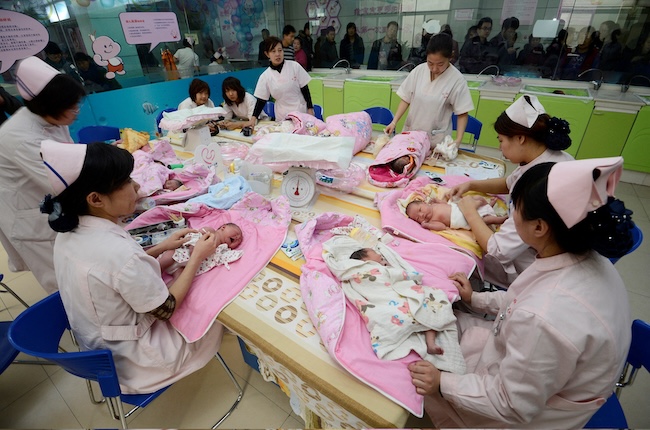
Infants undergo a daily medical examination at a maternal and child health care hospital in Taiyuan, Shanxi province, December 3, 2012. REUTERS/Stringer/File Photo
China said that by the end of this year all tertiary level hospitals must offer epidural anaesthesia during childbirth, a move it said would help promote a "friendly childbearing environment" for women.
Tertiary hospitals - those with more than 500 beds, must provide epidural anaesthesia services by 2025 while secondary hospitals - those containing more than 100 beds - must provide the services by 2027, China's National Health Commission (NHC) said in a statement last week.
Authorities are struggling to boost birth rates in the world's second largest economy after China's population fell for a third consecutive year in 2024 with experts warning the downturn will worsen in the coming years.
Around 30% of pregnant women in China receive anaesthesia to relieve pain during childbirth, compared with more than 70% in some developed countries, the official China Daily said.
The World Health Organization recommends epidurals for healthy pregnant women requesting pain relief and it is widely utilised in many countries around the world, including France, where around 82% of pregnant women opt to have one, and in the United States and Canada where more than 67% do.
The move will "improve the comfort level and security of medical services" and "further enhance people's sense of happiness and promote a friendly childbearing environment," the NHC said.
A growing number of provinces across China are also beginning to include childbirth anaesthesia costs as part of their medical insurance schemes to encourage more women to have children.
High childcare costs as well as job uncertainty and a slowing economy have discouraged many young Chinese from getting married and starting a family.
In June, health authorities in China's southwestern Sichuan province proposed to extend marriage leave up to 25 days and maternity leave up to 150 days, to help create a "fertility-friendly society."
(Reporting by Farah Master and the Beijing newsroom; Editing by Kate Mayberry)
© 2025 by Asian Media Group Inc.
Recent Articles
- Unitree Prices IPO at $9 Billion Valuation
- AMD Buys Taalas to Expand Bet on AI Inference Chips
- N. Korean Forces Joining Russia's War Against Ukraine in Large Numbers
- S. Korea Province Deploys Drones to Warn Elderly Farmers Amid Heatwave
- Nintendo Operating Profit Jumps 151% on Robust Software Demand, Tariff Refund
- New Left-Wing Media Power Surge of Progressive Candidates
- MAGA Republicans, Democrats Jointly Blame Trump's Tech Ties for AI Inaction
- OpenAI, Anthropic AI Agents Implicated in New Security Breaches
- Iran Threatens to Hit Gulf States If US Launches New Strikes
- Ralph Lauren's Beat Powered by Young Shoppers in Asia, North America
Other Asian Media Group Sites
- AsiaMs.net — Asian American Women's Resource
- AsianSports.net — Asian American Sports and Fitness
- VoxCali.com — Videos and Podcasts for Asian Americans
- MyGoldScene.com — Guide to Asian Entertainment
- AttheBanquet.com — Asian Fine Dining and Hospitality
- EastwardDrive.com — Asian Carbuying Intelligence
- EastTable.com — Modern Asian Food and Culture
- TadkaTable.com — Inside South Asian Cooking
- GoGenerational.com — Diaspora Families Building Wealth