

Chinese Ships to Face $3.2 Billion in US Port Fees
By Reuters | 07 Oct, 2025
The US is threatening to impose port fees on Chinese built ships expected to total $3.2 billion in 2026 for the top 10 carriers.
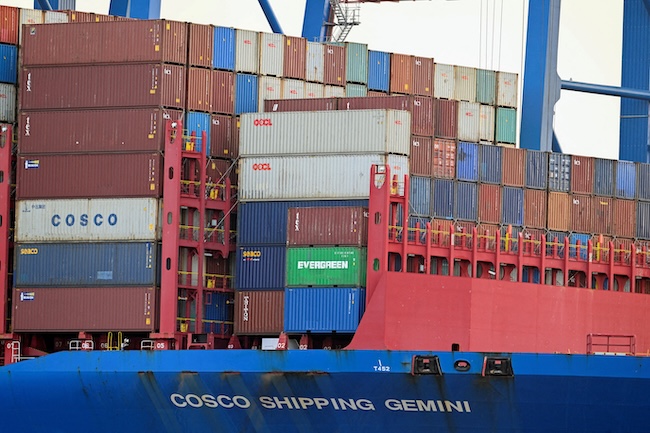
Cargo ship 'Cosco Shipping Gemini' of Chinese shipping company 'Cosco' is loaded at the container terminal 'Tollerort' in the port in Hamburg, Germany, October 25, 2022. REUTERS/Fabian Bimmer
The U.S. is one week away from imposing port fees on certain vessels with links to China, a move expected to cost the top 10 carriers $3.2 billion next year as President Donald Trump seeks to address China's growing dominance on the high seas.
"While some observers believe the October 14 deadline may be extended — or even scrapped — as part of broader negotiations, the uncertainty has already unsettled carriers, adding another layer of geopolitical risk to fleet deployment strategies," S&P said in a report this week.
Trump's administration said fees imposed on ships built, owned or operated by Chinese entities will help pay to revive U.S. shipbuilding. A law to direct that long-term funding is making its way through the U.S. Congress with strong bipartisan support.
In an update late last week, the U.S. Trade Representative put ship owners on notice that they, not the agency, are responsible for establishing if the fees apply.
"The burden for determining if a vessel owes the fee is on the operator, NOT CBP," USTR said.
It also said fees must be paid through the Department of the Treasury's Pay.gov website, not at the port of entry.
Vessels owned or operated by a Chinese entity will face a flat fee of $80 per net tonnage per voyage to the U.S. Non-Chinese operators of Chinese-built ships will be charged the higher amount of either $23 per net tonnage or $154 per 20-foot equivalent unit capacity. Both fees are imposed on a ship no more than five times a year, maritime technology and data provider Alphaliner said.
Following intense industry push back, USTR significantly eased fees from initial proposals, exempted many U.S.-based operators and extended the timeline for fees on liquefied natural gas (LNG) carriers.
On the other hand, it expanded fees to include any non-U.S. built roll-on/roll-off auto carriers - with exceptions for U.S.-flagged ships.
Alphaliner estimated that Chinese carrier COSCO, including its OOCL fleet, is most exposed to the fees.
COSCO's fees could be as much as $1.53 billion next year - nearly half of the $3.2 billion projected for the top 10 cargo carriers, it said.
Many other carriers, including France's CMA CGM, said they re-deployed Chinese-built ships to avoid the fees.
Meanwhile, Beijing has responded. Premier Li Qiang signed a decree pledging countermeasures against any discriminatory measures on Chinese ships or crews.
Trump and Chinese President Xi Jinping are slated to meet at the Asia-Pacific Economic Cooperation (APEC) summit scheduled for late October through November 1 in South Korea.
Last year, U.S. shipyards built fewer than 10 commercial ships. China shipyards, many of which build both commercial and military vessels, turned out well over 1,000.
(Reporting by Lisa Baertlein in Los Angeles, additional reporting by Gus Trompiz in Paris; Editing by David Gregorio)
© 2025 by Asian Media Group Inc.
Recent Articles
- Getting Fit Pt. 2 - Raising Our Floor
- South Korea Survives World Cup Scare, Advances to Round of 32
- SpaceX Targets US Consumers with Starlink Mobile Service Push
- Former First Lady Kim Keon Hee Gets 7-Year Jail Term for Bribery
- Iran Reasserts Right to Control Hormuz Passage After Ship Hit Near Oman
- Trump's Cutoff of Clean Energy Tax Credit Drives Rush of New Projects Before Costs Soar
- US May Goods Trade Deficit Widened Sharply on Imports Surge
- VW Eyes 100,000 Job Cuts, Closure of Four Plants in Biggest Overhaul Yet
- Small Aircraft Crashes into Beijing's Tallest Building
- Both Japan and Sweden Advance with Draw