

Denny's Busboy to Global Tech Statesman
By H Y Nahm | 02 Aug, 2026
How an immigrant from Taiwan by way of Thailand named Jensen Huang became the Asian American face of the AI era.
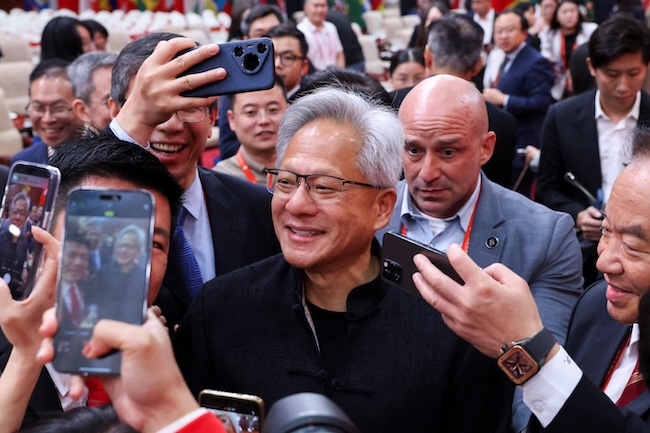
Nvidia CEO Jensen Huang greets fans during his visit to a PC cafe in Seoul, South Korea, June 5, 2026. REUTERS/Kim Soo-hyeon
When CNBC's Jim Cramer called Nvidia CEO Jensen Huang a "statesman" on live television in July 2025, he was not deploying hyperbole for ratings. He was putting a word to something the geopolitical world had been watching for months: a Taiwanese-born, American-raised engineer navigating the most consequential technology rivalry in modern history — not from a government briefing room, but from Silicon Valley.
Nvidia CEO Jensen Huang poses for a group photo at a dinner he hosts with Taiwan tech CEOs in Taipei, Taiwan January 31, 2026. REUTERS/Ann Wang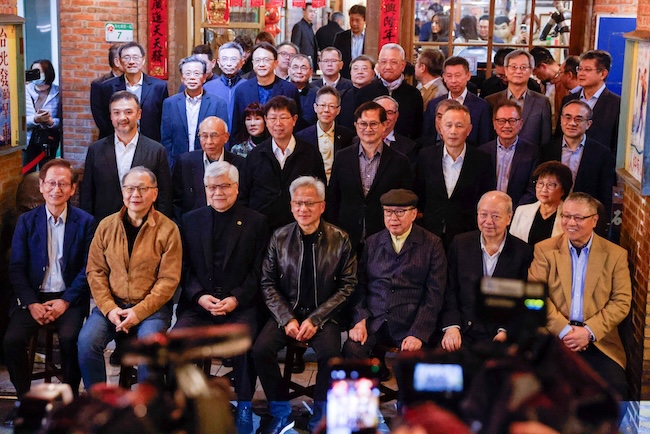
Few figures in the current era more fully embody the idea of an Asian American tech statesman than Huang, whose trajectory from immigrant child to the helm of the world's most valuable company has made him one of the most influential people alive.
FILE PHOTO: NVIDIA CEO Jensen Huang and U.S. President Donald Trump shake hands at an 'Investing in America' event in Washington, D.C., U.S., April 30, 2025. REUTERS/Leah Millis/File Photo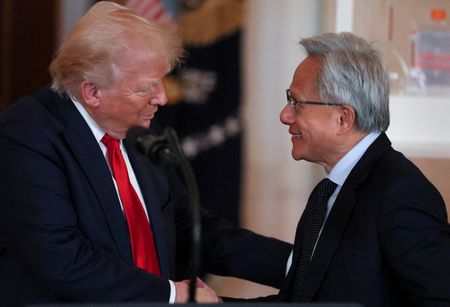
The arc begins in Tainan, Taiwan, where Jen-Hsun Huang was born on February 17, 1963. His family moved to Thailand when he was five, and by age nine he was in the United States, sent ahead by his parents as the Vietnam War spilled toward the borders. He eventually landed in Oregon, put himself through Oregon State University on an electrical engineering degree, and later earned a master's from Stanford. Before any of that, though, he was a busboy and dishwasher at a Denny's in San Jose — the same restaurant where, years later, he would sketch the earliest ideas for Nvidia with his co-founders.
In 1993, at age 30, he launched the company, survived near-bankruptcy in its earliest years, and methodically steered it from a niche graphics chip maker into the essential infrastructure of the global artificial intelligence revolution. As of 2026, Forbes estimates his net worth at over $200 billion, making him one of the seven wealthiest individuals on the planet.
The statesman framing gained real traction in 2025, and it did so because of chips — not figuratively, but literally. After the Trump administration tightened Biden-era export restrictions in April, cutting Nvidia off from China's AI market, Huang mounted a sustained, high-profile campaign to reverse the decision. He argued that locking American chips out of China — home to a vast share of the world's AI researchers — would accelerate Beijing's push to build a fully domestic AI stack, strengthening competitors like Huawei in the process.
Huang carried that argument to the White House, to Capitol Hill, and to the Center for Strategic and International Studies, where he delivered a detailed fireside chat in December 2025 on securing U.S. AI leadership. By July 2025, the Trump administration reversed course and granted export approval for Nvidia's H20 chips, and later its H200 processors, to approved Chinese commercial customers. Cramer's "statesman" label landed the morning that reversal was announced.
The cross-strait dimension of Huang's public life is equally striking, and far more complicated. In Taiwan, he is greeted with a celebrity fervor that local media have dubbed "Jensanity." His keynote at Computex 2025 in Taipei opened with a theatrical orchestral entrance; the crowd pressed in with phones raised and T-shirts bearing his face. Taipei's mayor literally handed Huang the keys to the city at the May 2025 groundbreaking of "NVIDIA Constellation," the company's first overseas headquarters — a 50-year lease anchoring 4,000 direct employees and 10,000 jobs by 2030.
Nvidia now spends an estimated $150 billion a year in Taiwan's supply chain, up from $10–15 billion just five years ago. At a Taipei night market in 2024, Huang told reporters, "Taiwan is one of the most important countries in the world." The comment triggered a sharp backlash in mainland China, and Huang later clarified he was not staking a geopolitical position — a careful hedge that is itself revealing of the impossible tightrope he walks.
That tightrope reflects something broader about what Asian American tech leadership looks like in the current era. Huang holds dual Taiwanese and American citizenship, counts AMD's Lisa Su (his cousin) and Intel's Lip-Bu Tan among a cohort of Taiwanese-raised, U.S.-trained executives at the center of global chip diplomacy, and has been appointed to the President's Council of Advisors on Science and Technology. In December 2025, both TIME magazine — naming him among the "Architects of AI" as its Persons of the Year — and the Financial Times, which named him its solo Person of the Year, recognized his outsized role in reshaping the global economy and geopolitical landscape.
The FT described him as "the driving force behind the massive AI boom which has the capacity to reshape the global economy." He was also featured by the Center for Strategic and International Studies discussing policies on AI innovation, allied collaboration, and national security — the vocabulary of a statesman rather than a mere executive.
None of this means Jensen Huang is without critics or complications. Some Taiwan-based commentators have argued that the "Jensanity" adulation obscures the fact that Huang's China lobbying serves shareholder value at least as much as any geopolitical vision. National security voices in Washington, from senators on both sides of the aisle to former White House officials, warned that H200 exports risk strengthening China's military AI capabilities. And Huang himself has shown no appetite to position himself as a political actor, consistently describing his arguments in economic and technological terms.
Still, intentions and outcomes are different things. The child who arrived in the United States with "just energy and imagination," as CSIS president John Hamre put it during their December fireside chat, now shapes energy policy debates, semiconductor supply chains, and the strategic calculus of great-power competition. In the annals of Asian American public life, that is a profile without precedent — and the full arc is far from over.
© 2026 by Asian Media Group Inc.
Recent Articles
- Unitree Prices IPO at $9 Billion Valuation
- AMD Buys Taalas to Expand Bet on AI Inference Chips
- N. Korean Forces Joining Russia's War Against Ukraine in Large Numbers
- S. Korea Province Deploys Drones to Warn Elderly Farmers Amid Heatwave
- Nintendo Operating Profit Jumps 151% on Robust Software Demand, Tariff Refund
- New Left-Wing Media Power Surge of Progressive Candidates
- MAGA Republicans, Democrats Jointly Blame Trump's Tech Ties for AI Inaction
- OpenAI, Anthropic AI Agents Implicated in New Security Breaches
- Iran Threatens to Hit Gulf States If US Launches New Strikes
- Ralph Lauren's Beat Powered by Young Shoppers in Asia, North America
Other Asian Media Group Sites
- AsiaMs.net — Asian American Women's Resource
- AsianSports.net — Asian American Sports and Fitness
- VoxCali.com — Videos and Podcasts for Asian Americans
- MyGoldScene.com — Guide to Asian Entertainment
- AttheBanquet.com — Asian Fine Dining and Hospitality
- EastwardDrive.com — Asian Carbuying Intelligence
- EastTable.com — Modern Asian Food and Culture
- TadkaTable.com — Inside South Asian Cooking
- GoGenerational.com — Diaspora Families Building Wealth