

Environmental Causes Draw Asian American Energy and Money
By Wes Yamanoha | 30 Jul, 2026
The Sunrise Movement, APEN, Wildlife Conservation Network and various efforts to protect our oceans are drawing prominent Asian support.
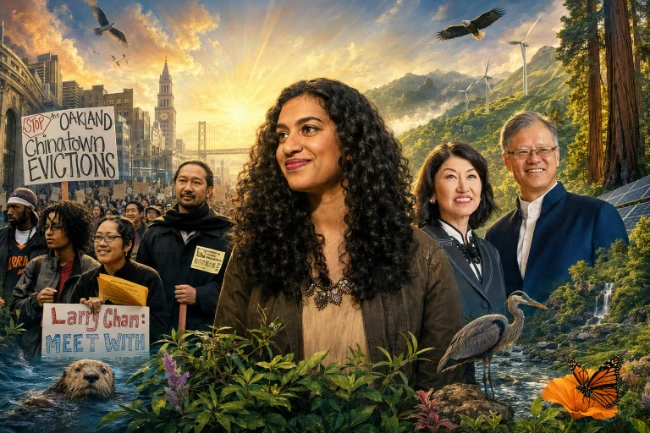
Asian American fingerprints on every area of environmental activism of the past two decades.
From the youth climate strikes that reshaped national politics to the quiet philanthropy funding wildlife conservation across the globe, Asian Americans and Pacific Islanders have emerged as organizers, donors, scientists and policymakers at the center of the environmental cause. It is a story that has received far less attention than the community's activism on civil rights or media representation, but it may prove just as consequential.
The breadth of that involvement is striking. It spans a young Massachusetts organizer who helped make the Green New Deal a household phrase, a Bay Area nonprofit that has spent three decades organizing immigrant and refugee communities against industrial pollution, a Silicon Valley couple whose fortune supports conservation on multiple continents, and a Hawaiian-born movie star who now advocates for the oceans at the United Nations. Together they illustrate how a community often stereotyped as politically quiet has become anything but when it comes to the planet.
A Youth Movement With Asian American Roots
Few organizations have changed the American climate conversation as quickly as the Sunrise Movement, and few individuals are as closely identified with it as Varshini Prakash. The daughter of Indian immigrants, Prakash co-founded Sunrise in 2017 with a group of young organizers who believed the climate movement needed the urgency and moral clarity of a mass mobilization. Barely a year later, the group vaulted into national headlines when its members occupied the office of then-incoming House Speaker Nancy Pelosi, joined by newly elected Representative Alexandria Ocasio-Cortez, to demand action on a Green New Deal.
The sit-in transformed a niche policy concept into a defining issue of the 2020 Democratic primary. Prakash herself became one of the most visible young climate leaders in the country, landing on prominent lists of rising leaders and serving on the joint climate task force convened by Joe Biden and Bernie Sanders during the 2020 campaign. Her prominence also carried symbolic weight. For many young South Asian Americans, watching one of their own lead a national movement signaled that climate activism was not a cause they were merely invited to join but one they could shape and direct.
Sunrise's broader membership reflects that shift. The organization has drawn heavily from young people of color, including many Asian Americans, who frame climate change not as an abstract scientific problem but as a matter of justice for the communities most exposed to its harms. That framing connects the youth movement to a much older tradition of Asian American environmental organizing on the West Coast.
Organizing at the Grassroots in Oakland and Richmond
Long before climate justice became a mainstream slogan, the Asian Pacific Environmental Network was practicing it. Founded in 1993 and rooted in the East Bay, APEN organizes working-class Asian immigrant and refugee communities around the pollution, housing pressures and health hazards that shape their daily lives. Its early work with Laotian refugee families in Richmond, California, a city that lives in the shadow of a massive oil refinery, became a model for environmental justice organizing nationwide.
One of APEN's signature victories illustrates its approach. After refinery incidents sent toxic smoke over Richmond, APEN's members pushed the county to create a multilingual emergency warning system so that residents who spoke Laotian, Mien and other languages would no longer be left uninformed while sirens blared. It was a modest-sounding reform with profound implications, establishing the principle that environmental protection must reach people in the languages they actually speak.
Under leaders such as Miya Yoshitani, who served for years as its executive director and became a nationally recognized voice in the environmental justice movement, APEN expanded from neighborhood campaigns to state policy. The organization helped shape California legislation directing clean energy investment toward disadvantaged communities and has been a persistent advocate for a just transition away from fossil fuels. Its member base of Chinese American seniors in Oakland Chinatown and Southeast Asian refugee families in Richmond remains its foundation, a reminder that Asian American environmentalism is as much about neighborhood air quality as it is about global carbon budgets.
Conservation Philanthropy From Silicon Valley
If activism supplies the movement's energy, philanthropy supplies much of its money, and here too Asian Americans have stepped forward. The most prominent example may be Akiko Yamazaki and her husband, Yahoo co-founder Jerry Yang. Yamazaki has served as board chair of the Wildlife Conservation Network, the Bay Area organization that channels donor funding to field conservationists protecting elephants, painted dogs, snow leopards and other threatened species around the world. WCN's model, which treats grassroots conservationists as entrepreneurs worth backing directly, has made it a favorite of Silicon Valley donors, and Yamazaki's leadership helped cement that reputation.
The couple's giving extends deep into environmental research and education. At Stanford University, their landmark gift funded the Jerry Yang and Akiko Yamazaki Environment and Energy Building, a hub for sustainability research on campus, and Yamazaki has been closely involved with Stanford's environmental programs. Their philanthropy reflects a broader pattern among Asian American tech wealth, which has increasingly flowed toward conservation, climate science and sustainability education rather than only toward the traditional beneficiaries of alumni giving.
They are not alone. Across Silicon Valley, Asian American founders, executives and engineers have become significant funders of climate technology, both as philanthropists and as investors betting that clean energy represents the next great industrial transformation. The line between giving and investing has blurred, but the direction of the money is unmistakable.
Protecting the Oceans
For Pacific Islander Americans and for the many Asian American communities with roots in coastal and island nations, ocean protection is personal. No figure embodies that connection more visibly than Jason Momoa. The Hawaiian-born actor, famous for playing Aquaman, has turned his screen identity into real-world advocacy, serving as a United Nations Environment Programme advocate for life below water and using his platform to campaign against single-use plastics and ocean pollution. His speeches at international ocean gatherings have blended celebrity draw with a distinctly Indigenous Pacific perspective on humanity's obligation to the sea.
Political leaders from Hawaii have carried the same priorities into Congress. Senator Mazie Hirono, the first Asian American woman elected to the Senate, has been a consistent supporter of marine conservation, climate resilience for island communities and the protection of vast marine national monuments in the Pacific. For Hawaii's delegation, ocean policy is not a boutique issue but a matter of economic survival, cultural heritage and climate defense all at once.
Cultural leadership matters here as well. The Polynesian Voyaging Society, led for decades by the celebrated Native Hawaiian navigator Nainoa Thompson, sailed the traditional canoe Hokulea around the world on a multiyear voyage dedicated to caring for the Earth and its oceans. The journey, which relied on ancestral wayfinding rather than modern instruments, became one of the most eloquent environmental statements of its era, carrying a message of ocean stewardship to ports on six continents.
Power in Washington
Asian Americans have also shaped environmental policy from inside the government. Ali Zaidi, who was born in Pakistan and raised in upstate New York, served as White House national climate advisor and was a key architect of the implementation of the largest climate investment in American history. Before him, Steven Chu, the Nobel Prize-winning physicist, ran the Department of Energy and pushed the agency toward renewable energy research and ambitious clean technology programs.
On Capitol Hill, Representative Pramila Jayapal has been a leading co-sponsor of Green New Deal legislation, Representative Ro Khanna has pressed for aggressive climate action and accountability for fossil fuel companies, and Senator Tammy Duckworth helped found the Senate's first environmental justice caucus, focusing attention on the polluted air and water that burden low-income communities and communities of color. Their presence means that when environmental legislation is drafted, Asian American perspectives are in the room.
Science and the Next Generation
The pipeline behind these leaders runs through laboratories and lecture halls. Arun Majumdar, an Indian American engineer who previously led the federal government's advanced energy research agency, became the inaugural dean of Stanford's new school devoted entirely to climate and sustainability, one of the most significant academic investments in the field in a generation. Across universities, Asian American scientists are heavily represented in climate modeling, battery chemistry, solar research and conservation biology, doing the unglamorous work that makes political ambition technically possible.
Public communication is part of that scientific work. Asian American researchers and writers have become increasingly visible explainers of climate science, translating dense findings on warming oceans, extreme heat and shifting monsoons for general audiences. Their visibility serves a double purpose, informing the public while signaling to Asian American students that environmental science is a field where they can lead rather than merely assist. In a discipline long criticized for its lack of diversity, that signal carries real weight.
Meanwhile, a younger generation is coming up behind them. Asian American students are visible in campus divestment campaigns, local conservation corps and climate journalism, often connecting their advocacy to family histories shaped by typhoons, floods and rising seas in Asia and the Pacific. For them, the environment is not a borrowed cause but an inherited one.
Taken together, the movement's organizers, donors, artists, scientists and officials sketch a portrait of a community fully engaged with the defining challenge of the century. The energy is real, the money is flowing, and the causes named in headlines, from Sunrise to APEN to the Wildlife Conservation Network to the fight for the oceans, are stronger for it.
© 2026 by Asian Media Group Inc.
Recent Articles
- Unitree Prices IPO at $9 Billion Valuation
- AMD Buys Taalas to Expand Bet on AI Inference Chips
- N. Korean Forces Joining Russia's War Against Ukraine in Large Numbers
- S. Korea Province Deploys Drones to Warn Elderly Farmers Amid Heatwave
- Nintendo Operating Profit Jumps 151% on Robust Software Demand, Tariff Refund
- New Left-Wing Media Power Surge of Progressive Candidates
- MAGA Republicans, Democrats Jointly Blame Trump's Tech Ties for AI Inaction
- OpenAI, Anthropic AI Agents Implicated in New Security Breaches
- Iran Threatens to Hit Gulf States If US Launches New Strikes
- Ralph Lauren's Beat Powered by Young Shoppers in Asia, North America
Other Asian Media Group Sites
- AsiaMs.net — Asian American Women's Resource
- AsianSports.net — Asian American Sports and Fitness
- VoxCali.com — Videos and Podcasts for Asian Americans
- MyGoldScene.com — Guide to Asian Entertainment
- AttheBanquet.com — Asian Fine Dining and Hospitality
- EastwardDrive.com — Asian Carbuying Intelligence
- EastTable.com — Modern Asian Food and Culture
- TadkaTable.com — Inside South Asian Cooking
- GoGenerational.com — Diaspora Families Building Wealth