
How a Long Beach Neighborhood Became the Heart of Cambodian America
By Kelli Luu | 20 Jun, 2026
After the Khmer Rouge, Cambodian refugees fled to Long Beach California to rebuild their lives, allowing survivors of the tragedy to become a thriving community.
© 2026 by Asian Media Group Inc.
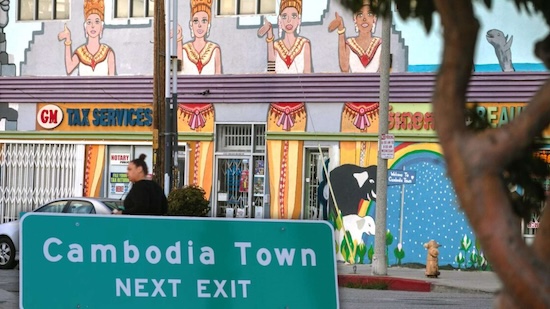
Anaheim Street in Long Beach, California is covered with Khmer script on storefronts, Cambodian restaurants serving authentic dishes, and murals that celebrate Cambodia’s history.
The Long Beach neighborhood is known as Cambodiatown with an estimated 20,000 Cambodians living in the area. The larger metropolitan Long Beach area has roughly 50,000 people of Cambodian descent, making it home to the largest Cambodian population outside of the country itself. So how did it come about?
Cambodiatown’s story dates back to 1975 when the Khmer Rouge seized control of Cambodia and carried out a genocide that killed 2 million people through forced labor, starvation, and disease causing countless of families to desperately flea the country. The United States began accepting Cambodian refugees in 1979 after the fall of the Khmer Rouge and a significant number of them found their way to Long Beach, California.
Long Beach was more affordable compared to other parts of Southern California and many jobs were available through the city’s port and manufacturing companies. The Cambodian population increased throughout the 1980s and 1990s and as more refugees arrived, the community grew stronger. Buddhist temples were established as well as Cambodian-owned restaurants and markets. By the 2000s, community leaders were advocating for recognition of the neighborhood and its cultural significance.
Their efforts paid off in 2008 when the City of Long Beach designated a part of Anaheim Street as Cambodiatown, making it the very first officially recognized Cambodiatown in the U.S. Today the neighborhood continues to be the cultural center of Cambodian America. Parades and festivals attract thousands of visitors every year and community organizations are constantly working to promote the Khmer language and history to younger generations.
Even with the many challenges affecting neighborhoods across the country, Cambodiatown has remained a powerful symbol of cultural preservation representing those who were able to rebuild their lives and create a lasting home oceans away from where their stories began.
Recent Articles
- Unitree Prices IPO at $9 Billion Valuation
- AMD Buys Taalas to Expand Bet on AI Inference Chips
- N. Korean Forces Joining Russia's War Against Ukraine in Large Numbers
- S. Korea Province Deploys Drones to Warn Elderly Farmers Amid Heatwave
- Nintendo Operating Profit Jumps 151% on Robust Software Demand, Tariff Refund
- New Left-Wing Media Power Surge of Progressive Candidates
- MAGA Republicans, Democrats Jointly Blame Trump's Tech Ties for AI Inaction
- OpenAI, Anthropic AI Agents Implicated in New Security Breaches
- Iran Threatens to Hit Gulf States If US Launches New Strikes
- Ralph Lauren's Beat Powered by Young Shoppers in Asia, North America
Other Asian Media Group Sites
- AsiaMs.net — Asian American Women's Resource
- AsianSports.net — Asian American Sports and Fitness
- VoxCali.com — Videos and Podcasts for Asian Americans
- MyGoldScene.com — Guide to Asian Entertainment
- AttheBanquet.com — Asian Fine Dining and Hospitality
- EastwardDrive.com — Asian Carbuying Intelligence
- EastTable.com — Modern Asian Food and Culture
- TadkaTable.com — Inside South Asian Cooking
- GoGenerational.com — Diaspora Families Building Wealth