

How Tariff Bullying Only Ballooned Our Trade Deficit
By Tom Kagy | 09 Jul, 2026
Trump's erratic protectionist tariffs paradoxically promote imports by creating uncertain times in which consumers of trading partners are willing to work harder and make more sacrifices than Americans.
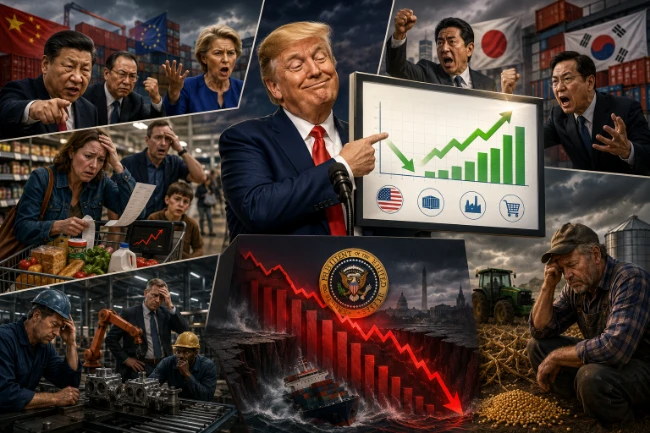
In the simplistic world Donald Trump seems to inhabit trade deficits are the ultimate scoreboard of whether America is winning or losing. If the US buys more from another country than it sells to it, he sees proof that America has been cheated. His remedy is simple enough for a bumper sticker: slap tariffs on imports, make foreign goods more expensive, force production back home and watch the trade deficit shrink.
That’s the theory. The reality has been almost the opposite.
The latest trade numbers show why. In May 2026, the US goods-and-services deficit jumped to $77.6 billion, up $23 billion from April. Exports fell 3.2% while imports rose 3.3%, exactly the combination tariffs were supposed to prevent. The goods deficit alone widened to $106.5 billion. (Bureau of Economic Analysis)
That doesn’t mean every monthly swing is caused by tariffs. AI-related capital spending, energy flows, exchange rates and business inventories all matter. But the broader lesson is hard to miss. Tariffs haven’t cured the trade deficit because the trade deficit was never just a customs problem. It’s rooted in the mismatch between America’s appetite for consumption and investment and its willingness to save, produce and export enough to pay for it.
Tariffs make that mismatch more expensive. They don’t make it disappear.
The Frontloading Trap
One of the paradoxical effects of Trump tariffs is that they increase imports rather than reduce them. Importers hear a tariff is coming and rush to bring goods into the US before the duty takes effect. Retailers stockpile inventory. Manufacturers accelerate orders for components. Consumers pull forward purchases of cars, electronics, appliances and other imported goods before prices rise.
The World Trade Organization identified exactly this pattern in 2025, noting that an improved trade forecast was driven largely by frontloading of imports into the US ahead of tariff hikes, even as higher tariffs were expected to weigh on trade later.
So tariffs create their own import surges. The more erratic the policy, the bigger the incentive to import early. Trump’s wildly overblown tariff style makes that dynamic worse because no one can be sure whether a threatened duty will be imposed, delayed, doubled, exempted, reinstated, struck down, negotiated away or replaced with a different legal mechanism. Brookings has described the 2025 tariff regime as a shift from rules to discretion, with firms facing uncertainty because tariff policy could be imposed and adjusted with unusual speed and flexibility.
In normal business conditions, companies try to keep inventories lean. Under Trump-style tariff threats, they do the opposite. They import extra because the cost of being caught short after a tariff hike can be ruinous. That stockpiling shows up as imports. If exports don’t rise at the same pace, the deficit widens.
America Consumes While Others Sacrifice
Trump’s tariffs also collide with a deeper cultural and economic reality: Americans are still the world’s most rabid and persistent consumers. When prices rise, many households complain, shift brands, borrow, delay savings or hunt for deals. But they don’t easily accept a big drop in living standards.
The US personal saving rate was just 3.0% in May 2026, according to the BEA and St. Louis Fed data. China’s gross savings rate, by contrast, was measured at 43.4% in 2024, and many other Asian export economies also run much higher saving rates than the US.
Those numbers make all the difference as to whether tariffs of any form can ever be a useful instrument of US trade policy. In uncertain times, many export-oriented societies have more room, and often more habit, to absorb pain through lower consumption, thinner business margins, longer hours, public subsidies, currency management or shifts to new markets. American consumers, by contrast, tend to preserve lifestyle first and savings second.
The result is paradoxical. Tariffs are meant to make imports less attractive. But if American consumers still want the goods, and foreign producers are willing to cut margins, reroute supply chains, move final assembly or accept lower returns to keep access to the US market, imports continue. The tariff becomes a tax layered onto the same dependence. Prices on everything go up, putting America's lower and middle classes in financial jeopardy.
It’s not that foreign consumers personally love working harder to subsidize American shopping. It’s that households, workers, firms and governments in export-oriented economies often tolerate more sacrifice to preserve jobs and market share. Americans, whose economy is built around consumption, are far less willing to give up the imported comforts that make middle-class life feel middle class.
The Deficit Is a Savings Problem
A trade deficit isn’t just a sign that foreign countries are “taking advantage” of America. It’s also the accounting mirror of a country that spends more than it produces and invests more than it saves. When the US runs large budget deficits and households save little, foreign capital helps fill the gap. The dollars foreigners earn from selling goods to America don’t vanish. They come back as purchases of Treasury bonds, stocks, real estate, factories, companies and other assets.
Tariffs don’t change that basic arithmetic. To shrink the trade deficit sustainably, the US would need to save more, borrow less, produce more competitive goods and export more. Tariffs by themselves mainly reshuffle costs.
That’s why Trump’s tariff policy is the most superficial of wars on symptoms. He sees imports arriving at the ports and assumes the problem begins there. But those imports are the visible end of a much longer chain: American consumers want low prices, American businesses want efficient inputs, American investors want high returns, Washington wants to borrow cheaply, and foreign savers are willing to hold American assets.
A tariff on washing machines, semiconductors, steel, aluminum or auto parts can raise the price of those things. It can make some protected producers temporarily happier. But it can’t force American households to save like East Asians, make US infrastructure as efficient as China’s, give small manufacturers the supplier networks of Shenzhen or erase the federal deficit.
Tariffs Hurt the Manufacturers They’re Supposed to Save
The most damaging irony is that Trump’s tariffs often hit US industry first. Modern manufacturing doesn’t work like a Norman Rockwell painting in which raw materials enter one end of an American factory and finished products emerge from the other. It works through dense, cross-border supply chains. American manufacturers import machine tools, chips, sensors, chemicals, metals, motors, batteries, packaging, parts and subassemblies.
Tariffs on those inputs raise production costs for the very companies that are supposed to lead the manufacturing revival. Equitable Growth found that US manufacturing industries are especially exposed to tariffs on intermediate inputs, with manufacturing making up 19 of the 25 most affected subsectors in its analysis.
That means a tariff meant to punish foreign producers can end up punishing an American factory in Ohio, Michigan, Texas or South Carolina. If a US company pays more for steel, aluminum, electronics or imported machinery, it has only a few choices. It can raise prices and risk losing customers. It can absorb the cost and accept lower profits. It can delay investment. It can cut payroll. Or it can move more production abroad to stay competitive.
The first Trump trade war already showed this danger. EconoFact, summarizing Federal Reserve research, reported that the 2018 China tariffs had a net negative effect on manufacturing employment, with modest protection gains more than offset by higher input costs and foreign retaliation.
That’s simply how supply chains work, even if Trump would prefer to pretend otherwise.
Retaliation Turns Tariffs Into Export Taxes
Tariffs don’t happen in a vacuum. Other countries respond. They target politically sensitive exports such as soybeans, pork, aircraft, machinery, whiskey, motorcycles and autos. American farmers, manufacturers and logistics firms then lose access to markets they spent decades building.
When China or Europe or Canada retaliates against US exports, the trade deficit can worsen from both ends. Imports may remain high because Americans still want foreign goods. Exports fall because foreign customers shift away from US suppliers.
That's why tariffs can shrink trade without shrinking the deficit. They reduce the total size of the pie while leaving the imbalance intact, or even making it worse. A farmer who loses a Chinese soybean contract doesn’t become stronger because a shopper pays more for a toaster. A machine-tool maker that loses a European customer doesn’t benefit because imported steel is more expensive.
Yale’s Budget Lab estimated that the 2025 US tariffs plus foreign retaliation would lower real GDP growth by about 0.5 percentage points in 2025 and 0.4 points in 2026, leave payroll employment 490,000 lower by the end of 2025 and reduce exports by 16% in the long run.
That’s not winning. It’s paying more to sell less.
Supply Chains Move But Not Necessarily Home
Trump often assumes that if tariffs make Chinese goods more expensive, factories will return to America. Sometimes a few do. More often, supply chains move from China to Vietnam, Mexico, Bangladesh, India or other lower-cost producers.
Rhodium Group found that after the first round of Trump tariffs, supply-chain shifts were especially visible in low-skilled, labor-intensive goods such as mass-market furniture, with production moving toward countries with lower landed costs. It also noted that countries such as Vietnam, Mexico and Bangladesh became attractive alternatives as firms adapted to the 25% tariffs on China.
That may reduce the bilateral deficit with China. But it doesn’t necessarily reduce the overall US trade deficit. It just changes the return address on the shipping container.
This is one reason Trump can claim victory in one narrow lane while the broader imbalance continues. Imports from China may fall, but imports from Southeast Asia or Mexico rise. The underlying American demand remains. The supplier changes.
In some cases, China still stays in the chain by exporting components to third countries where final assembly takes place. The label changes. The dependency doesn’t.
The Global Economy Loses Too
The damage isn’t confined to the US. Tariffs make global production less efficient by forcing companies to choose suppliers based on political risk rather than cost, quality and reliability. They encourage redundant inventories, legal gamesmanship, customs engineering and defensive investment. They make businesses postpone decisions because no one knows what the rules will be next quarter.
The WTO warned in 2025 that higher tariffs would weigh on trade into 2026, even after frontloading temporarily cushioned the blow. PIIE researchers similarly concluded that Trump’s 2025 tariffs would produce slower US growth, higher inflation and lower real GDP for the global economy, with damage worsening if other countries retaliated or if investors demanded a higher risk premium for holding US assets.
That’s the real all-around loss. Foreign exporters lose margin and stability. American consumers lose purchasing power. US manufacturers lose cheap inputs. Farmers lose markets. Retailers lose predictability. Governments lose trust. The global economy loses efficiency.
Protectionism is sold as a patriotic correction. In practice, it usually becomes a tax on competence.
A Real Trade Strategy Would Be Harder Than Tariffs
A serious strategy for reducing the trade deficit would be less theatrical and much harder. It would raise national savings, reduce reckless fiscal deficits, invest in infrastructure, expand vocational and engineering training, support strategic industries without punishing their inputs, streamline permitting, promote exports, rebuild alliances and create stable rules businesses can trust. These aren't the kind of steady, patient steps someone like Trump cares to comprehend or champion.
It would also distinguish between national-security vulnerabilities and ordinary consumer imports. It makes sense for the US to secure supply chains for advanced chips, critical minerals, defense components, pharmaceuticals, grid equipment and key industrial technologies. It doesn’t make sense to treat every imported toy, shoe, refrigerator or machine part as a national humiliation.
Trump’s tariff policy failed because it substitutes anger for strategy. It assumed foreigners will surrender, Americans will painlessly substitute domestic goods, companies will suddenly build factories at home and the deficit will shrink by force of will. But economies don’t respond to slogans. They respond to costs, incentives, habits, savings, supply chains and confidence.
Erratic tariffs weaken all of those.
The Scoreboard Trump Won’t Read
The trade deficit persists because America still wants more from the world than it is willing to pay for through exports. Tariffs don’t fix that. They just make the transaction noisier, costlier and more politically satisfying for people who mistake disruption for strength.
The May 2026 deficit spike is a reminder that the American economy remains import-hungry even under tariff pressure. When uncertainty rises, imports can surge. When input costs rise, US producers suffer. When trading partners retaliate, exports fall. When supply chains move, they often move somewhere cheaper, not necessarily back to America.
Trump promised tariffs would make America rich again. What they have more reliably done is make Americans pay more, make businesses plan less, make allies trust less and make the global economy work worse.
The trade deficit was never going to be beaten by a Trumpian tariff tantrum. It can only be narrowed by building an America that saves more, produces more, exports more and governs with enough steadiness that companies want to invest for the long term.
That kind of America can compete. Tariff chaos just teaches the world to route around it.
© 2026 by Asian Media Group Inc.
Recent Articles
- Chey Tae-won's Risky Bet Pays off as SK Hynix Debuts in New York
- Volkswagen Deliveries Suffer Biggest Drop Since 2022 on China Slump
- Delta Signals Fare Hikes Will Stay as Resilient Demand Cushions Fuel-Cost Hit
- Nvidia Supplier King Yuan Electronics to Invest up to $1.4 Billion in US Facility
- Tanker Traffic Slows in Strait of Hormuz After US and Iran Clashes
- Shein Finally Wins China's Approval for Hong Kong IPO on 3rd Attempt
- Inside the US Race for Drone Delivery Dominance
- How Chinese Is Italian Fashion?
- Global EV Demand Rises Again as Europe Offsets China, US Weakness
- OpenAI Unveils Long-Awaited "Super App" in Answer to Anthropic's Claude CoWork