

How the Bible Aligns with the Non-Human Worlds of the Vedas and Ancient Chinese Texts
By Ben Lee | 18 Jul, 2026
The Book of Enoch closes the global loop on ancient human knowledge of powerful non-human beings.
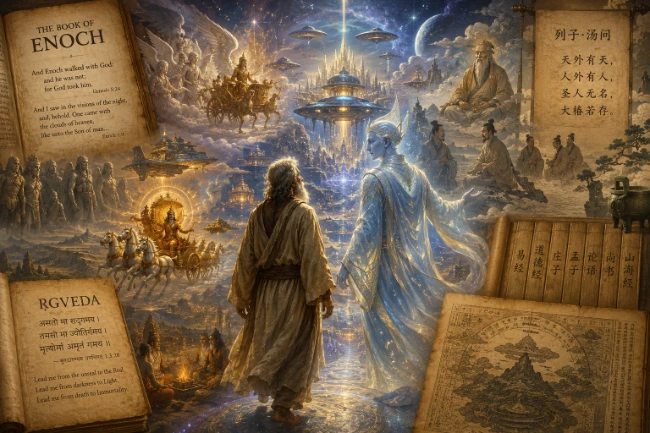
There is a book of the Bible that most Christians have never read — because it appears in only one Bible on Earth.
The Book of Enoch, canonical scripture for Ethiopia's Orthodox Tewahedo Church and excluded from every other major Christian and Jewish canon, is arguably the Abrahamic world's most detailed account of non-human civilizations: their leaders, their factions, their forbidden knowledge, and the layered cosmos they inhabit.
And when it is placed beside the Sanskrit literature of ancient India and the classical texts of China, something remarkable comes into focus. Three traditions with no obvious debt to one another describe strikingly similar worlds — worlds above and below our own, populated not by vague spirits but by organized, intelligent, powerful beings.
Whether one reads this convergence as shared human imagination, ancient cultural transmission, or something stranger, the pattern itself deserves a closer look than it usually gets.
The Book that Fell Out of the Bible
Enoch is a shadowy figure in Genesis — the great-grandfather of Noah, a man who "walked with God: and he was not; for God took him." That single cryptic verse became the seed of an entire literature. The Book of Enoch, composed in stages beginning around the third century BCE, purports to record what Enoch saw when he was taken.
For centuries the book flourished. The New Testament's Epistle of Jude quotes it directly as prophecy. Early church fathers, including Tertullian, treated it as inspired scripture. The community at Qumran copied it repeatedly; Aramaic fragments turned up among the Dead Sea Scrolls, confirming its antiquity.
But by the fourth century, the book had fallen from favor in the Western and Byzantine churches, and it eventually vanished from Europe entirely. It survived, complete, in only one place: Ethiopia, translated into the classical Ge'ez language and preserved as full canon by the Tewahedo Church. When the Scottish traveler James Bruce carried Ge'ez manuscripts back to Europe in the 1770s, Western scholars were reading, essentially for the first time in a millennium, the Bible's lost cosmology.
What they found was not a book of moral instruction. It was a travelogue of other worlds.
The Watchers: a Civilization from Above
The most famous section of Enoch expands a terse, mysterious passage in Genesis 6 — the "sons of God" who took human wives — into a full narrative. Two hundred angels, called the Watchers, descend upon Mount Hermon under a leader named Semjaza. They are not a mob but an organization: they swear a binding oath together, they have named chiefs of ten, they have specialists. And each specialist teaches humanity a forbidden art. Azazel teaches metallurgy and the making of weapons, along with cosmetics and ornamentation. Others teach sorcery, root-cutting, astrology, the courses of the moon.
The Watchers take human wives, and their offspring are the Nephilim — giants whose appetites devastate the earth. The judgment that follows sets the stage for the Flood, and the spirits of the slain giants become, in Enoch's telling, the demons that afflict humanity ever after.
Strip away the theological framing and the structure of the story is unmistakable: a hierarchical society of powerful non-human beings descends from a higher realm, interbreeds with humanity, and transmits civilization-altering knowledge — with catastrophic consequences. It is a story about contact.
Enoch's Tour of the Heavens
The second thing Enoch offers is a journey. Taken up by angelic guides — chiefly Uriel — Enoch physically tours the architecture of the cosmos. He visits the storehouses of the winds and the foundations of the earth. He sees the prison where the fallen Watchers await judgment, the compartmented abode of the dead, the fiery ends of the world, and the tree of life held in reserve. The book's Astronomical section reads like a guided survey of celestial mechanics: the gates through which the sun rises and sets, the ordering of the stars, a 364-day solar calendar explained realm by realm.
The later Enochic tradition formalizes this into a tour of multiple heavens, each with its own inhabitants and functions. The universe of Enoch is not an empty sky with a single throne at the top. It is a layered, populated, administered cosmos — and a human being is escorted through it, level by level, by beings who live there.
The Vedic Parallel: Lokas, Devas, and Ascent
Half a world away, the Sanskrit tradition had been elaborating the same architecture for centuries. Vedic and Puranic cosmology describes fourteen lokas — seven realms above the earthly plane and seven below — each inhabited by its own classes of beings: the shining devas of the upper worlds, the serpent-bodied Nagas in the splendid subterranean realm of Patala, the Gandharvas and Apsaras who move between levels as musicians and messengers.
The correspondences with Enoch are not vague. Beings from higher realms descend and take human spouses; the epics are full of half-divine lineages, just as Genesis and Enoch describe the Nephilim. Knowledge flows downward from non-human teachers. Rival orders of powerful beings — devas and asuras — contend across the levels of the cosmos, as Enoch's loyal and fallen angels do. Time itself runs differently in the higher worlds: the Puranic story of King Kakudmi, for whom moments in Brahma's realm equal ages on Earth, finds an echo in Enoch's transport across vast cosmic distances and epochs. And in both traditions, a chosen human is granted a guided tour: what Uriel does for Enoch, divine charioteers and sages do for figures like Arjuna, carried up to Indra's heaven to see it firsthand.
The Chinese Parallel: Celestial Bureaucracy and Hidden Kingdoms
Classical China supplies the third panel of the triptych. The Chinese cosmos, as it develops through texts like the Shanhaijing and the Daoist canon, is famously administrative: heaven is organized as a literal government, with ministries, ranked officials, and jurisdictions — a civilization above, mirroring the empire below. The xian, or immortals, dwell in remote paradises such as Kunlun and the sea-isles of Penglai, complete societies with palaces of gold and jade, and travel the sky on cranes and dragons.
Below the surface, the Dragon Kings hold court in underwater palaces with ministers and armies — a tradition so structurally similar to India's Nagas that when Buddhist texts arrived in China, translators simply rendered "Naga" as long, dragon. Here the loop visibly closes: the Indian and Chinese versions of the hidden serpent-kingdom are not merely parallel but historically connected, one tradition recognizing itself in the other.
And China, too, tells of knowledge descending from higher beings. Culture heroes and celestial figures teach writing, agriculture, and medicine at the dawn of history — the same civilizing gift that Mesopotamia attributed to the fish-sage Oannes and that Enoch attributes, in its darker key, to Azazel and his companions. Scholars have long noted that the Watchers narrative itself likely reworks those Mesopotamian sage traditions, which places Enoch in a documented chain of transmitted ideas stretching across the ancient Near East.
What the Alignment Means
Lay the three traditions side by side and the shared blueprint is hard to miss: a vertically layered cosmos; organized non-human societies with rulers, laws, and cities; descent, intermarriage, and hybrid offspring; forbidden or civilizing knowledge handed down; prior ages ended in catastrophe; and a privileged human witness escorted through the upper worlds.
What explains it? Mainstream scholarship concludes that human minds everywhere personify the sky and the deep; societies project their own hierarchies onto the heavens; and real transmission occurred along real roads — from Mesopotamia into the Jewish world that produced Enoch, from India into China with Buddhism. Those not bound to traditional view of history and religion read the same pattern as a memory of early human contact with extraterrestrial beings.
Regardless of the belief system on subscribes to, there's reason for astonishment. That a Ge'ez manuscript preserved in the highlands of Ethiopia, a Sanskrit cosmology recited on the Gangetic plain, and a bureaucratic heaven imagined along the Yellow River should converge on the same vision of a populated, many-storied universe tells us something profound. Perhaps it's about the ancient world's connectedness, or about the deep structure of human cosmological imagination, or an era in which extra-terrestrials provided ancient peoples with knowledge far beyond their then level of development.
© 2026 by Asian Media Group Inc.
Recent Articles
- Chipmakers' Big Profit Gains May Not Be Enough
- Blockbuster Films Produce Record Revenues for AMC
- Archer, Anduril Unveil Autonomous Aircraft Platform for Defense
- Why Oil Prices Haven't Gone Crazy Despite 5 Months of US-Iran Conflict
- Suzuki's No-Frills Cars Once Ruled India. Then Buyers Demanded Frills.
- Japanese Mayor Makes History with Maternity Leave That Caused a Stir
- Chinese Brave Simulated Typhoons to Prepare for the Real Thing
- GE Aerospace Unveils Breakthrough in Hybrid-Electric Flight
- Houthi Red Sea Blockade Tightens Iran's Grip on Global Energy Supplies
- Google's Newest Chip to Run Gemini Models 6 Times More Efficiently