

How the US Became an Extreme Gerontocracy—and How We Can Restore Youthful Leadership
By Tom Kagy | 13 Jun, 2026
Endless political campaigns that reward unlimited spending have kept youthful leaders from emerging onto the national stage.
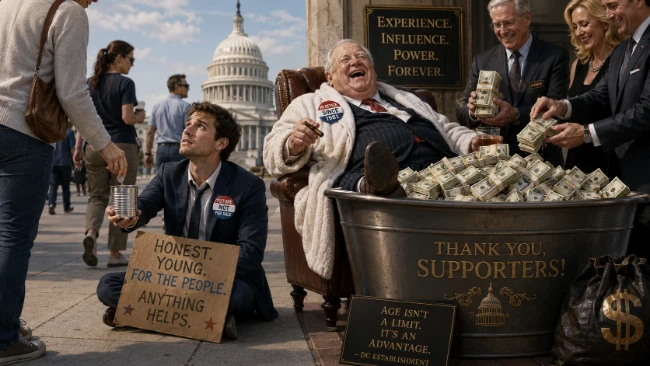
(Image by ChatGPT)
In contrast to the onetime image of the United States as a vibrantly young nation, our national political leadership is now one of the world's most aged. This swift slide into gerontocracy reflects the insidious influence of big, limitless money seeping into our national debate. Unless it's checked soon, we're likely to find ourselves sloshing from swamp to cesspool like so many third-world nations where money literally buys power.
In 2016 Donald Trump was 70 years old when he won the presidency—the oldest first-term president in American history at that point. He held that record until 2020, when Joe Biden beat him at the ballot box and shattered it at 77. Then, in 2024, Americans were faced with a rematch between an 81-year-old Biden (who ultimately stepped aside) and a 78-year-old Trump. When Trump was inaugurated for his second term in January 2025, he was 78—older than Biden was when Biden first took office.
We didn't just inch toward gerontocracy. We sprinted.
For context, during the 2016 race, Hillary Clinton was 68. Bernie Sanders, the candidate young voters flocked to, was 75. The 2020 Democratic primary featured candidates who averaged well into their 60s. At no point in recent memory has the American political stage felt genuinely young.
You might be thinking, "But haven't other countries always been run by old men?"
Authoritarian Gerontocracies
China's Xi Jinping is 71. Russia's Vladimir Putin is 72. Iran's Supreme Leader Ali Khamenei was 85 until apparently being killed in the February US strike. These are nations that the West routinely criticizes as authoritarian gerontocracies, places where power calcifies in the hands of aging men who've long since lost touch with the everyday concerns of younger generations. And yet, America's recent presidential matchups would fit right in at that table. We've essentially replicated the succession dynamics of a one-party state while maintaining the aesthetic of a democracy. That's quite a trick.
America's Money Problem
What makes America's situation especially odd is that it's not a structural requirement. There's no Politburo. There's no supreme leader who appoints his successor from within an insular inner circle. The US has competitive elections, a free press, and a massive, energetic population with a median age of around 38. So why does the world's oldest democracy keep nominating its oldest citizens to lead it?
Like most American problems, the answer traces back to money.
Running for president in the United States isn't really a political process anymore—it's a financial one. A serious presidential campaign now requires raising and spending somewhere in the range of $1 billion. Senate races in competitive states can easily crack $100 million. Even a House seat in a swing district might demand $5 to $10 million in fundraising. That's not a barrier to entry. It's a wall with razor wire on top.
Who can clear that wall? People who've spent decades cultivating donor networks, currying favor with bundlers, and making themselves indispensable to the party infrastructure. That takes time—lots of it. By the time a politician has built the kind of financial architecture needed to run nationally, they're typically well into their 60s or beyond.
A 38-year-old with great ideas and genuine charisma simply can't compete with a 72-year-old who's been collecting IOUs from wealthy donors since the Clinton administration.
Citizens United
The Supreme Court's 2010 Citizens United decision poured gasoline on this fire. By ruling that political spending is a form of protected speech and that corporations and outside groups can spend unlimited amounts on elections, the Court didn't just open the floodgates—it demolished the dam. Since then, the donor class has grown dramatically more powerful relative to ordinary voters, and the candidates who thrive are those with the deepest ties to that class.
Young insurgents do occasionally break through—Alexandria Ocasio-Cortez's 2018 primary upset is the most famous example—but they're exceptions that prove the rule, and they tend to win at the congressional level, not the presidential one.
Endless Campaigns
Then there's the sheer duration of American campaigns. Presidential candidates now effectively begin running two to three years before the actual election. That's two to three years of constant travel, fundraising calls, debate prep, media appearances, and retail politicking in Iowa diners. It's an endurance test that favors people whose kids are grown, whose mortgages are paid off, and who've had decades to build the staff, infrastructure, and name recognition to survive it.
A talented 42-year-old governor with young children and a normal life is at a structural disadvantage compared to a 74-year-old career politician with nothing but time and ambition.
Youthful Democracies
It doesn't have to be this way, and other democracies prove it. France elected Emmanuel Macron at 39. New Zealand's Jacinda Ardern became prime minister at 37. Finland's Sanna Marin took office at 34. The UK has had prime ministers in their 40s.
These countries have shorter, publicly financed campaigns that don't require candidates to spend years of their lives chasing billionaire donors. When the financial barrier is lower and the campaign timeline is compressed, younger candidates can actually compete.
So what could America actually do?
Solutions for the United States
First, publicly financed campaigns would be the single biggest structural lever. If candidates received matching public funds—or if small-dollar donations were amplified by government matching at, say, a 6-to-1 ratio—the ability to raise $50 million from a handful of hedge fund managers would matter a lot less. New York City has experimented with exactly this model, and it's produced a more diverse, younger candidate pool at the local level.
Second, shortening the campaign season would help enormously. A mandatory primary window of, say, four to six months—rather than the current two-year marathon—would make a run for office compatible with actually having a life and a career. It'd reduce the advantage of incumbency and name recognition, and give talented newcomers a fighting chance.
Third, ranked-choice voting in primaries would reduce the spoiler effect that keeps voters clustering around "electable" name-brand candidates. If you can rank your preferences, you're more willing to take a chance on someone younger and less established.
Finally, changing the culture matters too. Americans need to stop treating political inexperience as automatically disqualifying. The idea that you need 30 years in Washington to understand how Washington works is circular logic that conveniently benefits everyone who's already been in Washington for 30 years. Competence, judgment, and vision aren't age-dependent virtues.
None of this is to say that older leaders are inherently bad. Experience and wisdom matter. But there's a difference between a 68-year-old who earned their seat at the table through genuine merit and a system that structurally filters out everyone under 60 before they even get to the starting line. The US currently has the latter—a credentialing process so expensive, so long, and so dependent on legacy donor networks that it functions less like a meritocracy and more like a seniority system.
America's always prided itself on being a young country—restless, innovative, willing to reinvent itself. It'd be nice if the government looked a little more like that country. That would take a system that doesn't make it nearly impossible to get there before you're collecting Social Security. The fix is well within our reach—if we've got the political will.
That will likely take getting some younger people into office first.
© 2026 by Asian Media Group Inc.
Recent Articles
- Unitree Prices IPO at $9 Billion Valuation
- AMD Buys Taalas to Expand Bet on AI Inference Chips
- N. Korean Forces Joining Russia's War Against Ukraine in Large Numbers
- S. Korea Province Deploys Drones to Warn Elderly Farmers Amid Heatwave
- Nintendo Operating Profit Jumps 151% on Robust Software Demand, Tariff Refund
- New Left-Wing Media Power Surge of Progressive Candidates
- MAGA Republicans, Democrats Jointly Blame Trump's Tech Ties for AI Inaction
- OpenAI, Anthropic AI Agents Implicated in New Security Breaches
- Iran Threatens to Hit Gulf States If US Launches New Strikes
- Ralph Lauren's Beat Powered by Young Shoppers in Asia, North America
Other Asian Media Group Sites
- AsiaMs.net — Asian American Women's Resource
- AsianSports.net — Asian American Sports and Fitness
- VoxCali.com — Videos and Podcasts for Asian Americans
- MyGoldScene.com — Guide to Asian Entertainment
- AttheBanquet.com — Asian Fine Dining and Hospitality
- EastwardDrive.com — Asian Carbuying Intelligence
- EastTable.com — Modern Asian Food and Culture
- TadkaTable.com — Inside South Asian Cooking
- GoGenerational.com — Diaspora Families Building Wealth