

How Tony Zhao and Cheng Chi Got the Jump on Making Your First Domestic Robot
By JL Zhang | 06 Aug, 2026
Sunday Robotics used a clever training system to efficiently program robots to use their hands like humans to handle the most repetitive tasks of daily life.
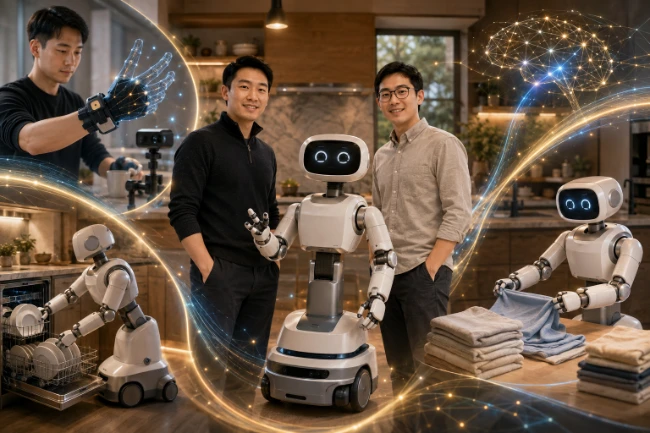
The most difficult place to put a useful robot may not be an automobile factory, warehouse or battlefield. It may be your kitchen after dinner.
A factory robot performs the same tightly defined motion thousands of times in a carefully controlled setting. A domestic robot must recognize hundreds of unfamiliar objects, navigate clutter, adjust to different homes and handle everything from greasy plates to crumpled underwear without breaking, spilling or frightening anyone.
Sunday Robotics founders Tony Zhao and Cheng Chi believe they’ve found a way through that chaos.
Memo folds laundry. (Sunday Robotics Photo)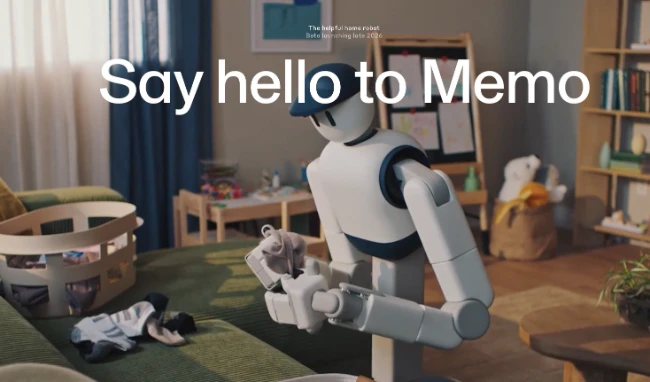
Their robot, Memo, rolls rather than walks, uses simplified three-fingered hands and learns household skills from people wearing sensor-equipped gloves. Instead of paying trained operators to control expensive robots for every lesson, Sunday can collect demonstrations from ordinary people performing chores in ordinary homes.
That clever shortcut has helped the young Mountain View company move unusually quickly. Founded in April 2024, Sunday has raised $200 million, reached a valuation of about $1.15 billion and plans to place its first Memo robots in selected homes during the fall of 2026.
That’s still a beta deployment, not mass production. But Zhao and Chi may have gotten a jump on the home-robot competition by recognizing that the central problem wasn’t building a machine that resembles a person. It was finding an affordable way to transfer human physical experience into a machine.
Memo scrapes dinner dishes. (Sunday Robotics Photo)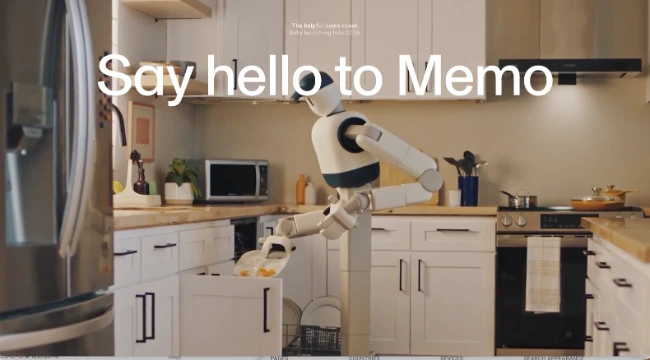
Tony Zhao’s Search For Robot Dexterity
Zhao entered robotics through artificial intelligence and machine learning. He earned his bachelor’s degree in electrical engineering and computer science from the University of California, Berkeley in 2021, working with prominent AI researchers Sergey Levine and Dan Klein.
His interests ranged beyond robotics. As an undergraduate, he worked on reinforcement learning, language models and methods for improving the reliability of AI predictions. Yet he became especially interested in the challenge of teaching machines to perform precise physical tasks.
Zhao worked at X, Google’s moonshot laboratory, and spent time on Tesla’s Autopilot team. He later became a student researcher at Google DeepMind.
At Stanford, he entered the computer science doctoral program under roboticist Chelsea Finn. He received a Stanford Robotics Fellowship and began developing systems that made robot learning less expensive and more reproducible.
His best-known academic contribution was ALOHA, short for A Low-cost Open-source Hardware System for Bimanual Teleoperation. The system let a human operator demonstrate two-handed tasks using relatively inexpensive mechanical controls linked directly to a pair of robot arms.
Earlier teleoperation systems often involved virtual-reality headsets, elaborate tracking hardware and substantial delays between human movement and robot response. ALOHA made controlling a robot feel more immediate, helping researchers collect smoother demonstrations of delicate tasks.
Zhao and his collaborators paired that hardware with Action Chunking with Transformers, or ACT. Rather than commanding each tiny movement independently, ACT predicted short sequences of actions. That was closer to the way people move: we look at a cup, begin reaching and execute much of the motion without reconsidering every millisecond.
The combination let relatively affordable robots learn tasks such as inserting batteries, opening containers and manipulating flexible objects from surprisingly few demonstrations.
Zhao later helped create Mobile ALOHA by putting the two-armed system on a wheeled platform. It could move through kitchens, open cabinets and perform multistep chores, providing an early glimpse of the machine that would become Memo.
Cheng Chi’s Route Through Real-World Robotics
Chi approached the same problem from a somewhat different direction.
Before becoming a robotics researcher, he worked on technologies connecting computation with the physical environment. His industry experience included mapping and imagery research at Uber, camera-system development at Apple and mapping and localization for Nuro’s autonomous delivery vehicles.
He entered Columbia University’s computer science doctoral program in 2021 under roboticist Shuran Song. When Song joined Stanford, Chi continued working with her there through Stanford’s program for students accompanying newly recruited faculty.
Chi’s research focused heavily on objects that frustrate conventional robots. Clothing changes shape every time it’s touched. Cutting food requires adapting to materials with different hardness. Serving a cup involves grasping, balance, motion and release in environments that may never look exactly alike.
His work on GarmentNets explored how robots could perceive and manipulate clothing. Another project taught robots to adapt their movements while handling deformable objects and won the best-paper award at the 2022 Robotics: Science and Systems conference.
Chi’s most influential contribution was Diffusion Policy. Image generators use diffusion methods to turn noise into coherent pictures. Chi and his collaborators adapted a related approach to robot movement, allowing a model to consider multiple plausible ways to complete a task rather than averaging them into an awkward compromise.
The technique performed substantially better than earlier approaches across a range of robot-manipulation tests. More importantly, it made imitation learning more tolerant of demonstrations collected from different people, each of whom might accomplish the same task differently.
That opened the door to collecting robot-training experience at much larger scale.
A Meeting Through Competing Papers
Zhao and Chi didn’t initially meet in the same laboratory. They noticed each other because ALOHA and Diffusion Policy appeared within a few months of one another.
The two researchers connected through social media and began following each other’s work. Zhao had improved the hardware and model used to learn dexterous actions. Chi was attacking the remaining bottleneck: collecting enough varied demonstrations to make those actions work outside a laboratory.
Traditional robot training requires a working robot for every data collector. A person controls the machine, watches what its cameras see and repeats a task hundreds or thousands of times.
That creates a punishing economic constraint. If each training station costs tens of thousands of dollars, collecting millions of household demonstrations could require a robot fleet before the company has created a robot intelligent enough to sell.
Chi’s Universal Manipulation Interface, or UMI, offered an escape. It used a small camera and a relatively simple handheld gripper to record a person’s movements without requiring the actual robot to be present.
Chi and a few fellow researchers carried the devices around Stanford and into restaurants. Before food arrived, they might record themselves serving cups or manipulating tableware. Within a short period, three people collected roughly 1,500 examples of one serving task—an unusually large real-world dataset by robotics standards.
They then trained a robot arm on the demonstrations and pushed it around the Stanford campus on a cart. It could serve drinks in places it hadn’t encountered during training.
Watching the machine continue working as its environment changed convinced Zhao that the approach could support a company. The experiment failed mainly in direct sunlight because the training data had been gathered during rainy weather. Even that failure delivered a useful lesson: a robot can handle real-world variation when its training experience includes that variation.
Sunday Begins In An Apartment
Sunday started with Zhao and Chi clamping a robot to a desk in Chi’s apartment and trying to make it perform useful tasks.
The founders quickly concluded that creating a domestic robot would require much more than a clever AI model. They needed mechanical engineers, industrial designers, manufacturing specialists, software developers and a large operation devoted to collecting and cleaning training data.
By the end of 2024, the team had grown to about eight people. Sunday later moved into a larger Mountain View facility and expanded rapidly, recruiting researchers and engineers from Stanford, Tesla, DeepMind, Waymo, Meta and other major technology organizations. By mid-2026, it reportedly employed more than 100 people.
The company chose household chores deliberately. A factory offers predictable lighting, standardized tools and controlled human access. Homes contain pets, children, narrow passages, shifting furniture, half-open drawers and almost limitless varieties of clothing, dishes and appliances.
If a robot can become dependable there, Zhao argues, it will have developed something close to general physical intelligence.
The mission also offers an obvious consumer benefit. Sunday isn’t asking people to rearrange their lives around an abstract technological achievement. It’s offering to clear the table, load the dishwasher, fold laundry and make coffee.
Designing Memo For Usefulness
Memo doesn’t have legs because legs add cost, weight, energy use and the danger of falling. It moves on a stable wheeled base and can vary its height, reaching down toward the floor or extending its arms as high as seven feet.
It has two arms but only three fingers on each hand. Humans have five fingers, but the middle, ring and little fingers frequently act together when grasping handles or holding containers. Combining them simplifies the motors, sensors and control system while preserving much of a human hand’s practical usefulness.
Memo’s joints are compliant rather than rigid. A person can push an arm aside instead of colliding with a machine determined to follow a preprogrammed trajectory. Its low center of gravity allows the robot to remain standing even if power is cut.
A silicone exterior eliminates many sharp edges and makes Memo look more like an animated character than an industrial machine. Sunday believes a household device people encounter every day should appear approachable rather than intimidating.
The hardware is intentionally less mechanically precise than a traditional industrial robot. Memo’s cameras and AI compensate by observing the result of a movement and adjusting. A blind robot needs costly mechanical perfection. A robot that can see the cup can correct its hand as it reaches.
The Glove That Broke The Data Bottleneck
Sunday’s key innovation is its Skill Capture Glove.
The wearable device has the same basic geometry and sensor arrangement as Memo’s hand. People put on the gloves and perform chores naturally. Cameras record what they see, while sensors capture hand position, finger movement and physical forces.
Sunday’s software then transforms those human demonstrations into data that looks as though Memo performed the actions itself. Because the human glove and robot hand correspond so closely, much of the difficult translation between human and machine movement disappears.
The gloves cost only a small fraction of a full teleoperation station and can be shipped to people around the country. Sunday says it has distributed thousands of them to what it calls Memory Developers, who record chores inside diverse, lived-in homes.
That gives Memo exposure to different tables, dishwashers, fabrics, lighting conditions, appliances and human habits. One household may stack plates carefully. Another leaves utensils mixed with napkins and food scraps. Those variations are precisely what a general home robot must learn to handle.
Sunday used this human-generated experience to train ACT-1, a foundation model that initially required no robot-generated training data. Memo demonstrated the ability to clear tables, handle fragile wine glasses, load dishwashers, operate an espresso machine and fold socks.
From Impressive Demos To Measured Reliability
In July 2026, Sunday introduced ACT-2, aimed at closing the gap between a compelling demonstration and a dependable household product.
The company reported a 99.1 percent success rate across 785 autonomous laundry-folding attempts involving nine garment categories in unfamiliar homes. No data from the evaluation homes or garments was used to customize the model for those deployments.
Sunday says ACT-2’s broader pretraining allows improvements made on its in-house robot fleet to transfer into homes the engineers haven’t seen. A single carefully chosen correction can sometimes teach the model a behavior that generalizes across many environments.
The results remain company-reported and laundry folding is only one domestic skill. A robot that folds shirts reliably may still struggle with a cluttered dishwasher, tangled cable or child who moves an object midway through a task.
Nevertheless, Sunday is trying to replace flashy videos with declared tests showing the range of conditions, success rate and amount of adaptation required. That’s an important step toward treating home robotics as a product rather than a collection of stunts.
Enough Money To Reach The Home
Sunday emerged from stealth in November 2025 with $35 million in backing from Benchmark and Conviction.
In March 2026, it raised an oversubscribed $165 million Series B led by Coatue. Bain Capital Ventures, Fidelity, Tiger Global, Benchmark, Conviction and Xtal Ventures also participated. The financing placed Sunday’s valuation at approximately $1.15 billion and brought total disclosed funding to $200 million.
That’s substantial enough to build a beta fleet, expand manufacturing engineering, operate a large data-collection network and continue training increasingly capable models. Sunday said its engineering staff had tripled, research had quadrupled and data operations had expanded fivefold ahead of deployment.
It isn’t necessarily enough to manufacture hundreds of thousands of robots. Consumer hardware requires supply contracts, assembly systems, service networks, replacement parts, liability planning and years of reliability testing.
A Memo prototype currently costs Sunday about $20,000 to build by hand. The company expects scale manufacturing to reduce that by at least half, but it hasn’t announced a final consumer price.
When Memo May Actually Arrive
Sunday plans to place Memo in an invite-only Founding Family beta program during the fall or latter part of 2026. Participation is free, allowing the company to study how the robot performs without asking customers to accept the risks of purchasing an unfinished machine.
The beta will focus on matters that demonstrations rarely reveal: hygiene, noise, maintenance, durability, privacy, interaction with children and pets, and how frequently a robot becomes stuck or requires help.
Sunday says Memo won’t be offered for purchase until the beta has been completed and its lessons incorporated into a production design.
That makes 2027 the earliest plausible year for limited commercial availability, though Sunday hasn’t promised that date. True mass production is more likely to begin in 2027 or 2028 if the beta proves that Memo is safe, reliable and affordable to manufacture.
The distinction matters. Sunday appears close to deploying real robots, but it isn’t yet close to producing them like smartphones or appliances.
Its head start lies elsewhere. Zhao and Chi have created a system in which every glove-wearing person and deployed Memo can contribute to a growing pool of physical experience. If that data flywheel works, the robot entering homes in 2027 could learn far faster than the one demonstrated in 2025.
The first useful domestic robot probably won’t arrive with perfectly human hands or legs. It may roll slowly into the kitchen, look like a cartoon character and fold shirts at half the speed of a person.
But if it performs the chores people hate without breaking the dishes, that’ll be more than enough to change daily life.
© 2026 by Asian Media Group Inc.
Recent Articles
- Unitree Prices IPO at $9 Billion Valuation
- AMD Buys Taalas to Expand Bet on AI Inference Chips
- N. Korean Forces Joining Russia's War Against Ukraine in Large Numbers
- S. Korea Province Deploys Drones to Warn Elderly Farmers Amid Heatwave
- Nintendo Operating Profit Jumps 151% on Robust Software Demand, Tariff Refund
- New Left-Wing Media Power Surge of Progressive Candidates
- MAGA Republicans, Democrats Jointly Blame Trump's Tech Ties for AI Inaction
- OpenAI, Anthropic AI Agents Implicated in New Security Breaches
- Iran Threatens to Hit Gulf States If US Launches New Strikes
- Ralph Lauren's Beat Powered by Young Shoppers in Asia, North America
Other Asian Media Group Sites
- AsiaMs.net — Asian American Women's Resource
- AsianSports.net — Asian American Sports and Fitness
- VoxCali.com — Videos and Podcasts for Asian Americans
- MyGoldScene.com — Guide to Asian Entertainment
- AttheBanquet.com — Asian Fine Dining and Hospitality
- EastwardDrive.com — Asian Carbuying Intelligence
- EastTable.com — Modern Asian Food and Culture
- TadkaTable.com — Inside South Asian Cooking
- GoGenerational.com — Diaspora Families Building Wealth