

Kiran Musunuru Saved an Infant and Built a Platform for Personalized Gene Therapy
By Wes Yamanoha | 05 Aug, 2026
Saving Baby KJ from a fatal mutation showed that gene editing can become a practical solution for many genetic conditions.
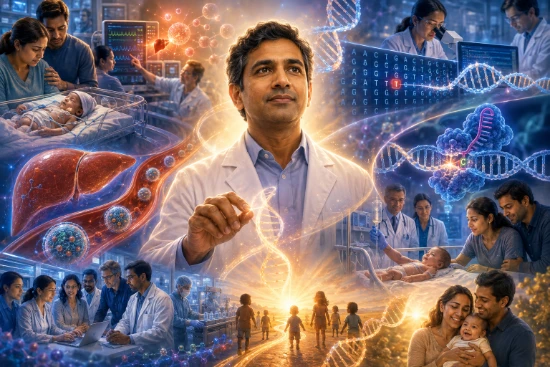
KJ Muldoon was only two days old when his parents learned that something was catastrophically wrong. The newborn had become lethargic, and a blood test showed an ammonia level above 1,000, compared with a normal level generally measured in the tens.
He was rushed from the Hospital of the University of Pennsylvania to Children’s Hospital of Philadelphia, where doctors began emergency dialysis. Genetic testing revealed severe carbamoyl phosphate synthetase 1 deficiency, or CPS1 deficiency, an exceptionally rare disorder that prevents the liver from properly processing ammonia created when the body breaks down protein.
Without a functioning urea cycle, ammonia can poison the brain, causing permanent neurological damage, coma or death. KJ could be kept alive with dialysis, nitrogen-scavenging drugs and an extremely restricted diet, but every infection threatened another crisis. A liver transplant offered the conventional hope of survival, yet he first had to become old and stable enough to endure one.
The clock was already running.
A Scientist Prepared For An Impossible Case
Kiran Musunuru was unusually well prepared for a challenge demanding genetics, clinical judgment, manufacturing coordination and regulatory improvisation all at once.
Born in New York City to Indian immigrant parents and raised in Florida, Musunuru grew up close to medicine. His father was a cardiologist, and the younger Musunuru ultimately chose the same specialty while taking a more genetic route toward preventing disease.
He studied biochemical sciences at Harvard, earned a doctorate at Rockefeller University and completed his medical degree through Weill Cornell’s Tri-Institutional MD-PhD program. After clinical and research training at Brigham and Women’s, Johns Hopkins, Massachusetts General Hospital and the Broad Institute, he joined the University of Pennsylvania.
There Musunuru became a practicing cardiologist, geneticist and leading advocate for treating disease at its biological source. His work on naturally protective cholesterol variants led toward a one-time gene-editing “vaccination” against cardiovascular disease. He later studied law and regulatory affairs at Penn—training that proved practical when a dying infant needed a never-before-used medicine cleared in months rather than years.
Building The Platform Before KJ Arrived
KJ’s treatment wasn’t conceived from nothing after his diagnosis. Musunuru and CHOP pediatric geneticist Rebecca Ahrens-Nicklas had begun collaborating in 2023 on individualized therapies for urea-cycle disorders and other inherited metabolic diseases.
Their goal was to overturn the brutal economics of rare-disease drug development. Conventional medicines can take a decade and enormous investment to reach market, while many genetic disorders are divided among hundreds of mutations found in only a few people.
The Penn-CHOP team believed CRISPR could transform each new therapy from a separate invention into a variation on a standardized product. The delivery particle, editor, manufacturing process and safety system could remain largely the same. Scientists would principally change the genetic “address” directing the editor to a particular mutation.
Years of animal studies, liver-delivery research and work on related metabolic variants had given the team a foundation. KJ presented the chance—and necessity—to prove the system could operate at clinical speed.
One Wrong Letter
KJ had inherited damaging changes in the CPS1 gene, including a single-letter variant the team believed could be corrected with an adenine base editor.
Traditional CRISPR is often described as molecular scissors because it cuts DNA. Base editing is more like a microscopic pencil and eraser. It chemically converts one DNA letter into another without making a complete double-strand break, avoiding some risks associated with cutting a chromosome.
The scientists designed a guide RNA to locate KJ’s precise target. Messenger RNA instructed his liver cells to briefly manufacture the base editor, while the guide brought it to the right genetic address. Both components were enclosed in lipid nanoparticles—tiny fatty spheres that naturally tend to accumulate in the liver after an intravenous infusion.
The objective wasn’t to repair every cell. Restoring CPS1 function in even a fraction of KJ’s liver could improve ammonia processing enough to widen his diet, reduce his dependence on drugs and protect his brain while he grew.
Six Months From Sequence To Infusion
Once the target was identified, researchers, manufacturers and regulators had to behave less like a conventional drug industry and more like an emergency engineering team.
Candidate editors were tested in cells, the genome was searched for sites that might be altered accidentally, and the therapy was evaluated in animals and manufactured under clinical-grade conditions. Industry partners contributed nanoparticle technology and production capacity while the team assembled evidence for the Food and Drug Administration.
KJ’s parents, Nicole and Kyle Muldoon, agreed to the treatment while knowing that no one had ever received a gene-editing drug designed specifically for one person.
On February 25, 2025, at about seven months of age, KJ received his first infusion. Musunuru and Ahrens-Nicklas watched every breath and movement, but the baby largely slept through it. Follow-up doses were given in March and April.
The First Signs It Worked
The treatment didn’t produce a cinematic instant cure. Its success appeared in metabolic numbers and ordinary childhood events that previously would have been dangerous.
Within days, doctors could give KJ more dietary protein without the expected surges in ammonia and glutamine. His need for nitrogen-scavenging medication declined, and he began growing more vigorously. Most encouragingly, he endured common infections, including rhinovirus, without suffering the severe ammonia crises his doctors feared.
After more than 300 days in the hospital, KJ went home in June 2025 to live with his parents and siblings. At the first anniversary of his treatment, CHOP reported that he continued to make progress.
He’ll require lifelong monitoring, and the therapy shouldn’t yet be called a complete cure. Doctors still need to learn how durable the edit will be and whether delayed complications emerge. Yet it did what a proof of concept must do: it produced meaningful clinical improvement in the patient for whom it was designed.
Why One Baby Changes The Economics
The platform may prove more consequential than the individual edit.
Thousands of single-gene disorders are known, and rare diseases collectively affect hundreds of millions worldwide. Many lack approved treatments because each mutation affects too few patients to justify a traditional commercial program.
Musunuru’s model separates reusable machinery from patient-specific instructions. Once an editor and delivery system have accumulated enough safety evidence, a new guide RNA could be treated as a modification of an established platform rather than an entirely new medicine.
That distinction could reduce development from years to months and perhaps eventually weeks. It could also allow patients with different mutations—or related disorders caused by different genes—to enter a common clinical program when the same editing system and biological logic apply.
Regulators have begun considering a “plausible mechanism” framework that could allow grouped evidence for individualized therapies. KJ’s case demonstrated why the old one-drug, one-trial, one-population model can’t serve patients with ultra-rare mutations.
The Boundaries Of The Breakthrough
The platform isn’t universal. KJ’s disease offered several advantages: doctors knew the causal gene, the mutation was accessible to a base editor, the liver could be reached efficiently with lipid nanoparticles, and partial correction could provide substantial benefit.
Brain, muscle and heart diseases will require new delivery systems. Some mutations can’t be handled by existing base editors, while chromosome abnormalities and multigene disorders demand other approaches. Gene editing also can’t reverse developmental injury that has already occurred.
Even so, the list of plausible targets is enormous. Prime editing can make a broader range of substitutions, insertions and deletions. Better nanoparticles may reach organs beyond the liver, while automated laboratories and AI-based guide design could compress customization further.
The future won’t consist of one universal CRISPR injection. It will consist of a family of validated editors and delivery vehicles matched to different mutation types and organs.
From Heroic Rescue To Medical Infrastructure
The greatest mistake would be treating KJ’s story as a miracle too exceptional to repeat. Miracles depend on luck. Platforms depend on preparation, standardization, shared data, manufacturing capacity and rules that allow responsible speed.
Musunuru and Ahrens-Nicklas want other academic centers to reproduce their process rather than guard it as a proprietary trick. That will require new funding models, small-batch manufacturing, platform-level regulation and hospitals with integrated genetics and translational-research teams.
The first cases will be expensive. But the relevant comparison isn’t an inexpensive bottle of pills. It’s repeated hospitalization, lifelong disability, organ transplantation and the loss of children whose diseases were theoretically correctable but commercially uninteresting.
A New Meaning For Personalized Medicine
For years, “personalized medicine” often meant choosing among existing drugs based on a patient’s biomarkers. KJ’s treatment gave the phrase a literal meaning: the medicine itself was constructed around the letters in one child’s genome.
Musunuru didn’t merely help save an infant from an immediately fatal metabolic defect. He and his collaborators demonstrated that a hospital-linked scientific network could identify a unique mutation, build a corrective drug, test it, manufacture it and deliver it before the patient’s window of survival closed.
Hundreds of thousands of people won’t receive KJ’s exact therapy. They may benefit from the workflow his case validated.
The lasting breakthrough is the possibility that no mutation will be considered too rare to deserve treatment simply because too few people share it. Baby KJ turned a futuristic promise into a working medical process—and Kiran Musunuru helped show how that process can become a system.
© 2026 by Asian Media Group Inc.
Recent Articles
- Unitree Prices IPO at $9 Billion Valuation
- AMD Buys Taalas to Expand Bet on AI Inference Chips
- N. Korean Forces Joining Russia's War Against Ukraine in Large Numbers
- S. Korea Province Deploys Drones to Warn Elderly Farmers Amid Heatwave
- Nintendo Operating Profit Jumps 151% on Robust Software Demand, Tariff Refund
- New Left-Wing Media Power Surge of Progressive Candidates
- MAGA Republicans, Democrats Jointly Blame Trump's Tech Ties for AI Inaction
- OpenAI, Anthropic AI Agents Implicated in New Security Breaches
- Iran Threatens to Hit Gulf States If US Launches New Strikes
- Ralph Lauren's Beat Powered by Young Shoppers in Asia, North America
Other Asian Media Group Sites
- AsiaMs.net — Asian American Women's Resource
- AsianSports.net — Asian American Sports and Fitness
- VoxCali.com — Videos and Podcasts for Asian Americans
- MyGoldScene.com — Guide to Asian Entertainment
- AttheBanquet.com — Asian Fine Dining and Hospitality
- EastwardDrive.com — Asian Carbuying Intelligence
- EastTable.com — Modern Asian Food and Culture
- TadkaTable.com — Inside South Asian Cooking
- GoGenerational.com — Diaspora Families Building Wealth