

Naveen Rao May Have Found a Smarter Way to Use Silicon
By JL Zhang | 03 Aug, 2026
Unconventional AI eschews conventional silicon chips for a way to tap into silicon's more interesting properties.
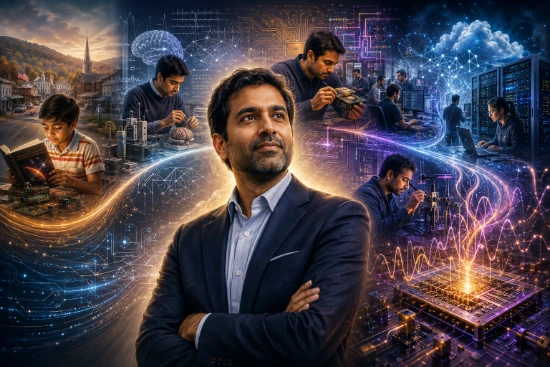
Inside every digital processor, transistors are physical devices with continuously varying voltages, currents, leakage, noise and nonlinear behavior. Yet engineers generally force that rich electrical activity into two dependable states: zero or one. That simplification made modern computing possible. It also may be an increasingly wasteful way to run artificial intelligence.
Naveen Rao’s new startup, Unconventional AI, is betting that the next great leap in AI won’t come from packing still more digital switches into another GPU. It will come from letting silicon behave more like silicon—and training AI models to exploit the results.
That doesn’t mean abandoning chips. It means abandoning the assumption that a chip’s most useful role is to perform enormous sequences of exact arithmetic while constantly shuttling data back and forth from memory.
Rao thinks silicon can instead be organized into physical systems whose voltages, currents and rhythms evolve toward useful answers on their own. Rather than digitally simulating every step, the chip would let the process happen inside its circuitry.
A Kentucky Childhood And A Restless Mind
Rao is the son of Indian immigrants and grew up in Whitesburg, a small town in eastern Kentucky. His childhood mixed outdoor sports, fantasy games and science-fiction novels.
He studied electrical engineering and computer science at Duke University, then spent roughly a decade working across chip and systems architecture, including jobs associated with Sun Microsystems and Kealia.
Most engineers fluent in chip design remain on that track. Rao veered into neuroscience.
He earned a doctorate from Brown University, where his research examined the cortical dynamics involved in planning and executing movement. His dissertation explored how sensory information becomes motor action across networks in the brain.
Rao wanted to understand why biological nervous systems accomplish so much with so little energy. The human brain consumes about as much power as a dim light bulb, yet it learns continuously, adapts to unfamiliar conditions and interprets incomplete information.
After Brown, Rao worked on neuromorphic computing at Qualcomm, bringing together the two fields that would shape his career: silicon architecture and biological intelligence.
Two Startups Built On Efficiency
In 2014 Rao cofounded Nervana Systems with Amir Khosrowshahi and Arjun Bansal. Deep learning was becoming commercially important, but the industry was still adapting graphics processors built for rendering images to train neural networks.
Nervana created its own software framework, cloud service and processor architecture, stripping away graphics features AI didn’t need and devoting more silicon to neural-network operations.
Intel acquired Nervana in 2016 for a price widely reported at roughly $350 million to $400 million. Rao became head of Intel’s artificial-intelligence products group and gained a close view of both the strengths and inertia of a semiconductor giant.
Intel later discontinued the processor line, but Nervana helped establish a principle now accepted throughout the industry: AI performs better when hardware is designed around the workload.
Rao’s next company moved up the stack. MosaicML, cofounded in 2021, optimized large-model training so expensive GPU clusters could accomplish more work. It also released open models and tools intended to make large-scale AI more accessible.
Databricks acquired MosaicML in 2023 for about $1.3 billion. Rao then led generative AI at Databricks as MosaicML’s technology became part of its enterprise AI platform.
Instead of retiring into investing or advising, Rao returned to the question beneath both companies: Why is artificial intelligence still being squeezed through an architecture designed for other purposes?
Digital Silicon Hides The Physics Underneath
A digital chip isn’t truly digital at the physical level. Its transistors respond continuously to voltage. Charge accumulates and dissipates. Signals take time to propagate. Temperature, manufacturing differences and electronic noise create variation.
Engineers suppress or compensate for those behaviors so billions of transistors can act like dependable switches. That reliability is essential for banking, databases and any task in which one wrong bit can corrupt the result.
AI is different. Neural networks tolerate approximation, low precision and noise. Their power comes from large populations of simple elements interacting, not from every operation being accurate to many decimal places.
Conventional AI chips nevertheless translate those networks into long sequences of digital matrix multiplications. Each value must be encoded as bits, fetched from memory, moved through wires, multiplied, added, stored and fetched again.
Increasingly, arithmetic isn’t the main energy problem. Moving model parameters and intermediate results between memory and computing units consumes an enormous share of the power.
That’s why a faster multiplier can’t by itself produce the thousandfold efficiency gain Rao seeks. The relationship among computing, memory, time and the AI model must change.
Letting A Circuit Find The Answer
Imagine predicting how thousands of connected pendulums will move. A conventional computer represents their positions as numbers and repeatedly solves equations for each successive instant.
A physical system of actual pendulums doesn’t calculate its next state. It simply moves. Gravity, momentum and coupling produce the answer continuously.
Electronic circuits can behave similarly. Oscillators can synchronize or oppose one another. Capacitors can accumulate charge. Transistor networks can amplify, inhibit, leak, settle into stable states or follow complex trajectories. Properly designed circuits can embody differential equations directly.
The challenge is finding a physical system whose natural behavior corresponds to a useful AI operation. Rao describes this as finding the right “isomorphism” for intelligence: a mapping between the mathematical structure of learning and the physical structure of a circuit.
If that mapping works, the chip wouldn’t laboriously simulate the system. The silicon would be the system.
Un-0 Offers An Early Demonstration
In June 2026 Unconventional AI released Un-0, an experimental image generator based on simulated coupled oscillators.
An oscillator can be pictured as a metronome with its own rhythm. Connect many metronomes and let each influence the others, and they can self-organize into patterns.
In Un-0, the connection strengths among thousands of oscillators are learned during training. The system begins with random phases, evolves according to those couplings and produces a latent representation that a relatively small conventional decoder turns into an image.
The largest published version used 16,384 oscillators and generated 64-by-64-pixel ImageNet images at a quality comparable to some important early conventional image models.
That’s a proof of concept, not a finished product. The oscillators were simulated on Nvidia GPUs, and the images still required a digital decoder. Today’s best conventional generators remain considerably more capable.
What Un-0 demonstrated is narrower but important: trained physical dynamics can perform meaningful work inside a modern generative model. Tests that removed, froze or simplified the oscillator dynamics produced worse results.
The next step is to embody those dynamics directly in hardware so the circuit’s evolution replaces costly digital simulation.
More Than Analog Computing
The approach resembles analog computing, but Rao’s ambition is broader than reviving the analog machines of the past.
Traditional analog computers represented mathematical quantities with voltages or currents. They could be efficient but were difficult to program, vulnerable to noise and less precise than digital systems.
Unconventional AI expects to use both analog and digital components. Digital logic may supervise the system, while analog or mixed-signal circuitry performs the portions of AI computation that benefit from continuous physical dynamics.
Noise could even become a feature. Generative AI often begins with randomness, and neural networks can be trained to tolerate hardware variations. Energy spent forcing every component into perfect uniformity might be reduced if the model learns the imperfections of its substrate.
The company also wants to keep memory close to computation, reuse physical state over time and reduce the need to reload billions of parameters for every token or image. That requires designing the model and chip together instead of building a processor first and asking software to accommodate it later.
Rao calls that neural co-evolution.
A Nearly Half-Billion-Dollar Seed Bet
Unconventional AI emerged publicly in December 2025 with $475 million in seed funding at a $4.5 billion valuation. Lightspeed Venture Partners and Andreessen Horowitz led the round, joined by other prominent investors. Rao committed $10 million of his own money.
His cofounding group includes MeeLan Lee, MIT professor Michael Carbin and Stanford professor Sara Achour, combining expertise in hardware, programming systems, compilers and physically grounded computation.
There’s no guarantee the approach will scale. Analog variability can destroy accuracy. Converting between analog and digital signals can consume the energy savings. Physical systems can be difficult to control, manufacture and program. A laboratory demonstration may fail when expanded to billions of components.
Rao’s advantage isn’t that he has eliminated those problems. It’s that his career has prepared him to attack them simultaneously.
Silicon May Have More To Give
The semiconductor industry has spent decades perfecting silicon as a platform for digital logic. But AI may be exposing the costs of that generality.
Intelligence is dynamic, approximate, distributed, noisy and dependent on interactions over time. Conventional processors turn it into rigid sequences of exact operations because that’s what conventional processors know how to do.
Rao’s wager is that silicon can express intelligence more naturally when engineers stop forcing it to behave like an immense collection of microscopic light switches.
Nervana specialized silicon for neural networks. MosaicML made existing AI hardware easier to use. Unconventional AI is going deeper by asking whether the industry has misunderstood what the hardware should be doing in the first place.
Digital computing has defeated many proposed alternatives over the past 80 years because its reliability, programmability and manufacturing ecosystem are extraordinarily difficult to match.
Yet AI’s energy demands have created an opening for a different kind of machine. Rao isn’t trying to make today’s computer incrementally better. He’s trying to expose the richer machine that has been hiding inside silicon all along.
© 2026 by Asian Media Group Inc.
Recent Articles
- Unitree Prices IPO at $9 Billion Valuation
- AMD Buys Taalas to Expand Bet on AI Inference Chips
- N. Korean Forces Joining Russia's War Against Ukraine in Large Numbers
- S. Korea Province Deploys Drones to Warn Elderly Farmers Amid Heatwave
- Nintendo Operating Profit Jumps 151% on Robust Software Demand, Tariff Refund
- New Left-Wing Media Power Surge of Progressive Candidates
- MAGA Republicans, Democrats Jointly Blame Trump's Tech Ties for AI Inaction
- OpenAI, Anthropic AI Agents Implicated in New Security Breaches
- Iran Threatens to Hit Gulf States If US Launches New Strikes
- Ralph Lauren's Beat Powered by Young Shoppers in Asia, North America
Other Asian Media Group Sites
- AsiaMs.net — Asian American Women's Resource
- AsianSports.net — Asian American Sports and Fitness
- VoxCali.com — Videos and Podcasts for Asian Americans
- MyGoldScene.com — Guide to Asian Entertainment
- AttheBanquet.com — Asian Fine Dining and Hospitality
- EastwardDrive.com — Asian Carbuying Intelligence
- EastTable.com — Modern Asian Food and Culture
- TadkaTable.com — Inside South Asian Cooking
- GoGenerational.com — Diaspora Families Building Wealth