

Taiwan's TiSpace Fails to Orbit Test Rocket in Japan Launch
By Reuters | 13 Jul, 2025
TiSpace is one of several Asian private rocket companies looking to enter the space flight market.
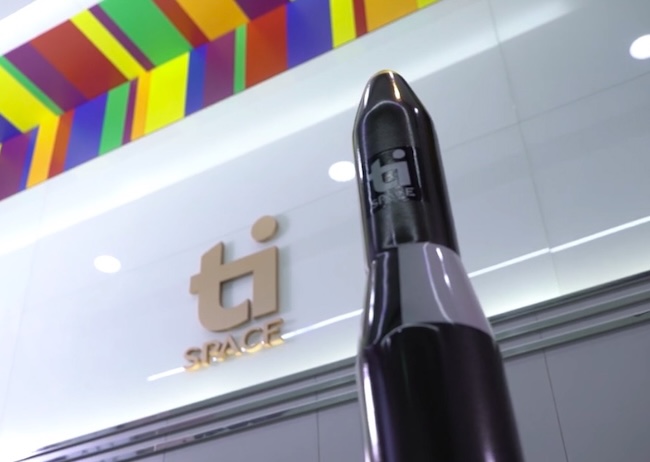
A model of TiSpace's Hapith V rocket is shown beside the company logo at its Taiwan headquarters.
Taiwanese private rocket company TiSpace terminated the flight of one of its rockets shortly after lift-off in northern Japan on Saturday, failing to become the first foreign company to perform a successful launch on Japanese soil.
TiSpace, through its Japanese unit jtSPACE, tried to reach outer space 100 km (62 miles) above the Earth's surface on the inaugural flight of its 12-metre (40-foot), hybrid-fuelled rocket VP01 in a launch from Japan's Hokkaido Spaceport.
The rocket lifted off at 11:40 a.m. (0240 GMT), but within a minute its trajectory turned wobbly and it went into freefall, footage from Japanese public broadcaster NHK showed.
"We are examining the situation of the flight," a spokesperson for Space Cotan, the Japanese company operating the Hokkaido Spaceport, said after the launch attempt.
The rocket did not carry a satellite, although Space Cotan has said its success would be a step toward building a satellite-launching vehicle.
TiSpace, led by a former Taiwan Space Agency official, has not had a successful spaceflight. It turned to Japan in search of a test site after failing to launch a rocket in Australia in 2022.
While local officials and businesses in Hokkaido welcomed the move as a milestone toward becoming an international space hub, some Japan space policy experts have worried about provoking China, which closely monitors Taiwan's advances in missile-related technologies.
In Japan private rocketmakers are racing to gain entry to the commercial launch market dominated by Elon Musk's SpaceX and U.S. rivals including Rocket Lab. No privately developed Japanese rocket has achieved orbital satellite launch.
Interstellar Technologies, a Hokkaido-based startup now backed by Toyota, was in 2019 the first private rocket venture in Japan to reach space, although without a satellite payload.
Canon Electronics-backed Space One conducted two failed orbital launches last year. Carmaker Honda last month succeeded in a low-altitude test of its prototype reusable rocket in Hokkaido, pledging to achieve spaceflight by 2029.
(Reporting by Kantaro Komiya; Editing by Tom Hogue and William Mallard)
© 2025 by Asian Media Group Inc.
In Japan private rocketmakers are racing to gain entry to the commercial launch market dominated by Elon Musk's SpaceX and U.S. rivals including Rocket Lab. No privately developed Japanese rocket has achieved orbital satellite launch.
Recent Articles
- Google Limits Meta’s Use of Its Gemini AI Models
- Key Volkswagen Shareholder Pitches Producing China Models in Germany
- S. Korea's Early World Cup Exit Triggers 'Utterly Baffled' Tirade by President
- Anthropic Allowed to Release Mythos AI Model to 'Tusted' US Organizations
- Apple Seeks Approval to Buy from Blacklisted Chinese Company to Ease Memory Crunch
- China's Industrial Profits Stay Resilient on Factories, Exports
- Meet the Teen Who Undertook a 7-Continent Solo Flight Against Cancer
- Getting Fit Pt. 2 - Raising Our Floor
- South Korea Survives World Cup Scare, Advances to Round of 32
- Why Asian-White Marriages Suffer Multiples the Disruption Rates of Asian-Asian Marriages