

Teenage Mutant Ninja Turtles Reclaim Asian American Roots
By J. J. Ghosh | 30 Mar, 2026
As the first Asian American writer in the Ninja Turtles franchise's 40-year history, Gene Luen Yang is helping the crime-fighting amphibians get back in touch with their Asian American identity.
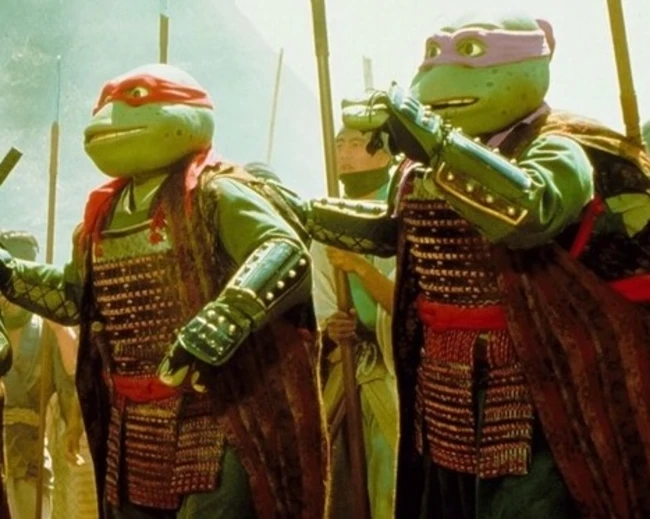
A still from 1993's live action film "Ninja Turtles III"
90s kids basically fell into one of two camps: Power Rangers or Teenage Mutant Ninja Turtles.
I was firmly on Team Ninja Turtles.

The 1987 cartoon version of the Teenage Mutant Ninja Turtles
To me, it was like choosing the Yankees over the Red Sox. Star Wars over Star Trek. Marvel over DC. Cardi over Nicki.
I had dozens of Ninja Turtles action figures, their VHS collection, and even a pair of velcro Turtles shoes. As a five year old, the fandom effectively consumed my entire personality.
I'll be honest: I was drawn to the characters because they were cool and funny. They ate pizza in sewers while making wisecracks and fighting crime with weapons I had never seen before.
But now as an adult, I'd like to try and claim that I was drawn to the Ninja Turtles because they came with a fairly high educational value, like the fact that Raphael, Michelangelo, Donatello, and Leonardo are of course named after the most famous Renaissance painters.
And more importantly: the entire series being based around Japanese culture.
It's a fact that is surprisingly overshadowed by the gang's love of pizza and teenage shenanigans. But that might change very soon.

Chinese American cartoonist Gene Luen Yang
Japanese Identity
The Teenage Mutant Ninja Turtles were literally designed around their Japanese American identity, yet, how much any given version chose to lean into it has varied pretty dramatically.
The original Mirage Comics from 1984 took the Japanese roots seriously. The protaganists' "sensei" Splinter's backstory was grounded in Japanese martial arts tradition. The henchmen Foot Clan was a direct homage to the Foot Soldiers from the Frank Miller manga-influenced comic Daredevil. The tone was dark, violent, and earnest — not a joke, not a toy commercial. The Japan connection felt intentional and substantive.

The debut 1984 Ninja Turtles comic
Then came the 1987 cartoon —which I grew up on —and which essentially traded all of that in for pizza jokes and catchphrases. The Japanese elements were still there in name — the weapons, the sensei, the Foot Clan — but the show wasn't exactly asking anyone to think too hard about bushido or ninjutsu philosophy. It was asking you to buy action figures... which, fair enough. It worked.
Even so the 1987 series did occasionally dip back into its Japanese roots — notably in a time travel episode called "The Legend of Koji" that brought the Turtles to feudal Japan.
In 1993, the third live-action film did send the Turtles back in time to 17th century Japan entirely — though, unfortunately, the film’s 19% critics score on Rotten Tomatoes speaks for itself.
The 2003 series, which hews much closer to the original Mirage comics, is arguably the most culturally engaged version of the franchise. Japan plays a significant role in its fifth season, serving as the home of the Ninja Tribunal — a group of ancient masters who recruit the Turtles to train there and combat the reincarnation of the Tengu Shredder, the villain. The mythology is richer, the martial arts more seriously rendered, and Splinter's Japanese lineage more central to the storytelling.

Nickelodeon's 2003 iteration of the Ninja Turtles
The 2012 Nickelodeon series, meanwhile, leaned into anime-like iconography and visual style — a nod to Japanese animation traditions rather than Japanese cultural substance, but a nod nonetheless. It also included a time-travel episode, "Tale of the Yokai," in which the Turtles travel back to feudal Japan and witness pivotal moments in the backstory of Oroku Saki and Hamato Yoshi.
And then there's the 2014 Michael Bay-produced live action reboot, which leaned into approximately nothing except explosions and Megan Fox. The Japanese cultural identity of the franchise was not a priority.

Michael Bay's 2014 live action Ninja Turtles film
Save a few exceptions, the through-line across all of these versions is that the Japanese roots are treated as set dressing more often than they are treated as substance.
The weapons, the sensei, the clan names — they're part of the iconography, and audiences have always accepted them as such. But actually interrogating what it means for these characters to be shaped by Japanese culture, to carry that identity while living in American sewers, to be caught between two worlds? That's largely been left on the table.
Until now.
Gene Luen Yang
A few months ago in December 2025, it was announced that acclaimed comics writer Gene Luen Yang would be taking over animation company IDW's ongoing Teenage Mutant Ninja Turtles series.
Issue #13, would mark the first comic in the franchise's 40-year history to be penned by an Asian American.
And nobody was more suited for the job than Yang, a celebrated comics writer and illustrator known for acclaimed works like American Born Chinese, Boxers & Saints, and Superman Smashes the Klan.
In 2016 Yang became the third comics professional ever to receive a MacArthur "genius grant."
American Born Chinese — the story of a Chinese American teenager navigating identity, belonging, and the pressure to assimilate — became the first graphic novel ever nominated for a National Book Award and the first to win the American Library Association's Printz Award.
Yes, the man now writing the Ninja Turtles built his career on stories about what it feels like to grow up Asian American in a country that doesn't always see you clearly. It turns out those two things are more connected than they might appear.
As a child, Yang was himself a Ninja Turtles fanatic — maybe even more so than me! He recreated turtle battles with action figures, read the comics, watched the show.
His very first comic was published with a grant from the Xeric Foundation, an organization created by Ninja Turtles co-creator Peter Laird — a full-circle detail that Yang has described as deeply meaningful.
Yang’s Vision
Here's what Gene Luen Yang sees when he looks at Leonardo, Donatello, Michelangelo, and Raphael that perhaps not enough previous writers have:
He views the Turtles and their father figure Splinter as "reincarnations of a family from feudal Japan," making them "quintessentially Asian American" as they straddle two cultures at once.
Think about it for a second: Four brothers raised in the sewers of New York City, shaped by Japanese culture, trained in ancient Japanese martial arts, navigating an American world that doesn't quite understand them and that they don't quite fit into. They are, quite literally, a metaphor for the immigrant experience — rooted in one culture, living in another, belonging fully to neither and somehow finding a way to make that work.
Yang plans to lean hard into Japanese mythology and philosophy. The first villain of his story arc is Ujigami, a Shinto protector spirit.
He also wants to capture the "weirdness" of the original Mirage Studios comics — moving the Turtles away from gritty street-level stories and toward more fantastical adventures.
"We're gonna put the Turtles through the ringer and hopefully show just how important family is to them” he told one interviewer.
While the franchise has always been, at its core, about four brothers and the father figure who raised them, that emphasis on family lands differently when it comes from an Asian American writer who has spent his career exploring what family means to people caught between worlds.
The new run has already been a massive commercial success. IDW actually moved up the pre-order deadline due to order projections coming in higher than expected — necessitating extra time for printers to produce enough copies to meet demand.
The Current Moment
It has taken forty years for a franchise built on Japanese culture, steeped in Asian martial arts tradition, and metaphorically resonant with the Asian American experience to be handed to an Asian American writer.
Yang is of course Chinese and not Japanese.
While, on the one hand, there is hardly anything more insulting than Asian Americans from different ethnic backgrounds getting confused and lumped together, there’s also something touching about the solidarity that we hold with one another.
The details of our upbringings may differ. But key characteristics like discipline, family, and respect — and Yang’s willingness to embrace that — remind us that there is far more that unites the AAPI community than divides us.
In an era when DEI programs are being gutted, when AAPI communities are being targeted by immigration enforcement at record rates, and when the question of who gets to tell whose stories feels more charged than ever, the demand for Yang’s work feels particularly important.
No, Yang isn't making the Turtles Asian American. They already were. He's just the first person in the writer's chair who was positioned to see that clearly — and to do something meaningful with it.
And now I’m wondering if those velcro Ninja Turtles shoes come in adult sizes.
© 2026 by Asian Media Group Inc.
Recent Articles
- Unitree Prices IPO at $9 Billion Valuation
- AMD Buys Taalas to Expand Bet on AI Inference Chips
- N. Korean Forces Joining Russia's War Against Ukraine in Large Numbers
- S. Korea Province Deploys Drones to Warn Elderly Farmers Amid Heatwave
- Nintendo Operating Profit Jumps 151% on Robust Software Demand, Tariff Refund
- New Left-Wing Media Power Surge of Progressive Candidates
- MAGA Republicans, Democrats Jointly Blame Trump's Tech Ties for AI Inaction
- OpenAI, Anthropic AI Agents Implicated in New Security Breaches
- Iran Threatens to Hit Gulf States If US Launches New Strikes
- Ralph Lauren's Beat Powered by Young Shoppers in Asia, North America
Other Asian Media Group Sites
- AsiaMs.net — Asian American Women's Resource
- AsianSports.net — Asian American Sports and Fitness
- VoxCali.com — Videos and Podcasts for Asian Americans
- MyGoldScene.com — Guide to Asian Entertainment
- AttheBanquet.com — Asian Fine Dining and Hospitality
- EastwardDrive.com — Asian Carbuying Intelligence
- EastTable.com — Modern Asian Food and Culture
- TadkaTable.com — Inside South Asian Cooking
- GoGenerational.com — Diaspora Families Building Wealth