

Chinese Humanoid Robot Ban to Exact a High Cost from American Businesses and Consumers
By JL Zhang | 04 Aug, 2026
The robots being developed by Chinese robotics firm Unitree, among others, could have helped offset labor shortages for US industry and provided time-saving convenience for busy consumers.
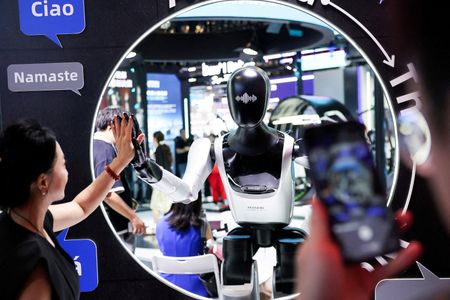
A visitor high-fives a humanoid robot at the Keenon Robotics booth during the World Artificial Intelligence Conference (WAIC) in Shanghai, China, July 18, 2026. REUTERS/Go Nakamura TPX IMAGES OF THE DAY/File Photo
The Trump administration’s ban on new Chinese-made humanoid robots is being presented as a decisive move to keep potentially dangerous machines out of American factories, businesses and homes.
A humanoid robot at a robotics laboratory during a government-organized media trip in Guangzhou, Guangdong province, China, April 16, 2026. REUTERS/Go Nakamura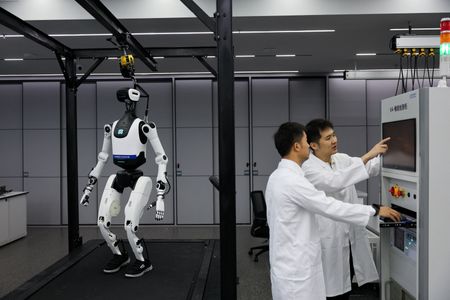
It may ultimately prove to be something else: a costly act of technological self-isolation that deprives Americans of some of the world’s most affordable and rapidly improving labor-saving machines.
An ensemble of humanoid robots produced by Linkerbot is set up with musical instruments at the company’s office in Beijing, China, April 27, 2026. REUTERS/Maxim Shemetov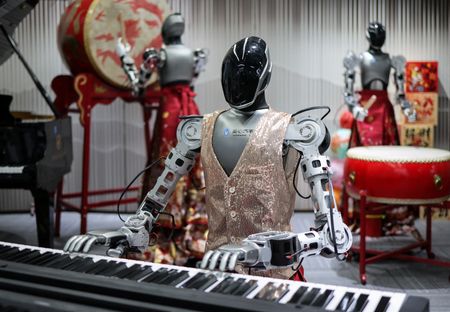
On July 28, the Federal Communications Commission announced restrictions covering new foreign-made humanoid robots, quadruped “robot dogs” and a broad range of other connected ground robots. Although the rules are technically framed around foreign equipment, they’re aimed overwhelmingly at China, which has built the world’s largest and most cost-competitive humanoid-robot manufacturing ecosystem. Previously authorized products aren’t immediately affected, but new models generally can’t be imported, marketed or sold without government approval.
The security concerns behind the ban aren’t imaginary. A networked robot equipped with cameras, microphones, wireless connections and powerful motors could collect sensitive information, map a building or potentially be manipulated remotely. Chinese firms may also be subject to government pressure that American customers can’t readily detect or resist.
But an indiscriminate ban confuses the existence of a risk with proof that every Chinese robot poses an unacceptable risk.
Instead of requiring secure operating systems, auditable software, local data storage, disconnected operating modes and strict restrictions for sensitive facilities, Washington has largely chosen the simplest possible solution: keep the robots out.
That simplicity will come at a high price.
China’s Humanoid Cost Advantage
Chinese companies haven’t necessarily produced the world’s most intelligent humanoid robots. American firms may still lead in foundation models, advanced robot cognition and some aspects of autonomous manipulation.
Where China has pulled ahead is in something equally important: turning humanoids into affordable physical products that researchers and businesses can actually buy.
Unitree’s R1 humanoid, for example, starts at just $4,900 for the basic Air version and $5,900 for the standard model, excluding tax and shipping. It stands about four feet tall, weighs roughly 60 pounds and includes as many as 26 powered joints, onboard cameras, microphones, speakers and wireless connectivity. More advanced versions provide open interfaces that let researchers connect additional computing systems and develop their own applications.
That’s a remarkable price for a mobile, programmable machine with arms, legs, visual perception and the basic physical architecture needed to operate in spaces built for humans.
Unitree’s larger G1 and H1 platforms cost more, but they’ve already become popular development platforms for universities, AI laboratories and robotics startups. Chinese competitors including AgiBot, UBTECH, Fourier Intelligence, Kepler, LimX Dynamics and Noetix are creating additional pressure on prices while specializing in factory work, healthcare, research, logistics and consumer applications.
China now has more than 20 significant humanoid-robot developers and an unusually deep network of domestic motor, sensor, battery, gearbox and actuator suppliers. That supply chain allows Chinese companies to iterate quickly, order components in volume and introduce lower-priced models without waiting for an entirely new industrial base to emerge.
The US ban removes that competitive pressure from the American market.
Tesla, Figure AI, Apptronik, Agility Robotics and several other American companies are developing impressive systems. But many are expensive, available only through limited pilot programs or focused initially on large corporate customers.
Without Chinese alternatives, American robot makers will face less pressure to reduce prices, open their platforms or make machines available to smaller buyers.
That won’t just affect who sells robots. It will determine who gets to use them.
A Tool for Labor-Starved Industries
Humanoid robots are often discussed as though their immediate purpose is to eliminate millions of well-paid jobs.
In reality, their first economically useful roles are more likely to involve jobs that employers already struggle to fill, tasks with high turnover and work that’s repetitive, physically punishing or dangerous.
The US had about 7.6 million job openings in May, according to the Bureau of Labor Statistics. Those included approximately 1.4 million openings in healthcare and social assistance, 1.2 million in trade, transportation and utilities, 941,000 in leisure and hospitality, 529,000 in manufacturing and 298,000 in construction.
Not every vacancy can be filled by a robot, of course. Today’s humanoids generally lack the judgment, dexterity, reliability and endurance needed to replace skilled workers across an entire shift.
But they don’t have to replace complete jobs to become valuable.
A nursing assistant who spends part of each day moving carts, collecting supplies and carrying linens could delegate those tasks to a robot. A warehouse worker could have a humanoid unload awkward packages or retrieve items from shelves designed for human reach. Hotel employees could send robots to deliver towels, collect trash or move laundry overnight.
Factories could use them for machine tending, parts transfer, visual inspections and repetitive assembly steps. Retailers could assign them to restocking, inventory scanning or after-hours cleaning. Construction companies might use ruggedized versions to transport tools, conduct site inspections or enter areas where falling debris, heat or contaminated air pose serious hazards.
In most of these settings, the initial economic benefit wouldn’t come from dismissing human workers. It would come from allowing scarce workers to accomplish more while spending less time on low-value physical chores.
The ban will delay that productivity gain.
Small Businesses Will Be Hit Hardest
Large corporations can afford to form partnerships with American robotics startups, customize hardware, hire engineers and wait through years of pilot testing.
A neighborhood hotel, regional warehouse, assisted-living facility, farm, restaurant group or small manufacturer can’t.
These businesses need machines that arrive largely assembled, cost less than an employee’s annual wages and can be adapted without a robotics research department.
That’s exactly the market China’s manufacturing system is positioned to serve.
A small business might be willing to risk $10,000 or $20,000 on an experimental robot that can handle several hours of useful work each day. It’s much less likely to risk $100,000 or enter a complicated robotics-as-a-service contract whose eventual cost remains uncertain.
Removing low-cost Chinese platforms raises the admission price for experimenting with physical AI.
The result will be an increasingly familiar pattern in American technology: the largest corporations gain access first, while smaller competitors wait years for prices to fall.
By the time affordable US-made humanoids finally reach the broader market, companies in China, Southeast Asia, the Middle East and parts of Europe may already have accumulated extensive experience integrating Chinese robots into real workplaces.
American businesses won’t merely pay more for the machines. They’ll lose valuable time learning how to reorganize operations around them.
The Research Setback
The consequences will also reach universities, independent developers and robotics startups.
Affordable Unitree robots have become widely used research platforms because developers can purchase them, modify their controls and test new software on actual hardware. Unitree’s open interfaces have helped make its machines something like the physical equivalent of a widely available development computer.
Researchers have used Unitree platforms to study whole-body teleoperation, fall recovery, natural-language-directed movement and other capabilities essential to practical robotics.
In one 2026 proof-of-concept experiment, a teleoperated Unitree G1 served as a first assistant during a cadaveric endoscopic surgical procedure, maintaining the visualization needed by the operating surgeon. The experiment didn’t demonstrate autonomous robotic surgery, but it showed how an affordable general-purpose humanoid could become a platform for exploring specialized medical tasks.
Other researchers have demonstrated real-time control of a G1 using wearable motion-capture equipment, reproducing actions including walking, sitting, turning and coordinated gestures.
Cutting US laboratories off from future generations of these platforms will make robotics research more expensive and concentrate it in organizations able to afford scarce domestic alternatives.
That could perversely weaken the very American robotics industry the ban is supposed to protect.
Software developers need plentiful hardware. Robot-learning systems improve through physical practice, failure and accumulated operating data. A country that limits access to affordable robots risks producing excellent theories but too few machines on which to test them.
Consumers Will Pay More Too
The FCC restrictions apparently reach beyond humanoids to various connected ground robots weighing more than about 4.4 pounds, potentially including future robotic cleaning and household systems. Existing authorized models may continue to be sold, but new products face substantial barriers.
This matters because the most immediate consumer impact of embodied AI may not be a full-size robotic butler.
It may arrive as increasingly capable cleaning robots, lawn and garden machines, mobile security devices, elder-assistance systems, home delivery carts and compact robots able to fetch objects or perform simple household tasks.
China’s consumer-electronics supply chain has driven down the cost of robot vacuums, drones, electric appliances and other motorized devices. The same manufacturing network could do the same for more advanced household robots.
Blocking that competition will help shield US producers from Chinese pricing, but consumers will pay for the protection through higher prices and slower product improvement.
The burden will be especially painful for older Americans and people with disabilities.
Even limited robots capable of lifting groceries, carrying laundry, monitoring falls, retrieving dropped items or enabling remote assistance could help people remain independent longer. Such systems won’t replace trained caregivers, but they could multiply the time and reach of caregivers whose services are increasingly difficult to obtain.
A $10,000 machine that provides several useful hours of assistance a day could be transformative. A $75,000 machine available only through a premium subscription won’t be.
The Security Case for Smarter Regulation
Washington’s concerns deserve a serious response, particularly when robots are used in military facilities, government buildings, power plants, communications networks, hospitals or other sensitive locations.
But the risks vary dramatically by setting.
A humanoid connected to a defense contractor’s internal network isn’t equivalent to a robot folding towels in a budget hotel. A robot mapping a government laboratory isn’t equivalent to one operating in a university test arena with its wireless hardware disabled.
The US could have created a tiered system.
Chinese robots could be banned from military bases, intelligence facilities and critical infrastructure. Commercial users could be required to keep sensitive data on US servers, disclose all network connections and allow software inspections. Cameras and microphones could be physically disabled where they aren’t needed.
Importers could be required to provide software bills of materials, publish vulnerability-response policies and guarantee that robots remain functional without contacting foreign servers. Independent laboratories could test machines for hidden communications or unauthorized data collection.
Government procurement could favor US-built systems without preventing private businesses from purchasing lower-cost foreign machines under enforceable cybersecurity rules.
Those measures would require more work than a blanket ban, but they’d address actual vulnerabilities instead of using a robot’s national origin as a crude substitute for security testing.
Protection May Produce Complacency
Supporters of the ban hope a protected home market will give American robotics companies room to scale.
It might.
But protection has two possible effects. It can give a young industry time to mature, or it can reduce the urgency to cut costs and improve products.
US humanoid developers will now know that their most aggressive low-cost competitors can’t freely enter the country. Investors may celebrate. Customers have less reason to do so.
The danger is that American firms will focus on a small number of expensive corporate deployments while Chinese firms achieve mass production by selling throughout Asia, Europe, Latin America, Africa and the Middle East.
Chinese manufacturers will continue gaining experience, lowering component costs and collecting operational data. The US ban won’t stop that development. It will merely prevent many Americans from participating in it.
By the time domestic robots become affordable, China’s industry may be several product generations ahead in manufacturing scale.
A Tax on the American Future
Humanoid robots remain immature. They fall down, exhaust their batteries quickly, struggle with unfamiliar objects and require extensive supervision. Much of the industry’s marketing races far ahead of what the machines can reliably do.
But that’s how transformative technologies often begin.
Early personal computers were limited. Early smartphones were expensive. Early industrial robots could perform only narrow, repetitive motions.
Progress came because developers, businesses and consumers were able to buy them, experiment with them and discover applications their manufacturers hadn’t anticipated.
The Chinese humanoid ban interrupts that process at the moment physical AI is beginning to leave the laboratory.
Some national-security restrictions are essential. America shouldn’t allow potentially compromised foreign robots to wander freely through military installations, critical infrastructure or sensitive government facilities.
But protecting those environments doesn’t require denying a hotel an affordable laundry robot, a university an experimental platform, a factory a machine-tending assistant or an older person a device capable of carrying groceries.
The US is trying to win the robotics race by preventing Americans from buying many of the world’s most accessible robots.
That’s unlikely to slow China. It’s more likely to slow the United States.
American businesses will operate with fewer labor-saving tools. Consumers will pay more for household assistance. Researchers will have less hardware on which to develop American software. Domestic manufacturers will face less pressure to make their products affordable.
The ban may keep Chinese humanoids outside America.
Unfortunately, it may also keep many Americans outside the humanoid future.
© 2026 by Asian Media Group Inc.
Recent Articles
- Unitree Prices IPO at $9 Billion Valuation
- AMD Buys Taalas to Expand Bet on AI Inference Chips
- N. Korean Forces Joining Russia's War Against Ukraine in Large Numbers
- S. Korea Province Deploys Drones to Warn Elderly Farmers Amid Heatwave
- Nintendo Operating Profit Jumps 151% on Robust Software Demand, Tariff Refund
- New Left-Wing Media Power Surge of Progressive Candidates
- MAGA Republicans, Democrats Jointly Blame Trump's Tech Ties for AI Inaction
- OpenAI, Anthropic AI Agents Implicated in New Security Breaches
- Iran Threatens to Hit Gulf States If US Launches New Strikes
- Ralph Lauren's Beat Powered by Young Shoppers in Asia, North America
Other Asian Media Group Sites
- AsiaMs.net — Asian American Women's Resource
- AsianSports.net — Asian American Sports and Fitness
- VoxCali.com — Videos and Podcasts for Asian Americans
- MyGoldScene.com — Guide to Asian Entertainment
- AttheBanquet.com — Asian Fine Dining and Hospitality
- EastwardDrive.com — Asian Carbuying Intelligence
- EastTable.com — Modern Asian Food and Culture
- TadkaTable.com — Inside South Asian Cooking
- GoGenerational.com — Diaspora Families Building Wealth