

The Making of a Striking Tiger
By MK Choi | 19 Jun, 2026
The difficult transition from Myanmar to Houston gave Joshua Van the motivation to become MMA's 1,000-hit wonder.
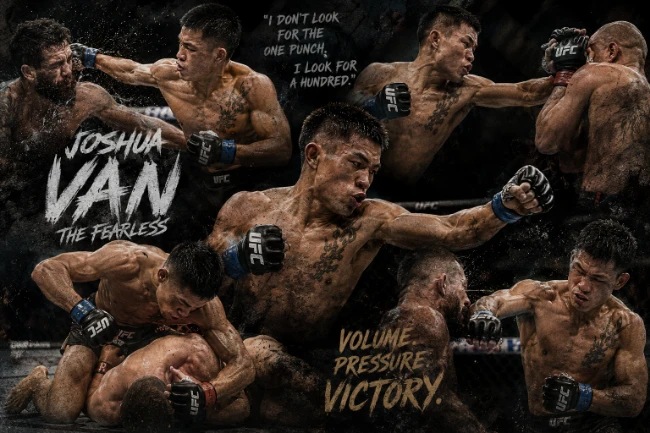
On the night of May 9, 2026, inside New Jersey's Prudential Center, Joshua Van stood across the Octagon from Tatsuro Taira and did what he has done in nearly every fight of his career: he kept coming forward, kept throwing, kept finding angles, until the volume became too much.
By the fifth round, the referee had seen enough. Van's hand was raised, his first successful defense of the UFC flyweight title secured. It was a fitting way to cement a championship reign that had begun, almost absurdly, just twenty-six seconds into a fight five months earlier.
At 24 Van is the UFC's second-youngest champion in history, behind only Jon Jones, and the first Asian-born male titleholder the promotion has ever crowned. He's also a fighter built almost entirely on output — the youngest competitor to ever land 1,000 significant strikes inside the Octagon, and the centerpiece of the highest-volume three-round fight in UFC history. For a kid who spent his earliest years in the misty hills of western Myanmar, the path to becoming the sport's busiest hands has wound through a refugee camp, a Texas strip-mall gym, and more heartbreak than most champions carry into their twenties.
From the Chin Hills to a Refugee Camp
Joshua Van Bawi Thawng was born on October 10, 2001, in Hakha, the mountain-ringed capital of Myanmar's Chin State — a remote, rugged corner of the country once so wild that local lore still recalls the tigers that prowled its forests. The Chin are one of Myanmar's ethnic minorities, and Van's family came of age amid the kind of military rule and ethnic conflict that has displaced millions of people across the country for decades. Before Van turned nine, his parents made the decision so many Chin families have been forced into: they left. The family fled to a refugee camp in Malaysia, and a couple of years later, resettled on the other side of the planet, in Houston, Texas.
Houston is where the rest of the story takes shape. Van has been candid that while his blood is from Myanmar, the city built him. He throws up the "H" with both hands during his walkouts, even as he carries Myanmar's colors into the cage — though not, technically, its flag. Because the UFC doesn't recognize Myanmar as a sanctioned nation for its purposes, Van isn't permitted to drape himself in it, a bureaucratic detail that has long irritated him more than it should have to.
Loss, Discipline, and a Gym Called 4oz
The Houston years were not easy ones. Van's father died when Van was sixteen, and the fighter has since admitted he felt like a disappointment to his dad while he was still alive — a wound that, by his own account, has quietly driven much of what came after. Around that period, Van found combat sports, training first under coach Scott Juarez at a local gym before settling into the team that has shaped him ever since: 4oz Fight Club, run by UFC veteran Daniel Pineda. Pineda's gritty, pressure-forward style became the foundation of Van's own approach, supplemented by wrestling coaches Jose Santibanez and Frank Gallego and hours of boxing work at Houston's Aztlan Boxing Gym.
Van made his amateur debut in 2020 at nineteen — his father wasn't alive to see it — and went 4-0 before turning pro the following year. He built his name on the Texas regional circuit with Fury Fighting Championship, climbing to a 7-1 record and capturing that promotion's flyweight title in December 2022 by submitting Cleveland McLean. The run was strong enough that the UFC, which had initially slated him for its developmental Contender Series, instead fast-tracked him straight onto the main roster.
Building a Body of Work
Van's UFC debut came in June 2023 at UFC on ABC 5, a split-decision win over Zhalgas Zhumagulov. He followed it with victories over Kevin Borjas and Felipe Bunes, establishing himself as a relentless, high-output prospect with a freestyle approach that blended his blue-belt jiu-jitsu, a sturdy wrestling base, and an evident preference for trading on the feet.
Then came the first real test. In July 2024, in Denver, flyweight contender Charles Johnson caught Van with a third-round uppercut that ended the fight — and, for a moment, the hype. It remains the only loss of Van's UFC career. Rather than derail him, it reset him. He has described the defeat as the moment a switch flipped: no more cutting corners in camp, no more taking anything for granted. He won his next two fights that year, decisions over Edgar Cháirez and Cody Durden, to close out 2024 still squarely in the division's top tier.
A Breakout Year, One Punch at a Time
If 2024 was about recovery, 2025 was about acceleration. Van opened the year with a clean decision over Rei Tsuruya in March, then stopped Bruno Silva with strikes in the third round that June. Three weeks later came the fight that changed everything: a three-round war with former title challenger Brandon Royval that set the UFC record for combined strikes landed by both fighters, 419 in total, and earned both men Fight of the Night honors. Van came out on top by unanimous decision, vaulting from prospect to No. 1 contender in the span of a month. "It's just the hunger, man," he said of the mentality that carried him through it.
That hunger earned him an immediate title shot. At UFC 323 in December 2025, Van challenged Alexandre Pantoja, the division's reigning champion since 2023 and, by most assessments, the toughest matchup at 125 pounds in years. Pantoja was defending his belt for the fifth time and entered as a heavy favorite over the 24-year-old upstart. Early in the first round, Pantoja threw a head kick; Van caught it cleanly and dumped him to the canvas. Pantoja's elbow buckled awkwardly on the fall, and the fight was waved off just twenty-six seconds in. Van was champion — and visibly uneasy about how it happened.
Rather than celebrate, he knelt beside Pantoja to check on him before the result was even announced. He has since said he wants a rematch to settle the matter outright, even as he called the outcome "bittersweet" and pushed back hard at anyone who questioned whether the title was legitimate. Two days after winning the belt, for the first time since claiming a regional title back in 2022, he finally felt ready to visit his father's grave.
Defending the Belt, Carrying a Country
Five months later, Van answered the doubters at UFC 328, grinding out a fifth-round TKO of Tatsuro Taira to make his first defense both decisive and emphatic. He climbed into the UFC's pound-for-pound top ten in the process, all while becoming something larger than a champion back home: a symbol, to many in Myanmar's diaspora and its younger generation, that the country's story isn't only one of conflict.
Van has used part of his earnings to buy his mother a house, fulfilling a promise made back in the family's displacement years. He still trains daily at 4oz Fight Club, still throws up the H, still calls Houston "my own city" even as he fights for a homeland he was forced to leave. He has talked openly about wanting the Pantoja rematch to erase any lingering doubt, and about being willing to fight whoever the UFC puts in front of him next, ranked contender or not — a habit his head coach, Daniel Pineda, has half-jokingly called the only downside of having him as a champion.
None of the hardware changes what got him here. The kid from Hakha didn't just survive the upheaval that shaped his childhood — he turned it into a fighting style nobody in the flyweight division has yet figured out how to slow down, let alone stop.
© 2026 by Asian Media Group Inc.
Recent Articles
- Unitree Prices IPO at $9 Billion Valuation
- AMD Buys Taalas to Expand Bet on AI Inference Chips
- N. Korean Forces Joining Russia's War Against Ukraine in Large Numbers
- S. Korea Province Deploys Drones to Warn Elderly Farmers Amid Heatwave
- Nintendo Operating Profit Jumps 151% on Robust Software Demand, Tariff Refund
- New Left-Wing Media Power Surge of Progressive Candidates
- MAGA Republicans, Democrats Jointly Blame Trump's Tech Ties for AI Inaction
- OpenAI, Anthropic AI Agents Implicated in New Security Breaches
- Iran Threatens to Hit Gulf States If US Launches New Strikes
- Ralph Lauren's Beat Powered by Young Shoppers in Asia, North America
Other Asian Media Group Sites
- AsiaMs.net — Asian American Women's Resource
- AsianSports.net — Asian American Sports and Fitness
- VoxCali.com — Videos and Podcasts for Asian Americans
- MyGoldScene.com — Guide to Asian Entertainment
- AttheBanquet.com — Asian Fine Dining and Hospitality
- EastwardDrive.com — Asian Carbuying Intelligence
- EastTable.com — Modern Asian Food and Culture
- TadkaTable.com — Inside South Asian Cooking
- GoGenerational.com — Diaspora Families Building Wealth