

Tired US Brands Sometimes Find a Brilliant Second Wind in Asia
By H Y Nahm | 07 Jul, 2026
Brands that lose their appeal with US consumers often find that Asian and European consumers see them as they were in their glory days—often amplified by the appeal of the exotic.
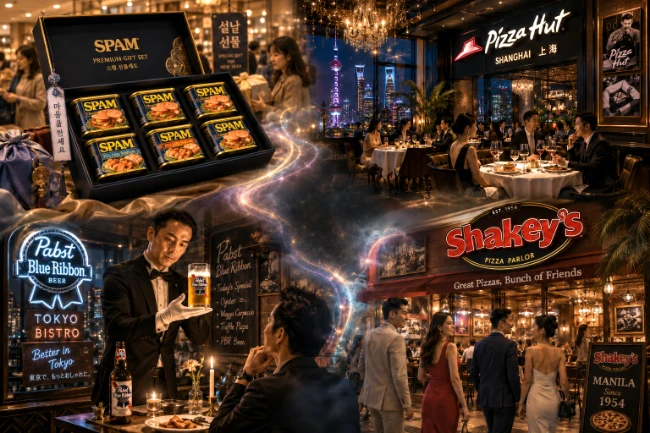
Walk into a Pizza Hut in Shanghai and you may wonder if you've stumbled into the wrong restaurant.
There are white tablecloths, escargot on the menu, waiters presenting steaks on sizzling platters, and couples lingering over wine. This is not the Pizza Hut of the American strip mall, the one that survives largely on delivery apps and nostalgia. This is Pizza Hut as an occasion—a place where families celebrate birthdays and young professionals go on dates. The brand that has spent two decades shrinking in the US spent the same two decades expanding into one of China's largest casual dining chains.
The phenomenon is common enough that it deserves a name. Call it the second-wind effect: an American brand exhausts its cachet at home, then discovers that in Tokyo, Seoul, Manila, or Shanghai, its reputation never aged. Foreign consumers encountered the brand at its peak—through movies, music, American soldiers, or an early franchise deal—and the image froze there.
Better yet, the brand arrives wrapped in the glamour of being foreign. What reads as tired and downmarket in Ohio reads as authentically, exotically American in Osaka. The result is a strange kind of commercial time travel, in which a company can meet a younger, more enthusiastic version of its own customer base simply by crossing an ocean.
The Beer that Became a Luxury Good
Perhaps no example is as striking as Pabst Blue Ribbon. In the US, PBR spent decades as the cheapest beer in the cooler, briefly resurrected as an ironic hipster totem in the 2000s before fading again. In China, the same company sells "Pabst Blue Ribbon 1844," a beer aged in whiskey barrels, packaged like champagne, and priced at many times what a six-pack of ordinary PBR costs in America. The marketing leans on the brand's nineteenth-century heritage—the blue ribbon supposedly won at the 1893 World's Columbian Exposition—and presents the beer as a piece of American craftsmanship with a pedigree. Chinese consumers, who never watched PBR become a punchline, took the story at face value. The heritage was real; only the American context that had devalued it was missing.
Buick tells the same story on four wheels. In the US, Buick became shorthand for the car your grandfather drove—so much so that General Motors seriously considered killing the brand during its 2009 bankruptcy. What saved Buick was China, where it had a completely different backstory. The last emperor, Puyi, rode in a Buick. So did Sun Yat-sen and Zhou Enlai. When GM re-entered China in the 1990s, it led with Buick precisely because of that prestige, and Chinese buyers embraced it as a statesman's car. For years, Buick sold several times more vehicles in China than in the US, and Chinese demand effectively dictated the brand's product line. A marque on death row in Detroit was a status symbol in Beijing.
Frozen in Their Prime
Why does this happen? Part of the answer is simple timing. Brands typically expand abroad when they are strong, which means foreign markets meet them at their best. When the brand later declines at home—through overexpansion, changing tastes, or self-inflicted wounds—the foreign subsidiary is often insulated. It has different management, different menus, different store designs, and, crucially, different memories. The Japanese consumer who fell in love with Shakey's Pizza in the 1970s never watched the chain collapse across America; in Japan and the Philippines, Shakey's simply kept being what it had always been. In the Philippines it remains a beloved family restaurant with hundreds of locations, a fixture of birthdays and after-church lunches, while most Americans under fifty have never seen one.
Mister Donut is an even purer case. Founded in Boston in 1956 by the brother-in-law of Dunkin' Donuts' founder, Mister Donut lost the American doughnut wars and mostly vanished from the US when Dunkin's parent company absorbed it. But its Japanese licensee, Duskin, had built the brand into a national institution, and it kept going. Today "Misdo," as the Japanese affectionately call it, has roughly a thousand shops in Japan, its own beloved seasonal products, collectible merchandise, and collaborations with luxury patissiers. An American brand that Americans forgot became one of Japan's defining fast-food chains—more Japanese, by now, than American, yet still trading on its mid-century American origin story.
Tower Records offers the retail version. The California music chain liquidated its US stores in 2006, done in by digital music. Its Japanese arm, which had been spun off years earlier, sailed on. Tower Records Japan still operates dozens of stores, including its famous nine-story flagship in Shibuya, which functions as a temple of physical media in a country where CDs never fully died. The yellow-and-red logo that signals bankruptcy and nostalgia to Americans signals a thriving, current music culture to Japanese shoppers.
The Spam Gift Set and Other Status Inversions
Sometimes the second wind comes not from a franchise structure but from a wholesale reinterpretation of what the product means. Spam, the canned pork that Americans treat as a Depression-era joke, is a premium product in South Korea. Introduced during the Korean War, when American military rations were precious, Spam became embedded in Korean cuisine—most famously in budae jjigae, "army base stew"—and never lost its aura of American abundance. Today, elaborately packaged Spam gift sets are a standard present during the Chuseok and Lunar New Year holidays, given the way Americans might give a nice bottle of wine. South Korea is Spam's largest market outside the US, and Koreans consume it without a trace of irony.
Apparel brands show the same inversion. Champion, the athletic-wear maker that spent years as a bargain-bin basics label in American discount stores, was simultaneously being curated in Japan and Europe as vintage Americana—its reverse-weave sweatshirts sold in boutiques at premium prices. Japanese and European streetwear culture treated the "C" logo as a piece of authentic American sportswear history, and that overseas prestige eventually flowed back home, fueling Champion's late-2010s revival in the US itself. Fila followed a more dramatic path: the fading sportswear brand was ultimately acquired outright by its South Korean licensee, which rebuilt it into a global streetwear player. In both cases, foreign markets didn't just buy the brand's products; they preserved and reprocessed the brand's meaning until it was valuable again everywhere.
Even the casual-dining sector, ground zero for American brand decay, keeps producing examples. Outback Steakhouse, which has closed waves of US locations, is treated in South Korea as a proper steakhouse—a white-collar dinner spot where the meal is a modest luxury rather than a chain-restaurant compromise. TGI Fridays and Denny's both found longer, healthier lives in Asian markets under local operators than their US trajectories would have predicted; Denny's in Japan, run by a local company, serves a Japanese menu to a loyal customer base that has no idea the brand connotes late-night diner fatigue in America.
What the Second Wind Teaches
There are lessons in all this beyond the novelty. The first is that a brand is not a global monolith but a bundle of local memories, and those memories decay at different rates in different places. A company that treats its overseas image as an extension of its domestic one may miss the fact that the overseas image is stronger—and more monetizable at a premium.
The second is that "exotic" is a renewable resource. The same distance that makes French brands seem chic in Chicago makes American brands seem chic in Chengdu. Heritage that feels stale at home—the 1893 blue ribbon, the reverse-weave sweatshirt, the roadside pizza parlor—can be re-presented abroad as artifact rather than leftover.
The third lesson is humbler: sometimes the foreigners are right. The Japanese customers lining up at Mister Donut and the Koreans gifting Spam are not deluded; they are responding to real qualities the home market stopped noticing. Familiarity breeds contempt, and the US consumer's contempt is often less a verdict on the product than a side effect of overexposure. When Champion's overseas cool re-imported itself to American closets, it demonstrated that the second wind can blow home again.
None of this makes foreign markets a guaranteed cure. Plenty of faded brands have failed abroad, too, and success usually requires ceding real control to local partners who understand what the brand means in their market rather than what it means in Ohio. But for a certain kind of company—one with genuine history, a recognizable name, and a home market that has simply seen too much of it—the most valuable asset on the balance sheet may be the version of itself that still exists, perfectly preserved, in someone else's imagination an ocean away.
© 2026 by Asian Media Group Inc.
Recent Articles
- Global M&A Activity on Track to Eclipse 2021 Deal Boom
- Rising Leverage Raises Funding Pressure in US Markets
- Asian Nations Seek to Build Stabilizing Alternatives to Aligning with US or China
- China Aims to Raise EV Share to 30% by 2030
- SpaceX and AI Startup Wealth Fuels Demand for Private Jets
- China Plans to Let Top AI Firms Buy Limited Nvidia H200 Chips
- Meta's AI Chip Finally Set to Go into Production in September
- Iran Becomes Tar Baby for Br'er Donald
- China's Producer Inflation Near 4-Year High in June, Squeezing Manufacturers
- SK Hynix US Listing Oversubscribed Over 7-Fold