

US Adopts Chinese-Style Industrial Subsidies to Chip Away at Crippling Dependence on Chinese Rare-Earths
By Tom Kagy | 12 Aug, 2026
Only the exigencies of a trade war started by Trump tariffs can justify the high costs with which US tech firms will be saddled for critical components into the foreseeable future.
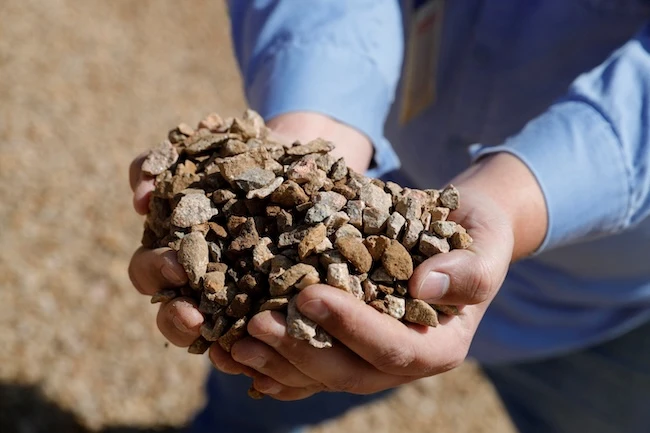
Matt Green, mining/crushing supervisor at MP Materials, displays crushed ore before it is sent to the mill at the MP Materials rare earth mine in Mountain Pass, California, U.S. January 30, 2020. REUTERS/Steve Marcus/File Photo
Until Trump started his gratuitous trade war, few Americans had ever heard of rare-earths. Now they've become the elephant in every trade negotiation conference room.
The MP Materials rare-earth refining plant is located at Mountain Pass, California, near the Nevada border. (MP Materials Photo)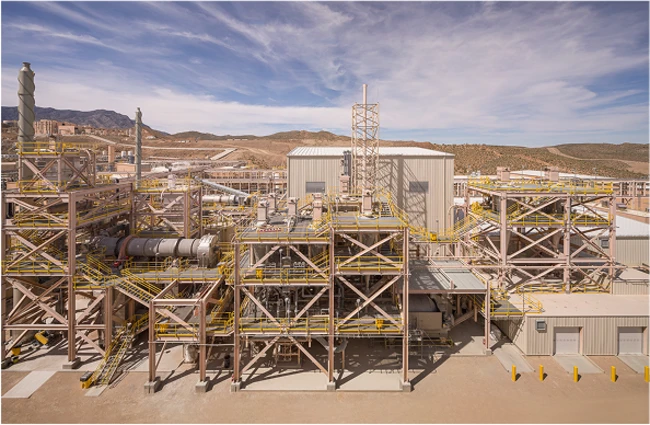
For decades, Washington treated rare-earth elements as somebody else's problem—specifically, China's. The mining was dirty, the separation chemistry was difficult, the margins were thin, and Beijing was happy to do the work.
That bargain collapsed the moment Trump made the foolish bet that he could impose unilateral tariffs on China without consequences. It didn't take long for the US-China trade war to escalate into a contest over strategic materials. China reached for the most potent economic weapon in its arsenal: export controls on the metals and magnets that make modern technology move.
Another view of the MP Materials refining facilities at Mountain Pass, California. (MP Materials Photo)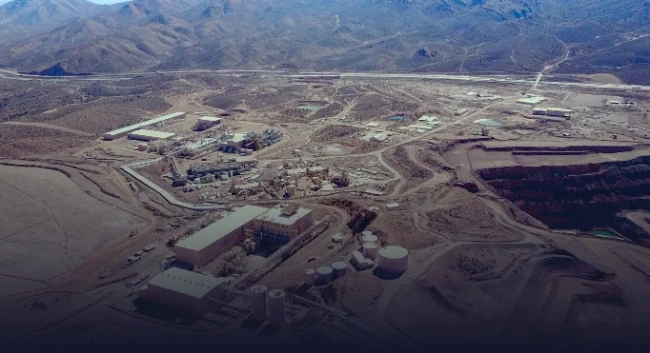
What has followed is one of the most remarkable reversals in American economic policy since the Second World War. The United States, long the world's loudest critic of state-directed capitalism, is now practicing it with abandon—equity stakes, price floors, guaranteed offtakes, procurement mandates—in a frantic effort to rebuild an industry it allowed to wither. The early numbers show genuine progress. They also show just how far there is to go, and how expensive the journey will be.
The Depth of the Hole
Start with the brutal arithmetic. The United States consumed roughly 48,000 metric tons of neodymium-iron-boron permanent magnets in 2025—the workhorse components inside electric-vehicle motors, wind turbines, precision-guided munitions, drones, and robotics—while producing only about 300 tons domestically, less than 1 percent of demand. Even under optimistic projections that see American capacity reaching around 5,000 tons by the end of 2026, domestic supply would cover perhaps 10 percent of current consumption. China, by contrast, turns out well over 260,000 metric tons of finished magnets annually, and all of America's allies combined—Japan, the European Union, South Korea, Australia—manage only a fraction of that.
The disparity is even starker upstream, in the processing stages where China's real power lies. Beijing controls roughly 90 percent of global rare-earth processing capacity. Its light rare-earth separation capacity alone runs to about 350,000 tons per year, against less than 50,000 tons for the entire rest of the world. For the heavy rare earths—dysprosium and terbium, the elements that let magnets survive the heat inside a fighter jet's actuators or an EV's traction motor—the picture until very recently was near-total monopoly. China accounted for 99 percent of heavy rare-earth processing, and as of last year the city of Wuxi hosted the only facility on Earth capable of refining dysprosium. In the first quarter of 2026, Australia's Lynas—the West's most established producer—managed a combined eight tons of dysprosium and terbium output against global demand measured in the thousands of tons.
Washington Discovers Industrial Policy
Against that backdrop, the American response has been to borrow shamelessly from Beijing's playbook. The centerpiece is the Pentagon's extraordinary partnership with MP Materials, operator of the Mountain Pass mine in California, the country's only active rare-earth mine. The Department of Defense took an equity position that made the US government the company's largest shareholder, with roughly a 15 percent stake. It guaranteed a ten-year price floor of $110 per kilogram for MP's neodymium-praseodymium output—nearly double the prevailing market price when the deal was struck. And it committed to ensuring that 100 percent of the magnets produced at MP's planned "10X" facility will find buyers among defense and commercial customers, a facility that once commissioned around 2028 should lift the company's total US magnet capacity to an estimated 10,000 metric tons per year.
This is not grant-making or loan guarantees at the margins. It is the state underwriting an industry's economics end to end: supply-side capital, demand-side certainty, and insulation from the price warfare that Beijing has historically used to bankrupt Western challengers. Analysts at the Center for Strategic and International Studies have observed that Washington has now deployed essentially the entire industrial-policy toolkit for rare earths—equity, concessional financing, public procurement—which is precisely how China built its own dominance over three decades. Layered on top is a regulatory forcing function: beginning January 1, 2027, defense-acquisition rules will prohibit Chinese-sourced permanent magnets in US defense procurement, converting a policy aspiration into a hard compliance deadline for contractors.
Signs the Bet Is Paying Off
The scoreboard, while modest in absolute terms, is moving. MP Materials reported second-quarter 2026 NdPr oxide production of 840 metric tons, up 41 percent year over year, with sales more than doubling. The Pentagon's price floor generated $17.6 million in price-protection income in the quarter alone—proof that the backstop is real money, not a theoretical promise. Market analysts marked March 2026 as a genuine milestone: the first month in which a functioning, commercial-scale rare-earth supply chain existed outside China, with Lynas delivering its first contracted shipments of separated heavy rare earths and MP commissioning its own dysprosium and terbium separation capability at Mountain Pass. Energy Fuels, meanwhile, has begun a commercial-scale expansion at its White Mesa Mill in Utah that aims to deliver terbium and dysprosium from Australian monazite feedstock by late 2027. A cluster of startups—Vulcan Elements, Phoenix Tailings, USA Rare Earth, and others—is racing to add magnet-making and metallization capacity, backed by a mix of venture capital and federal money.
Beijing has noticed. In June 2026, five weeks after a Trump-Xi summit raised hopes of extending the fragile minerals truce reached the previous October, China's Ministry of Commerce added MP Materials and USA Rare Earth—the two largest recipients of US federal rare-earth investment—to its export-control blacklist. The move carries extraterritorial teeth: no entity anywhere may transfer Chinese-origin inputs to the blacklisted firms, a provision that reaches deep into allied supply chains. The broader suspension of China's export controls runs only until November 10, 2026. It is a pause, not a peace.
The Price of Independence
Here is where the celebration must give way to accounting. Estimates of what genuine supply-chain independence would cost range from $12–15 billion across all processing stages to as much as $30–50 billion over five to seven years, depending on how independence is defined. And that capital buys capacity, not competitiveness. The very existence of the $110-per-kilogram price floor is an admission that American production cannot survive at Chinese-set prices; when the deal was signed, the floor implied a potential taxpayer outlay of roughly $300 million a year to keep MP whole. Prices have since risen into the $100–110 range, easing the subsidy burden—but largely because of the disruption itself, not because the underlying cost gap has closed. Chinese refiners retain structural advantages built over thirty years: accumulated process knowledge, permissive environmental regimes, cheap ion-adsorption clay feedstock from Myanmar, and the sheer efficiency of scale. As one Benchmark Mineral Intelligence analyst put it, the heavier the rare earth, the higher the refining cost—and China does it cheaply and efficiently.
Those costs land somewhere, and where they land is on American manufacturers. Automakers, wind-turbine builders, robotics firms, and electronics companies buying from the protected domestic supply chain will pay a structural premium over their competitors sourcing from China. A parallel market with higher prices is the explicit design, not an unfortunate side effect. That is a defensible trade only because the alternative—leaving the Pentagon and the industrial base hostage to a single geopolitical rival—became intolerable once the tariff war hardened into open economic conflict and Beijing demonstrated, from the Ford production halt of 2025 onward, that it would actually pull the trigger.
A Realistic Endgame
So will the United States ever achieve economically sustainable independence from Chinese processing? The honest answer is a split verdict. For defense, yes, and soon: the Pentagon's annual requirement of 3,000–4,000 tons of specialized magnets, projected to reach perhaps 10,000 tons by 2030, is small enough that the subsidized buildout can plausibly cover it within a few years, and no premium is too high for munitions that cannot be held hostage. For the far larger commercial economy, the credible ceiling is different: analysts tracking the buildout project that non-Chinese producers might capture around 20 percent of the global magnet market by 2030. That is resilience, not independence—enough allied capacity that a Chinese embargo would hurt but not paralyze, which strips Beijing of its most coercive lever without pretending America can out-compete a state-built industry on price.
That more limited goal has become one necessary to pursue, and is the one actually being pursued beneath the independence rhetoric. The Chinese-style subsidies now flowing into mines, separation plants, and magnet lines are chipping away at a dependence that should never have been allowed to form. But nobody should mistake the project for a market outcome. It's a war economy in miniature, justified by the trade war—and paid for, kilogram by kilogram, in the prices American technology firms must now carry for years to come—or until our trade relations with China become rational.
© 2026 by Asian Media Group Inc.
Recent Articles
- US Producer Prices Unchanged in July, Further Dimming Rate Hike Odds
- Trump Sued over Service That Offers Paid Early Access to Truth Social Posts
- Iran's State Media Mocks Trump with Meme Showing Him Hiding in Catering Truck
- Iran, US Make Competing Claims over Control of Strait of Hormuz
- DeepSeek Releases Official V4 Pro Model as It Steps up Expansion
- Musk Inspires Jump in S&P 500 CEO Pay
- Putin Visit to Disputed Island Irks Tokyo
- Asia Sales Lead Birkenstock Revenue Growth
- 'If I Go, You Go, Right?': Flying Air Force One - Without Trump
- Cerebras Slump Tests AI Growth Narrative
Other Asian Media Group Sites
- AsiaMs.net — Asian American Women's Resource
- AsianSports.net — Asian American Sports and Fitness
- VoxCali.com — Videos and Podcasts for Asian Americans
- MyGoldScene.com — Guide to Asian Entertainment
- AttheBanquet.com — Asian Fine Dining and Hospitality
- EastwardDrive.com — Asian Carbuying Intelligence
- EastTable.com — Modern Asian Food and Culture
- TadkaTable.com — Inside South Asian Cooking
- GoGenerational.com — Diaspora Families Building Wealth
- TransPacBound.com — Transpacific Traveler