

US Manufacturing Weak for 4th Straight Month on Tariff Malaise
By Reuters | 01 Jul, 2025
Uncertainty over tariffs and higher cost of inputs from China and other nations has kept US manufacturers in the doldrums since March.
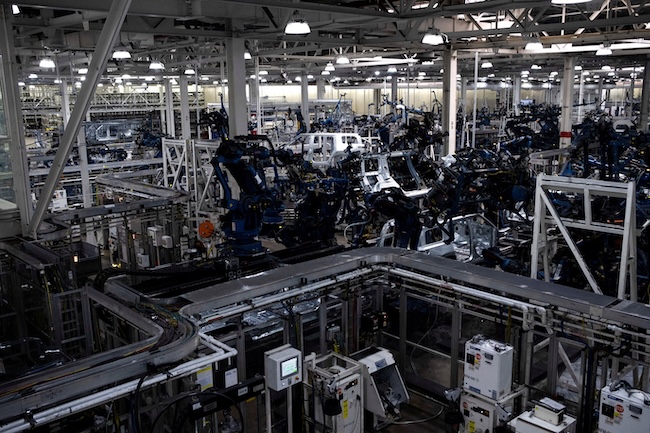
Machinery assembles second-generation R1 vehicles at electric auto maker Rivian's manufacturing facility in Normal, Illinois, U.S. June 21, 2024. REUTERS/Joel Angel Juarez/File Photo
U.S. manufacturing remained sluggish in June, with new orders subdued and prices paid for inputs creeping higher, suggesting that the Trump administration's tariffs on imported goods continued to hamper businesses' ability to plan ahead.
The Institute for Supply Management (ISM) said on Tuesday that its manufacturing PMI nudged up to 49.0 last month from a six-month low of 48.5 in May. It was the fourth straight month that the PMI was below the 50 mark, which indicates contraction in the sector that accounts for 10.2% of the economy. Economists polled by Reuters had forecast the PMI little changed at 48.8.
The survey joined weak data on the housing market, consumer spending and swelling unemployment rolls that have suggested the economy's underlying momentum slowed further in the second quarter even as gross domestic product probably rebounded as the drag from a record trade deficit faded due to falling imports.
A measure of domestic demand grew at its slowest pace in more than two years in the January-March quarter. President Donald Trump's sweeping tariffs, which have led businesses and households to front-run imports and goods purchases to avoid higher prices from duties, have muddled the economic picture. Economists warned it could take time for the tariff-related distortions to wash out of the economic data.
The PMI last month was likely lifted by longer delivery times, which under normal circumstances would be related to strong demand. The extensive tariffs have caused bottlenecks in the supply chain, resulting in factories waiting longer for raw material deliveries.
The ISM survey's supplier deliveries index slipped to 54.2 from 56.1 in May, though it was still high with a reading above 50 indicating slower deliveries. The ISM has reported "ongoing delays in clearing goods through ports of entry."
The situation, however, appears to have improved slightly, with the survey's imports measure rising to a still-subdued 47.4 after slumping to 39.9 in May. Manufacturing is heavily reliant on imported raw materials.
Though production at factories picked up last month, it was probably the result of manufacturers working through backlog orders. The ISM survey's forward-looking new orders sub-index dropped to 46.4 from 47.6 in May. This measure has now contracted for five consecutive months.
Its gauge of prices paid by factories for inputs ticked up to 69.7 from 69.4 in the prior month.
With manufacturers facing weak demand and higher prices for inputs, employment declined further last month. The survey's measure of manufacturing employment fell to 45.0 from 46.8 in May. The ISM has noted an "acceleration of headcount reductions due to uncertain near- to mid-term demand."
(Reporting By Lucia Mutikani; Editing by Chizu Nomiyama)
© 2025 by Asian Media Group Inc.
With manufacturers facing weak demand and higher prices for inputs, employment declined further last month. The survey's measure of manufacturing employment fell to 45.0 from 46.8 in May.
Recent Articles
- Google Limits Meta’s Use of Its Gemini AI Models
- Key Volkswagen Shareholder Pitches Producing China Models in Germany
- S. Korea's Early World Cup Exit Triggers 'Utterly Baffled' Tirade by President
- Anthropic Allowed to Release Mythos AI Model to 'Tusted' US Organizations
- Apple Seeks Approval to Buy from Blacklisted Chinese Company to Ease Memory Crunch
- China's Industrial Profits Stay Resilient on Factories, Exports
- Meet the Teen Who Undertook a 7-Continent Solo Flight Against Cancer
- Getting Fit Pt. 2 - Raising Our Floor
- South Korea Survives World Cup Scare, Advances to Round of 32
- Why Asian-White Marriages Suffer Multiples the Disruption Rates of Asian-Asian Marriages