

US on Track to Relive Japan's 3-Decade Slump
By Tom Kagy | 19 Jul, 2026
The yearning to preserve white privilege at all cost precisely parallels the Japanese yearning to preserve Japanese cultural purity against foreign elements—with precisely the same results for the economy.
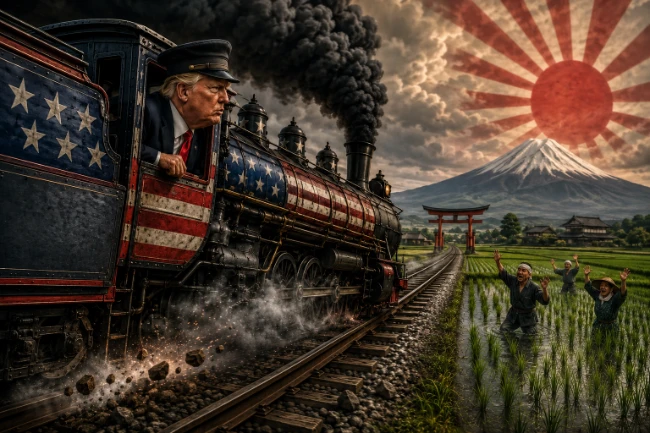
In 1989, Japan was the future. Its companies were buying Rockefeller Center and Pebble Beach, its management techniques filled American business school syllabi, and serious economists predicted its economy would overtake the United States within a generation.
Then the asset bubble burst, and Japan entered what became known as the Lost Decade—which stretched into a second decade, and then a third. The proximate cause was a financial crisis. The reason the crisis metastasized into thirty years of stagnation was something deeper: a political culture that, when forced to choose between economic dynamism and the preservation of a particular vision of national identity, chose identity every single time.
The United States, under Donald Trump and acolytes, is now making the same choice, for the same underlying reason, and there is little cause to expect a different result.
The Choice Japan Made
Japan's stagnation was never inevitable. Economists identified the remedies early and repeated them for decades: recapitalize the banks quickly, let failed firms die, open the labor market, and—above all—admit immigrants to offset a workforce that began shrinking in the late 1990s. Japan did none of these things at scale, and the refusal was a deliberate values judgment, not technical incompetence.
Letting zombie companies fail meant disrupting the lifetime-employment social contract that defined postwar Japanese manhood. Opening labor markets meant empowering outsiders—women, the young, the foreign—at the expense of the salaryman incumbents who dominated politics. And immigration, the single most powerful available lever, collided directly with the ideology of Nihonjinron: the belief that Japan's essence resides in its ethnic and cultural homogeneity, and that this purity is worth protecting at any price. Politicians did not hide this reasoning. Preserving "harmony" and "Japaneseness" was offered openly as justification for keeping the foreign-born population under two percent while the country aged into demographic crisis.
The price was paid in compound interest. A shrinking workforce meant shrinking domestic demand, which meant firms had no reason to invest at home, which meant wages froze for a generation. Nominal GDP in 2020 was roughly where it had been in 1995. Japan protected its identity and lost its future.
The American Rhyme
The American version of Nihonjinron doesn't proclaim itself as an ethnic purity, but its sub rosa intent and operational content are identical. The through-line of the current political moment—the mass-deportation agenda, the gutting of legal immigration pathways, the hostility to foreign students and skilled-worker visas, the panic over demographic change framed as "replacement"—is the conviction that America's essence resides in a particular racial and cultural configuration, and that preserving the relative status of that configuration justifies any economic cost. That's the preservation of white privilege functioning not as a policy agenda, and it maps onto the Japanese precedent with unsettling precision.
Consider the mechanics. The United States, like 1990s Japan, faces a demographic cliff. The native-born fertility rate has fallen well below replacement. The baby boom generation is exiting the workforce faster than native-born workers can replace it. For the past three decades, the entire net growth of the prime-age American labor force has come from immigrants and their children. Every serious projection shows that without sustained immigration, the US labor force flatlines and then contracts—the exact precondition of Japanese stagnation.
Current policy is engineered to produce that contraction. Deportation campaigns target the workforce of agriculture, construction, elder care, and food processing. Visa restrictions and visible hostility have already bent the curve of international student enrollment downward, cutting off the pipeline that historically converted the world's most ambitious young people into American engineers, founders, and taxpayers. Skilled workers who once defaulted to the United States now weigh Canada, Australia, and increasingly a courting China. A country cannot simultaneously wage a demographic war on its own labor supply and expect the labor supply to grow.
Protecting Incumbents, Punishing the Future
The parallel extends beyond demographics into industrial policy. Japan's stagnation was prolonged by the decision to protect incumbents—banks, keiretsu conglomerates, small shopkeepers, rice farmers—from competition, because those incumbents were the social base of the ruling party and the symbolic core of the nation. Capital and labor stayed trapped in low-productivity uses for decades because dislodging them was politically unthinkable.
The American analogue is a tariff regime and subsidy politics designed to preserve the industrial economy of 1965—the economy in which the privileged position of a particular demographic was at its zenith—rather than to win the industries of 2045. Steel, coal, and internal-combustion manufacturing are shielded and celebrated; the sectors where America's actual comparative advantage lies, which happen to be the sectors most dependent on immigrant talent and global openness, are treated with suspicion.
Universities, the crown jewels of American soft power and the seedbed of its innovation economy, are attacked as enemies of the people in significant part because they are the institutions most identified with the multiracial, cosmopolitan America that the preservation project exists to prevent. Japan starved its future to feed its past. The United States is following the same backward-looking program.
The Deflation of Ambition
The subtlest damage Japan suffered was psychological. Three decades of stagnation produced a generation that stopped founding companies, stopped taking risks, stopped believing tomorrow would be richer than today. Economists call the mechanism a deflationary mindset; it might better be called the deflation of ambition, and it proved harder to reverse than any balance-sheet problem.
The early American symptoms are visible. Business formation by immigrants—who found companies at roughly double the native-born rate and have founded more than half of America's billion-dollar startups—is directly throttled by the visa regime. Regions that have bet hardest on the preservationist program are precisely the regions losing population, investment, and their own young people. And the political coalition driving the program skews old, exactly as Japan's did: a gerontocracy spending down the seed corn because its members will not live to harvest what was never planted. When a polity's median voter has more past than future, policy follows.
Why the Endgame Is the Same
Defenders of the current course argue that America is not Japan—that its markets are more flexible, its currency privileged, its culture more entrepreneurial. All true, and all of it was said, mutatis mutandis, about Japan in 1990, when its firms were the envy of the world.
Structural advantages don't repeal arithmetic. An economy is workers multiplied by productivity. Cut the growth of workers to zero by design, and you have staked everything on productivity—while simultaneously expelling the researchers, defunding the science, and besieging the universities on which productivity growth depends.
The deeper lesson of Japan is that stagnation is something a country chooses, one defensible-sounding decision at a time, whenever it decides that the preservation of a dominant group's status is the supreme national interest. Japan's establishment was never confused about the tradeoff. It understood that immigration would restore growth and rejected it anyway, because growth was not actually the priority; purity was.
The core of the current American program is identical. The deportations, the visa walls, the tariffs, the war on the universities are not economic policy that happens to have cultural side effects. They are cultural policy that happens to have economic side effects—and the side effect, on the evidence of the only large rich country to have run the experiment, is a generation of lost growth.
Japan at least entered its lost decades wealthy, equal, safe, and cohesive, with universal health care and functioning institutions to cushion the long descent. Trump is pursuing the same experiment in social regression with none of those shock absorbers, atop a mountain of debt that only growth can make sustainable. Can the US really freeze its demographic composition in amber and remain the world's dynamic frontier economy? Japan's experience has already provided a sobering and resounding answer with the Lost Decades. Yet Trump & company are pressing on.
© 2026 by Asian Media Group Inc.
Recent Articles
- Chipmakers' Big Profit Gains May Not Be Enough
- Blockbuster Films Produce Record Revenues for AMC
- Archer, Anduril Unveil Autonomous Aircraft Platform for Defense
- Why Oil Prices Haven't Gone Crazy Despite 5 Months of US-Iran Conflict
- Suzuki's No-Frills Cars Once Ruled India. Then Buyers Demanded Frills.
- Japanese Mayor Makes History with Maternity Leave That Caused a Stir
- Chinese Brave Simulated Typhoons to Prepare for the Real Thing
- GE Aerospace Unveils Breakthrough in Hybrid-Electric Flight
- Houthi Red Sea Blockade Tightens Iran's Grip on Global Energy Supplies
- Google's Newest Chip to Run Gemini Models 6 Times More Efficiently