

White House Seeks to Gut Air Quality Laws
By Reuters | 02 Dec, 2025
By efforts to roll back fuel economy standards Trump wants to promote oil interests at the expense of EVs and efforts to cut greenhouse gas emissions.
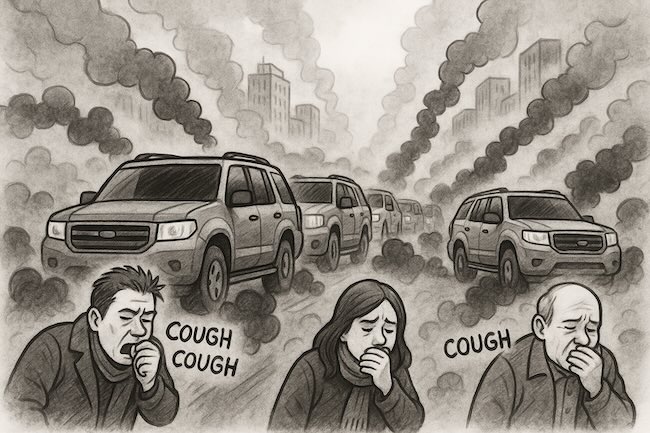
(Image by ChatGPT)
The Trump administration is set to propose a significant rollback of fuel economy standards finalized by former President Joe Biden last year, its latest push to make it easier for automakers to sell gas-powered cars, sources told Reuters.
The National Highway Traffic Safety Administration is expected to propose significantly reducing the fuel economy requirements for 2022-2031 model-year vehicles. President Donald Trump is set to announce the plan at a White House event on Wednesday that is expected to include executives from the three largest U.S. automakers, the sources added. Earlier this year, Trump signed legislation that ended fuel economy penalties for automakers, and NHTSA said they faced no fines dating back to the 2022 model year.
The White House and NHTSA did not immediately comment.
In June, NHTSA paved the way for looser U.S fuel economy standards by declaring that Biden's administration its authority by assuming high uptake of electric vehicles in calculating rules.
U.S. Transportation Secretary Sean Duffy in January signed an order directing NHTSA to rescind fuel economy standards issued under Biden for the 2022-2031 model years that had aimed to drastically reduce fuel use for cars and trucks.
Trump has taken a series of steps to make it easier to sell gas-powered vehicles and disincentivize EV production, including rescinding EV tax credits and barring California from banning the sale of traditional gas-powered vehicles after 2035.
In June 2024, during the Biden administration, NHTSA said it would hike Corporate Average Fuel Economy requirements to about 50.4 miles per gallon (21.4 km per liter) by 2031, from the current 39.1 mpg, for light-duty vehicles. That rule did not increase requirements light trucks for 2027 and 2028 and required 2% increases from 2029 to 2031.
The agency last year said the rule for passenger cars and trucks would reduce gasoline consumption by 64 billion gallons and cut emissions by 659 million metric tons, reducing fuel costs with net benefits estimated at $35.2 billion for drivers.
Last year, Chrysler-parent Stellantis paid $190.7 million in civil penalties for failing to meet U.S. fuel economy requirements for 2019 and 2020 after paying nearly $400 million for penalties from 2016 through 2019. GM paid $128.2 million in such penalties for 2016 and 2017.
(Reporting by David Shepardson; Editing by Lisa Shumaker and Paul Simao)
© 2025 by Asian Media Group Inc.
Recent Articles
- EV Demand Powered Europe Car Market in May, Helping Chinese Brands Grow Share
- Trump Orders Quantum Computing Push for Key Uses by 2028
- For Koreans a Partner at Samsung or SK Hynix Is the New 'A+' Catch
- India Says Ties with China Normalising as Top Officials Meet in Delhi
- Japan Factory Activity Ramps up in June on New Orders Surge
- Oracle Workforce Shrinks by About 21,000 Employees Amid AI Adoption
- Ohtani’s Baby Boom, Kim’s Birthday Celebration, and World Cup Updates
- Maya Lin Redefined American Architecture at 21
- Become an AI Bonus Baby—or Just Get Paid Like One
- Ferrari Denies Requiring Luce EV Purchase to Access Limited Edition Models