

Asian Airlines' Europe Windfall Fades as Gulf Rivals Rebound
By Reuters | 01 Jul, 2026
As Gulf carriers restore flights and lower ticket prices, Asian carriers like Singapore Airlines, Cathay Pacific Airways, Korean Air Lines and ANA Holdings are lunlikely to retain much of their market share gain.
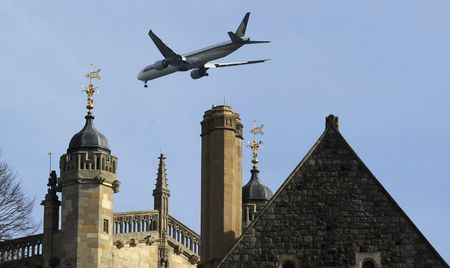
A Singapore Airline passenger jet flies over Windsor Castle on its way to Heathrow airport, in Windsor, west London March 25, 2012. REUTERS/Paul Hackett
Asian airlines that gained passengers and charged higher fares on European routes after the start of the Iran conflict are seeing those advantages erode as Gulf carriers restore flights and offer lower ticket prices, industry data shows.
The shift has been gradual, but it is raising doubts over whether carriers including Singapore Airlines, Cathay Pacific Airways, Korean Air Lines and ANA Holdings can retain much of the market share they gained during the disruption.
"It is clear that we have passed the peak of the load factor gains for the Asian carriers," said Nathan Gee, head of Asia-Pacific transportation research at BofA Global Research, referring to an industry term for the percentage of seats filled. "But long-haul bookings tend to be on a six-month window, suggesting the strongest contribution to flown revenues will be seen in the upcoming quarters."
Emirates, Qatar Airways and Etihad Airways carried nearly one-third of passengers from Asia to Europe and more than half of those from Australia and New Zealand to Europe before the conflict, according to Cirium data.
At the start of the Iran war on February 28, their Gulf hub airports were closed due to drone and missile attacks, but by mid-June the airlines' flights had returned to around 90% of normal levels, Flightradar24 data shows.
Between March and May, Middle Eastern carriers improved from a nearly 60% drop in passenger numbers from a year earlier to a 28% decline, according to International Air Transport Association data. And while non-stop traffic from Asia to Europe was up nearly 30% year-on-year in March, by May the gain had narrowed to 15%.
ASIAN FLIGHTS FULL
In June, Australia lifted a "do not travel" warning that had voided travellers' insurance policies at Gulf hubs. Flight Centre Travel Group said its bookings on Emirates, Qatar and Etihad were up 36% the following week.
Some travellers with pre-war bookings on Gulf carriers had bought refundable backup flights to Europe on Asian airlines as they assessed the security situation, said Michael Schischka, a senior adviser at Mary Rossi Travel in Sydney who specialises in luxury European trips.
"Not all clients, but I'd say the majority are now feeling more comfortable and safe and secure in flying through the Middle East," he said. "A lot of the Asian flights were very full and the cheaper fares weren't available. So that's driven people back to looking at the Middle East airlines again as well."
A Korean Air spokesperson said it had experienced a year-on-year increase in load factors on its European routes between March and May, but transfer traffic demand had softened as Gulf carriers resumed operations over the course of the second quarter.
ANA, which has yet to report May data, said its load factor on European flights had slipped from 93.1% in March to 86.9% in April, though it was still up 8.7 percentage points year-on-year. Cathay Pacific reported the load factor across its network was up 2 percentage points in May to 86.8% from a year earlier, whereas in March the gain was 9.5 points to 92.2%.
Independent aviation analyst Brendan Sobie said the data pointed to a gradual rather than sudden rebalancing, with Singapore Airlines' trajectory also illustrating the trend clearly.
The airline's Europe load factor surged 13.8 percentage points in March, but the gains narrowed sharply to 4.9 points in April and just 1.1 points in May.
"In May the load factors for both Europe and Australia normalised," Sobie said. "They had a big uptick in March, a smaller uptick in April and in May even smaller. To me it's more gradual, not overnight."
Cherie Lavin, a travel agent at Travel My Dear in Brisbane, said her clients looking to fly in the next one to three months remained hesitant about booking with Middle Eastern carriers.
"But I think for next year there's no qualms in quoting it," she said. "And it's being received well."
(Reporting by Julie Zhu in Hong Kong and Christine Chen in Sydney; Editing by Jamie Freed)
© 2026 by Asian Media Group Inc.
Recent Articles
- US June Private Payroll Growth Misses Expectations; Layoffs Decline
- Progressives Win Big Against Incumbent Democrats in Colorado Primaries
- Sony to End Discs for New PlayStation Releases as Gaming Shifts Online
- Russia Allowed Covert Military Training by China at Top Level
- Exports Help BYD Sales Rise for Second Month
- Older Americans Priced Out of GLP-1 Craze Expected to Flock to $50 per Month Program
- South Korea Exports Post Strongest Growth Since 1978 on AI Chip Boom
- Asian Airlines' Europe Windfall Fades as Gulf Rivals Rebound
- China's Q2 Factory Activity Strongest Since Late 2020
- Japan Business Mood Hits 8-Year High, Building Case for BOJ Rate Hikes