

AI Forces Students to Make Career Shifts That May Lead to Dead Ends
By Ben Lee | 26 Jul, 2026
The scramble for AI-proof fields may lead to intense competition for limited jobs in healthcare, engineering and skilled trades.
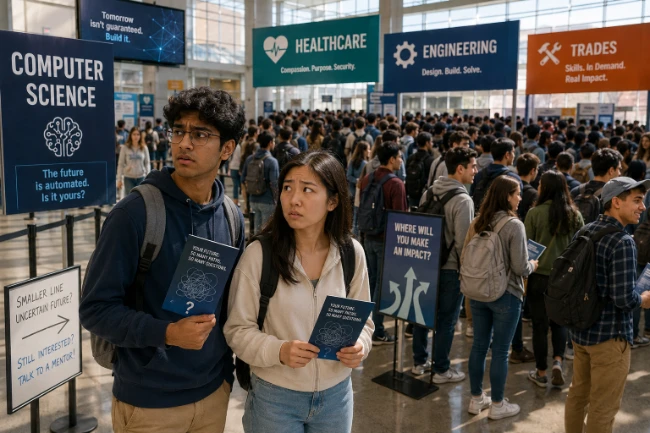
For fifteen years, the advice handed to American teenagers was as close to a sure thing as career guidance gets: learn to code. Computer science was the golden ticket, a straight line from a dorm room to a six-figure salary. That certainty has now collapsed with startling speed, and the students walking away from it are making a new set of bets — on nursing, on engineering, on the skilled trades — that may prove just as fragile as the one they abandoned.
The Exodus From Computer Science
The numbers tell a story that would've been unthinkable in 2021. According to National Student Clearinghouse data, undergraduate enrollment in computer science programs at four-year institutions fell 8.1 percent in the 2025–2026 academic year — the steepest single-year decline of any major since at least 2020. A Goldman Sachs analysis of the same Clearinghouse data, which covers more than 95 percent of U.S. degree-granting institutions, found that computer science and computer programming each posted declines of more than 10 percent, and identified the drop as the first clear evidence that students are steering away from majors exposed to AI displacement.
The retreat shows up campus by campus. Arizona State University saw bachelor's-level computer science enrollment fall roughly 14 percent between fall 2024 and fall 2025. At Washington University in St. Louis, the share of students majoring in computer science dropped 16 percent over two years. Across the University of California system, only one campus — UC San Diego — saw computer science enrollment rise, and it happens to be the only UC campus offering a dedicated artificial intelligence major.
And it's not just the students who've already switched. A Gallup study conducted with the Lumina Foundation found that 42 percent of bachelor's degree students have reconsidered their major because of AI. Some students even cite AI as a reason they enrolled in college in the first place — a hedge against a labor market they can't predict.
Where the Refugees Are Going
If students are fleeing the most AI-exposed majors, where are they landing? The Goldman analysis found enrollment rose about 3 percent on average in majors tied to occupations with low AI displacement risk and strong recent job growth — led by healthcare and engineering. The logic is intuitive. Engineering is technical but tethered to physical systems that a chatbot can't touch. Healthcare demands hands-on care and human judgment at the bedside.
Interest in computing hasn't vanished so much as rebranded. Student interest in AI as a field of study nearly tripled between 2023 and 2026, from 1.7 percent to 4.7 percent, even as pure programming concentrations fell from 14 percent to 10 percent. Roughly a fifth of applications to UC San Diego's computer science department now target its AI program. The University of South Florida enrolled nearly 3,000 students in a new college combining AI, cybersecurity, and related disciplines. Northwestern, Columbia, and USC are all launching AI programs this fall. Students aren't rejecting technology — they're trying to position themselves as the people who wield the automation rather than the people automated by it.
The reasoning behind the exodus is straightforward enough. AI coding tools have gotten remarkably good at precisely the kind of routine work that entry-level programmers were hired to do, and hiring at major tech firms has slowed visibly. One Houston-area college applicant told the Washington Post he was discouraged from pursuing the field because the payoff no longer felt certain even for top students. Nvidia CEO Jensen Huang has framed the risk differently — arguing that workers won't lose jobs to AI itself so much as to other people who've learned to use it — but for an 18-year-old choosing a major, the distinction offers cold comfort.
The Trouble With Safe Harbors
Here's the uncomfortable part: the fields students are fleeing toward may not be able to absorb them, and some may not stay safe for long.
Start with nursing, the archetypal AI-proof career. The demand is real — the Bureau of Labor Statistics projects around 189,000 registered nurse openings per year over the coming decade, and nurse practitioner is among the fastest-growing occupations in the country. But demand for nurses isn't the same as capacity to train them. Nursing schools have been turning away tens of thousands of qualified applicants annually for years, constrained by faculty shortages and limited clinical placement slots. A surge of AI refugees doesn't expand that pipeline; it just makes admission more competitive. The bottleneck sits at the schoolhouse door, not the hospital door.
Engineering has a different problem: time. The pipeline from freshman enrollment to a credentialed working engineer runs four to five years, which means today's enrollment surge won't hit the job market until the early 2030s — arriving all at once, in a wave, into whatever labor market exists then. And even healthcare, the supposed fortress, isn't untouched. AI already handles scheduling, records management, and portions of diagnostic work. The tasks that make a field feel safe today are exactly the tasks vendors are racing to automate tomorrow.
The Cobweb Problem
Economists have a name for what may be coming: the cobweb cycle. When students choose majors based on today's labor market, they graduate into a market shaped by everyone else who made the same choice four years earlier. Petroleum engineering offers the classic cautionary tale — enrollment exploded when oil prices spiked in the early 2010s, and graduates poured out of programs just in time for the 2015 oil crash to gut hiring. Something similar happened to law school applicants after the 2008 recession.
The AI-proof scramble has all the ingredients for a repeat. When tens of thousands of students simultaneously identify the same handful of "safe" fields — nursing, engineering, cybersecurity, the trades — they don't eliminate their risk. They relocate it. Individually, each pivot is rational. Collectively, they can manufacture exactly the oversupply everyone was trying to escape. The 2025 Gallup finding that nearly half of students have at least considered switching suggests the herd is large, and herds move together.
The skilled trades illustrate the tension neatly. The pitch is compelling: roughly half a million skilled trade jobs sit unfilled nationwide, data-center construction has electricians earning extraordinary sums, and apprenticeships offer paid training with zero student debt. Some career analysts now argue that the old hierarchy has inverted — that an electrician's career is structurally more secure than most white-collar office work. All of that is true today. But trade shortages are driven substantially by retiring baby boomers, a one-time demographic event. If cultural momentum keeps pushing college-skeptical Gen Z toward apprenticeships at scale, the shortage that makes the trades lucrative could narrow within a decade — right about when today's high school juniors finish their journeyman hours.
Betting Without Knowing the Odds
There's a deeper problem than oversupply, though: nobody actually knows which fields are AI-proof. The rankings that circulate — automation-resistance scores, displacement-risk indexes — are built on assessments of which tasks current AI systems can perform. They're snapshots of a technology that's been reliably embarrassing such snapshots every eighteen months. Radiology was declared doomed in 2016; radiologists remain in shortage. Coding was declared safe for the same reason trades are declared safe now — it seemed to require judgment machines couldn't replicate. Students in 2019 who chose computer science over nursing weren't being foolish. They were reading the best available evidence, which turned out to be wrong.
That's what makes the current moment genuinely hard for students rather than simply a matter of picking smarter. They're being asked to forecast, at age 17 or 18, both the trajectory of the most rapidly advancing technology in modern history and the behavior of millions of peers making the same forecast. The honest answer from economists and career counselors alike is that skill adaptability may matter more than field selection — that the durable advantage belongs to people who pair domain expertise with fluency in AI tools, whatever the domain. But "stay flexible" is unsatisfying advice when you're signing loan documents for a specific degree.
A few contrarians see opportunity in the panic itself. If everyone's crowding into nursing and engineering, the argument goes, the neglected fields become the bargains — including, perhaps, computer science itself, where thinner graduating classes in 2030 could meet an industry that still needs people who deeply understand the systems AI builds on. Others point to the humanities, long dismissed as impractical, whose emphasis on critical thinking, ethics, and communication maps surprisingly well onto the judgment-heavy work AI can't do. Both arguments are plausible. Both are also unfalsifiable until it's too late to act on them.
So the great reshuffling continues. Computer science departments that spent a decade managing overflow are watching classrooms thin out. Nursing schools are bracing for application floods they can't accommodate. Engineering deans are planning for a graduation wave five years out. And a generation of students is making the largest financial bet of their young lives on a question no one can answer: not whether AI will change the labor market, but where it'll strike next. The students rerouting today will reshape the job market before anyone — including them — knows whether they chose well.
© 2026 by Asian Media Group Inc.
Recent Articles
- Trump May Need to Allow Chinese Minerals as US Industry Struggles to Meet 2027 Deadline
- China Accuses US of 'AI Hegemonism' over Potential Probe, Threatens Retaliation
- China Calls for Cancellation of US 'Forced Labour' Tariffs
- US Core Capital Goods Orders Increased Strongly in June on AI Buildout
- Amazon Leo Proposes Over 5,000 Satellites for Direct-To-Phone Service
- Modi Faces Challenge over Surveillance at India Youth Protest
- Drone Strikes on Iran's Neighbours Suggest Tehran Testing Trump Resolve
- Takaichi's Approval Rating Slides as Inflation Bites, Yomiuri Poll Shows
- Singapore's Unique Monetary Policy Needed for Trade-Centered Nation
- Nvidia in Talks to Guarantee $250 Billion in OpenAI Data Center Financing