

Takaichi's Approval Rating Slides as Inflation Bites, Yomiuri Poll Shows
By Reuters | 26 Jul, 2026
The sliding approval rating of Japanese Prime Minister Sanae Takaichi complicates her expansionary fiscal and monetary policy bias admid a slump in yen to four-decade lows.
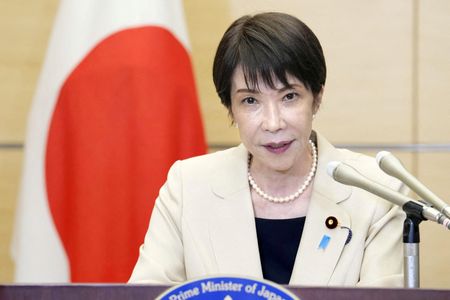
Japan's Prime Minister Sanae Takaichi speaks to the media at her official residence in Tokyo, Japan May 25, 2026, in this photo taken by Kyodo. Mandatory credit Kyodo/via REUTERS
The approval rating of Japanese Prime Minister Sanae Takaichi's administration slumped in July to the lowest level since she took office last year, the Yomiuri newspaper reported on Sunday, a sign that rising living costs were hitting her popularity.
The sliding popularity adds to headaches for Takaichi, who has seen her expansionary fiscal and monetary policy bias cause a spike in bond yields and a slump in yen to four-decade lows.
Such market pressures and opposition even from within her own ruling party have delayed the government's decision on whether and when to cut an 8% levy on food sales - a pledge Takaichi made to cushion the blow from rising living costs.
In a poll conducted between July 24 and 26, the approval rating for Takaichi's administration fell to 57%, down from 69% in June and the first time it has dropped below 60% since she took office, Yomiuri said.
The percentage that disapproved of her administration rose to 34% from 21% in June, the newspaper said.
Those polled who disapproved of her administration's efforts to combat the rising costs of living rose to 71%, up from 56%, it said.
Other recent media polls have also seen Takaichi's approval ratings slide. Kyodo news agency reported on Friday Takaichi may reshuffle her cabinet in August or September.
"Her approval ratings remain high compared to past administrations so it's not as if Takaichi's political grounding is shaking," said Kenji Yamamoto, chief market economist at Daiwa Securities.
"But it's also true the enormous political capital she gained from the lower house election victory is gradually diminishing," he said.
The focus now would be on what message Takaichi sends through the cabinet reshuffle on the direction of her reflationist policies, he added.
The Bank of Japan raised interest rates to a 31-year high of 1% in June, though real borrowing costs remain negative with inflation hovering around its 2% target for nearly four years.
Government fuel subsidies helped keep core consumer inflation below the BOJ's 2% target for a fifth straight month in June. But analysts expect core inflation to climb back above 2% later this year, as the recent surge in producer prices filters through to the broader economy.
(Reporting by Leika Kihara; Editing by Tom Hogue and Stephen Coates)
© 2026 by Asian Media Group Inc.
Recent Articles
- Trump May Need to Allow Chinese Minerals as US Industry Struggles to Meet 2027 Deadline
- China Accuses US of 'AI Hegemonism' over Potential Probe, Threatens Retaliation
- China Calls for Cancellation of US 'Forced Labour' Tariffs
- US Core Capital Goods Orders Increased Strongly in June on AI Buildout
- Amazon Leo Proposes Over 5,000 Satellites for Direct-To-Phone Service
- Modi Faces Challenge over Surveillance at India Youth Protest
- Drone Strikes on Iran's Neighbours Suggest Tehran Testing Trump Resolve
- Takaichi's Approval Rating Slides as Inflation Bites, Yomiuri Poll Shows
- Singapore's Unique Monetary Policy Needed for Trade-Centered Nation
- Nvidia in Talks to Guarantee $250 Billion in OpenAI Data Center Financing