

AI Shortens Drug Discovery to Around 1 Year in China, Insilico CEO Says
By Reuters | 24 Jul, 2026
Hong Kong-listed Insilico Medicine is enjoying an edge over traditional Western pharmaceutical giants by aggressively applying AI to drug research to cut development costs and bring medicines to market faster.
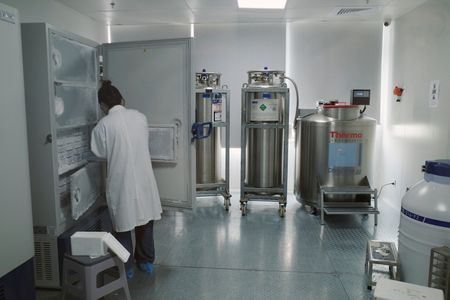
A lab technician retrieves biological samples from an ultra-low-temperature deep freezer at Insilico Medicine's research and development laboratory, in Shanghai, China, July 20, 2026. REUTERS/Laurie Chen
Hong Kong-listed Insilico Medicine has cut drug development timelines to about one year by combining AI with its China research ecosystem, its CEO said, giving it an edge over traditional Western pharmaceutical giants.
Its strategy highlights how China's growing role in global drug research, coupled with advances in AI, could further challenge established drugmakers, as the industry races to cut development costs and bring medicines to market faster.
"It usually takes about 4.5 years to get to a drug developmental candidate using the traditional approach. But if a pharma company has a research lab in China ... they cut two years of time," Insilico CEO Alex Zhavoronkov told Reuters in an interview at its Shanghai R&D facility.
"When you combine frontier AI that is proven to work experimentally with the power of China, you can significantly accelerate that. Now our record is nine months to a developmental candidate, with a typical timeline of 13 months."
Once known primarily as a low-cost manufacturer of generic drug ingredients, China has rapidly evolved into a major global hub for developing next-generation medicines, helped by lower research costs and streamlined regulation.
In China, clinical development could be conducted three times faster and at roughly half the cost of Europe, a senior Pfizer executive said last month. The U.S. has taken actions to speed up drug research to counter the Chinese biotech industry.
It typically takes 5-7 years to bring a drug development candidate to the market in China, compared to at least 8-10 years in the West.
"We now compete with Chinese pharmaceutical companies on timelines, and with traditional biotechnology companies in the West on novelty," said Zhavoronkov, whose Shanghai R&D lab has automated the biological sampling and screening process.
FOCUS ON MARKETS OUTSIDE CHINA
Insilico has partnered with major drugmakers such as Eli Lilly and Japan's Takeda on research and development. Last week, it announced a cooperation with Taiwan's Bora Pharmaceuticals potentially valued at over $2.5 billion. But no experimental medicines it is developing are yet approved for sale.
The U.S.-founded startup was an early pioneer in applying generative AI to drug discovery, and its first AI-designed drug, Rentosertib, has advanced to Phase II clinical trials.
AI has helped the company generate 31 developmental candidates over the past six years, a key milestone on the path to preclinical testing and human trials.
The firm conducts frontier AI research in Montreal and Abu Dhabi, while experimental drug validation and scaling take place in China, Zhavoronkov said. It customises and conducts post-training for foundational AI models using proprietary benchmarks tailored for drug discovery.
Despite its China presence, more than 90% of Insilico's revenue comes from Western pharmaceutical companies, Zhavoronkov said, declining to disclose a China revenue breakdown. China's lower national insurance reimbursement rates for ultra-novel drugs make Western licensing deals far more lucrative for pharma firms.
He added the company avoids selling most of its software in China because of potential geopolitical issues, although it plans to expand its Shanghai research footprint in future.
Zhavoronkov, however, warned of how wider AI adoption could disrupt workforce and resource deployment across the biotech industry, as companies automate more research and software functions.
"In my organization with 400 people, I can probably displace 40% easily on the software side," he said, adding that laboratory bench scientists and software engineers at his firm are being retrained to manage AI benchmarks and robotics.
(Reporting by Laurie Chen in Shanghai, additional reporting by Andrew Silver in Shanghai; Editing by Miyoung Kim and Kim Coghill)
© 2026 by Asian Media Group Inc.
Recent Articles
- Aerospace Fights for Young Recruits as AI Drains Talent Pool
- Nvidia, Microsoft, IBM, Meta Back Open-Source AI Models
- Suit by US Small Businesses Challenges Legality of Trump's New 'Forced Labor' Tariffs
- Asian Men Get to Be Fun and Sexual in New Hulu Series
- Lee to Visit SF to Meet Tech Bosses, Unveil Major Samsung, SK Hynix Chip Deals
- AI Shortens Drug Discovery to Around 1 Year in China, Insilico CEO Says
- Weapons Tech Firm Anduril Raises Valuation to Lockheed, Northrop Levels
- Verizon Lifts Annual Forecasts as New Mobile Plans Spur Subscriber Gains
- Volkswagen Sees Need for Deep Price Cuts as Chinese Competitors Close in on Europe
- AmEx Raises 2026 Revenue Growth Forecast as Affluent Cardholders Keep Spending