

Asian Identity Thriller: Midnight in Karakorum - Part 2
By Tom Kagy | 27 Jul, 2026
The President receives two pieces of shocking news from Silicon Valley.
Tom Kagy (00:00:01)
Hello, this is Tom Kagy with Unconventional Wisdom.
Any chess player knows that capturing the Queen is one of the quickest ways to dominate the board for almost certain victory.
You might say the white queen in the chess game that Jack Tang sets in motion in Midnight in Karakorum is First Lady Megan LaChapelle Taylor.
But Chip Garrison, special aide to the president is under the impression he's playing an entirely different game in which he's the joker designated as the wild card.
Garrison's entry into the game is one factor Jack Tang may have failed to consider when he conceived his grand scheme to tilt the global order in his favor and secure return of the woman who gave him life, as well as his own ultimate freedom.
So here then are Chapters One and Two of Midnight in Karakorum.
Chapter ONE
Yes, the decision would seem selfish and unpatriotic—maybe even stupid—but it was the only one she could live with.
Even if it hounded her to the grave.
Would she survive the firestorm when it became public Monday? The First Lady quaked at the thought. It couldn’t be as bad as the hell of the last three years. Nothing could be as bad as that.
The face in the double-layer of Plexiglass stared back as the chartered 707 rolled up to the V.I.P. gate. In those rainwater-blue eyes Megan Lachapelle Taylor saw only the despair of a middle-aged woman who had lost herself. Where was the celebrated beauty and glamour?
After the weekend there would be no more cause to dazzle crowds and cameras with a radiance fueled by her soul’s nuclear decay, no more stifling her rage to keep from rocking the ship of state. That promise of liberation gave Megan the will to unbuckle the seatbelt and descend the stairway for the limousine sweep into downtown San Francisco, the first stop of a California fundraising swing.
The six-minute speech to a sea of rounds of ten was followed by the main ordeal—a numbing series of handshakes with cooing trial lawyers in their best Brioni suits while a strobelike barrage of flashbulbs kept her blinded. What could wow a client more than a photo of his lawyer shaking hands with the First Divorcee? The thought gave a moment of life to Megan’s fixed smile. The fawning faces kept coming and the ten minutes agreed to by CTLA’s honchos ran over by five.
After escaping the trial lawyers the entourage made up the lost minutes by taking advantage of a CHP motorcycle escort. The Benz stretch-limo, courtesy of old friend Jack Tang, rolled into the driveway of Palo Alto’s Gold Lion a scant half-minute behind schedule. To Megan’s disappointment Jack wasn’t there to escort her in. In his place was a balding, paunchy chip fabricator she recognized as Logan Chu, another leading Asian American contributor. He clasped Megan’s hand, gave her a proper airkiss and, beaming like a proud father, escorted the First Lady into a gigantic ballroom packed with, Megan guessed, two and a half million in contributions.
“Jack should get here before you finish your talk,” whispered Chu into Megan’s ear, and left her at the podium to face a warm standing ovation, the heads filling the ballroom rising like a black tide.
“My dear friends of the Asian American Technology Association,” began the First Lady as she had begun a hundred speeches before crowds of adoring strangers. Among the many feelings that had brought these six hundred overdressed people to this ballroom was patriotism which, as the crowd showed, crossed racial lines. No matter what the future held for her, Megan felt obliged to touch them one last time as their First Lady.
The speech lasted nearly eight minutes, having been augmented by over a minute of extemporaneous remarks about her admiration for what Asian Americans had contributed to California’s prosperity and to the global economy.
“I will never be able to think of the great state of California, without remembering my dear friends of the Asian American Technology Association.”
An instant before her final few words found the audience, the microphone died. As Megan sensed the fading of the sound system, the cavernous ballroom went dark. From the tables rose a murmur of uncertainty, followed by humorous catcalls to strands of laughter. No one seemed worried. The Gold Lion was a major hotel. Surely someone would soon find the circuitbreaker switch or, if this were a power failure, switch on the emergency generator.
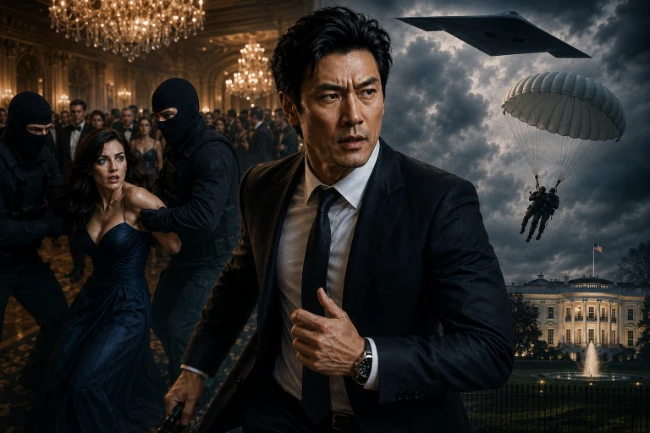
Determined to set an example by her composure, Megan waited patiently at the podium. Suddenly she heard a quick silent struggle behind her where two of her Secret Service agents had been standing. She felt strong hands grip her arms and pull her backward from the podium through the heavy velvet curtain. Before she could speak, a gloved hand clamped her mouth and she felt herself lifted off her feet. Her captors handled her with such sureness that struggle felt futile. The speed of their passage through the blackness suggested they were wearing infrared goggles. Megan felt herself being carried down a long flight of steps. Her terror rose into a scream stifled by the gloved hand clamped over her mouth.
An engine roared to life. The darkness was sliced by the headlight of a black van lurking in the underground utility access area. As she was shoved into the van, Megan glimpsed the face of one of her abductors, a muscular Asian wearing a black tuxedo like every male guest at the fundraiser. As the van squealed away in a violent arc, she struggled to stay up but was thrown back by the surge of centripetal acceleration. She felt a sting in her left upper arm, a spreading ache, then the slow spinning she recognized as the effect of a hospital-grade barbituate injected into the bloodstream.
Chapter TWO
Midnight at the White House in more ways than one, mused Special Aide Chip Garrison as he rode the elevator to the second floor of the Mansion.
Garrison dreaded what he would find in the bedroom. The President was having a very late tea with the purported daughter of the Chinese Ambassador. Ah, the stories that cold cups of tea could tell! Garrison took a quick breath before rapping hard on the thick white door. No answer. Well, here was a once-in-a-lifetime opportunity to unleash his voyeuristic impulses, test out his theories about the President’s sexual predilections vis-à-vis a 24-year-old Chinese beauty.
Garrison gripped the oversized doorknob. About time someone helped the Boss see that the White House wasn’t the No-Tell Motel. It wasn’t every day that a midnight barge-in squared with Emily Post. What had just happened out in California screamed for the President’s attention, the learned Ms Post would agree, and the man had ignored Garrison’s urgent phone calls. That could mean only one thing—the President was screwing his brains out.
With another quick breath, Garrison pushed open the tall door and shouted, “Excuse me, Mr President.” After stealing an eyeful of the President and his tea guest engaged in an act that Garrison wasn’t sure he could pull off, he politely turned toward the far wall where a handsomely-framed John Kennedy was watching the noisy thrashing with what Garrison decided was fond remembrance. The thrashing stilled as both heads jerked toward the intruder.
“For Sweet Jesus’s sake, Chip!” panted the President.
Garrison kept his gaze on John Kennedy as he delivered the news. “The First Lady has been kidnapped. And Jack Tang has been murdered.”
“Dear God!” The President untangled himself—with unseemly reluctance, it seemed to Garrison—and swung his feet around to sitting position. “What do we know?”
“She was speaking at a ballroom of the Gold Lion Hotel in Palo Alto, you know, the AATA fundraiser. The lights went out, total blackout. By the time the Secret Service restored power, she was gone.”
“What about Tang?”
“He was supposed to have been at the fundraiser. Never showed. Right after the abduction his secretary Alice Chen rushed to his Los Altos Hills estate and found his body. Messy killing, quite photogenic.”
The tea guest retrieved silken things and slipped into the bathroom as the President pulled on boxers and plopped into an armchair. “What’s our involvement?”
“What do you mean, Sir?”
“Just what I said,” snapped the President. “What’s our involvement?” The President’s eyes locked on Garrison’s.
“None, Sir.”
“None?”
“None.”
The President held the gaze. A sinking feeling came over Garrison as he understood what the Boss was asking. Did the President really think he would have had the First Lady abducted just to spare him a reelection-killing divorce?
Would his father have done something like that in service of his president? All Garrison knew was that his father wouldn’t have blinked before throwing himself in front of a bullet, especially the ones shot from a rifle that late November day in Dallas. No doubt of that in Garrison’s mind. His father had finished out his unhappy life nursing a dark grudge against the Secret Service Director who had kept him from that fateful trip. But would his father have sacrificed his own moral code in the service of his boss? Chip Garrison couldn’t really say.
At six a.m. Friday morning, barely six hours after the President had been rudely interrupted in flagrante delicto, four staffers sat before him in the Oval Office. To the President’s bleary eyes they were a picture of high-level beetlebrowed befuddlement. Chip Garrison wasn’t among them, in accordance with the President’s desire to ensure that his special aide maintained a detached perspective, to offer off-record options and to keep everyone else honest.
During the first of his two senate terms, as the youngest senator in history, the President had learned to second-guess the motivation of his collective staff. Forced constantly to jostle for position, the egoes of ambitious functionaries often tricked them into substituting their own self-interest for their boss’s best interest. On top of that, it was inevitable, really, for them to acquire a vested interest in proving out their boss’s incompetence and worst nature. How else could they prove their own value to him? At the same time, the President well knew he needed all these other eyes and ears, hands and mouths, to be involved enough to carry out intelligently the hundred routine but necessary tasks that could otherwise keep him buried in a bewildering array of minutiae, unable to provide the sound judgment that could only be exercised from the still eye of the storm.
Several pots of caffeine poured into their systems had produced consensus on one point at least—the President must cancel the Tokyo summit and remain in Washington D.C. until the First Lady’s abduction was resolved one way or another.
“You’re a concerned husband first, the President second,” declared Belinda Bosch, the President’s brand-new press secretary. Only her second day on the job and already the green-eyed, button-nosed blond was burning whitehot with the excitement of burnishing a president’s tarnished image. “Tokyo is important, but you’re far too focused on ensuring the First Lady’s return to worry about foreign policy. You’d better lose the coat and tie for the morning’s press conference, let them know you’ve been up all night.”
Who was he to argue with a gal who had performed a triple bypass on a stricken gossip rag and rebuilt it into the nation’s fattest monthly, mused the President? What lent that feat real poignance, in his eyes, was that it had been done while keeping her lithe little 35-year-old body in remarkable shape. Delectable shape. Temptingly packaged, too, in a red Calvin Klein mini-suit.
“Maybe we should play down the Jack Tang murder,” offered Chief of Staff Brock Reiner between gulps of coffee. “I’m not sure it helps the President to have people think the kidnapping has some sinister connection to his Asian supporters.”
His oversize tortoise-shell glasses made Reiner’s large brown eyes look even larger as they scanned the other faces in the room. The 36-year-old boy wonder had been tapped for his cerebral wattage. Unfortunately, it tended to shine mostly on the meat-and-potatoes side of the presidential terrain—a weakness alarming to a president entering the final five months of a reelection campaign. A streetfighter was needed and Belinda Bosch’s political reflexes had been sharpened in the canyons of Manhattan where fact was a four-letter word and sudden death, a fact of life. To her, Brock Reiner—with his bulging, prematurely-balding frontal lobe—was Bulb Boy, an assessment that jived with the President’s own. But that only enhanced Reiner’s appeal. The President liked being undisputed cock-of-the-walk.
“But everyone knows he’s my closest friend.” The President still had trouble believing Jack Tang was dead. The man had been more alive than virtually anyone he knew. A pang of guilt racked Frank Taylor as he recalled the private lunch with Jack the day before his murder. Tang had flown across the country and practically begged him to ask Defense Secretary Gerald Fletcher to grant an exemption from the ban on foreign travel imposed by Tang’s deep black Pentagon contracts. The President didn’t know the precise nature of the work Tang’s firm was doing, but he had refused. Out of concern for national security and Jack’s own safety, the President had told himself, but he recalled all too well that a more immediate concern had been to keep from compromising himself politically by calling attention to his cozy relationship with a wealthy Pentagon contractor, even if the favor could have attracted the notice of only a handful of people at the Pentagon, the CIA, the FBI and the State Department’s Passport Office.
“The Asian community would be offended if the President didn’t show real grief at Tang’s death,” said Bosch. “We must play up the personal double tragedy, the loss of a wife and a best friend. That will immunize the President against political attack for at least a few weeks, maybe through the election.” Only decorum kept a gleeful smile off Bosch’s pretty face. Since taking the press secretary job, her biggest headaches had been the President’s uncontrolled libido and failed relationship with the First Lady. Now a generous god had eliminated both problems with a snap of the finger, giving Bosch the far headier challenge of positioning the President for what looked to be the biggest landslide in Presidential election history. There was a special place in American hearts for grieving presidents. At the moment Bosch’s secret worry was that the damned FBI would somehow recover the First Lady safe and sound before November.
“I agree one hundred percent,” blurted campaign manager Daryl Delgado who had been nodding vigorously to everything Bosch said.
“But we can’t have a President debilitated by this tragedy,” protested Reiner. “That could backfire, especially with all these hotbutton social and economic issues Bartlett fired up the last two weeks.” So far Republican presidential nominee Nancy Bartlett had refrained from attacking the President below the belt, but everyone in the White House had been turning blue waiting for the other shoe to drop. Meanwhile, Bartlett had been laying the groundwork by blaming the President for contributing to a precipitous decline in America’s moral standards.
Bosch flapped her hand dismissively, barely giving Bulb Boy the courtesy of a glance. “Is Bartlett dumb enough to attack the President when he’s in pain? I don’t think so. Not for months. She’ll be falling all over herself to express sympathy and support in his hour of grief.”
“Agree one thousand percent,” added Delgado, nodding like a maniac. “Mr President, any chance we can get Bryce up here in time for the press conference? A good-looking First Son’s good for a couple of points.”
“Let’s leave him out of this.”
“Just a thought.”
Penn Stoner, the President’s speechwriter, had been quietly doodling and chewing his pencil. Sensing a lull in the discussion, he ventured, “So we want to lead with the kidnapping, then touch on Tang toward the end?”
“Not just touch on,” insisted Bosch. “The man is dead, for god’s sake. He would have been the second coming but for this tragedy. That will score major points with the Asian community.”
“Absolutely,” agreed Delgado. “Asians are thirteen percent of the California vote.”
“Tang was a Pentagon contractor, for Christ’s sake,” blurted Reiner. “How sympathetic can the voters be about a man who got filthy rich on weapons systems? It will only raise questions about the President’s connections.”
“I had nothing to do with his contracts,” said the President firmly. “Jack was totally self-made—lawyer, software genius, businessman. His company makes video games, you know. We don’t have to talk about the defense contracts.”
“The press will dig up the defense contracts sooner or later, what with the murder investigation,” persisted Reiner. He was deeply worried about the Tang connection. “Maybe we can fudge it for now by saying ‘software company’.”
“Speaking of investigation,” said the President, suddenly anxious to be done with this particular meeting, “When is Hanson getting his creaky old ass over here?”
As if on cue, the President’s secretary ushered in a tall pasty-faced man with pale thinning hair and blue eyes glittering with suspicion. The President jumped up to shake Samuel Hanson’s bony hand, noting once again how warm and dry they were. That impenetrable steadiness, in the President’s admiring view, came from the fact that Hanson was completely devoid of political impulses. Wonder of wonders, a man of unusual field skills and absolute integrity had ended up in the FBI’s top job. As much as he found the crusty old codger a pain to meet with, the President couldn’t fault his Republican predecessor’s choice for FBI Director.
“We can’t tell you much yet about the kidnapping,” began Hanson, without waiting to be asked. He seemed to inhabit a world in which he was always the epicenter. “Smells like Americans to me.”
“How so?”
“Tell you why, Mr President.” Hanson leaned forward confidentially, and pointed a thick finger at the President, fixing him in his red-rimmed gaze. “Planned and timed right down to a split second. No wasted motion. Nothing left behind, not one print. Only one nation on earth with operatives trained for that kind of quality work.”
“Maybe Americans working for another nation?”
“Maybe. Maybe not. Tell you one thing, though.”
“What’s that?”
“She’s safe. For now anyway.”
“How do you know?”
“Anybody invests that much effort and planning to take her alive wants her safe. Killing her would have been a cinch. Hell, any clown could have done that anywhere along her route.”
“When will you know more?”
“Can’t say yet. Maybe not until they make a demand. That’ll give us something to go on.”
“How many agents do you have on the case?” Reiner asked.
“What difference does it make?” Hanson snapped without turning to look at him.
“I was just wondering.”
“Don’t worry about how many agents we got on it. Worry about not helping them by asking too many fool questions, the answers to which don’t mean a damn to anyone but them.” Hanson cut Reiner a stern look before resuming his focus on the President.
“Now on this Tang murder, they got a suspect, last guy seen with Tang last night. According to Fletch’s boys at the Pentagon, the security agents they had staking out the Tang place didn’t see anyone else going into the house that evening.” After a long pause, Hanson pulled a sour face. “I don’t like him though.”
“Why not?”
“Stinks.”
“When you say he stinks—?”
“Doesn’t smell like a murder suspect. Name’s Robert Rosefall, a lawyer who publishes some Chinaman magazine, married, two kids, lives in Malibu. Tang’s secretary says he was at Tang’s place doing an interview. Thinks they were old friends. Doesn’t fit my notion of a murderer.”
“Any motive?”
“California boys are cooking up some silly blackmail theory.” Hanson rolled his eyes. “Dumbest thing I ever heard. Unfortunately, they may make it stick.”
“Why do you say that?”
“County DA’s up for reelection. This case looks like his ticket, biggest thing to hit the Bay Area in years. He’ll nail someone, doesn’t much matter who.”
“How awful,” gasped Belinda Bosch.
Hanson ignored her. “Seeing as how Tang was a highly classified contractor, we’re doing a routine espionage workup. If we turn up anything, we’ll make it a federal prosecution before those California boys make a mess of it.”
Suddenly the President recalled the evening a good twenty years ago when he had gone drinking with Tang and Rosefall, but decided there was no point in mentioning that connection. He stood and shook Hanson’s bone-dry hand.
“Fax me a daily memo on your progress,” said the President, more for show than anything. If anything significant turned up, his Special Aide Chip Garrison would brief him hours before the crusty codger would get around to faxing him a memo.
© 2026 by Asian Media Group Inc.
Recent Articles
- US Bans New Chinese Humanoid Robots to Protect US AI Buildout
- AI Glasses Key to EssilorLuxottica H1 Profits Beat
- Human Trafficking Surges into Asian Scam Centers
- High-Tech Manufacturing Hubs Pull Ahead in China's Uneven Growth
- Keiko Fujimori Takes Power in Peru
- India's June Industrial Output Grew Fastest in Nearly Two Years
- Persistently High Inflation to Stay with Global Economy Say Economists
- US Trade Deficit Stayed Elevated in June As Imports Jumped 16.6% on Year
- Top Stakes Held by Chinese Investors Subject Mercedes to Possible US Sales Ban
- BYD Launched EV Mini-Car in Japan