

Did China Crash 2 US Aircraft into South China Sea?
By Goldsea Staff | 27 Oct, 2025
The fact that both aircraft were operating from the USS Nimitz and crashed within 30 minutes of each other raises questions of possible electronic or microwave interference by China which claims sovereignty over the waters.
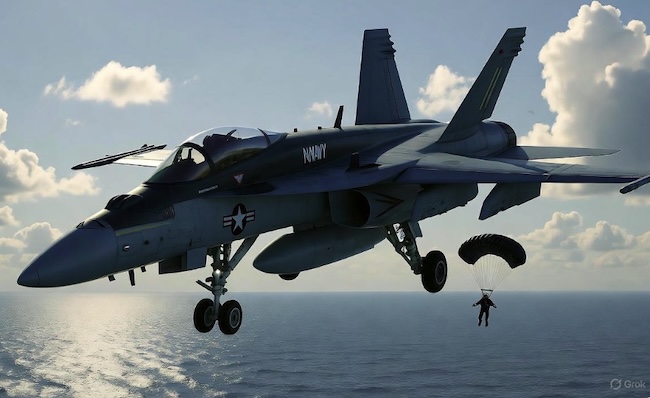
Artists conception of a US Super Hornet fighter ditching in the South China Sea. (Image by Grok)
On October 26, 2025 two U.S. Navy aircraft—a MH-60R Seahawk helicopter and an F/A-18F Super Hornet fighter jet—crashed into the South China Sea in separate incidents approximately 30 minutes apart.
Both were operating from the aircraft carrier USS Nimitz during routine training exercises. All five crew members were rescued safely with no serious injuries.
The coincidence of both planes were operating from the USS Nimitz carrier and crashed so close together in the South Sea raised suspicion that the crashes were induced by some form of electronic interference by China due to its repeated warnings to the US against operating in what it considers its sovereign territorial waters.
The U.S. Navy has initiated investigations into the causes, with early indications pointing to possible mechanical issues such as contaminated fuel. President Trump stated there is no suspicion of foul play, and China has offered humanitarian assistance while criticizing U.S. military activities in the region as destabilizing.
No official reports or evidence suggest external interference, including from China. Social media discussions include speculative claims of Chinese electronic jamming or cyberattacks, but these appear unsubstantiated and anecdotal.
Grok:
### China's Relevant Technological Capabilities
China does possess advanced technologies that could theoretically disrupt or down U.S. aircraft systems, potentially leading to crashes without overt physical damage. These fall into two main categories: directed energy weapons (DEW) and electronic warfare (EW) systems. Below is a summary based on publicly reported developments as of 2025:
Technology Category Key Examples Capabilities Relevant to Aircraft Crashes Limitations/NotesDirected Energy Weapons (DEW)- High-Power Microwave (HPM) guns (e.g., systems unveiled in 2025 capable of disabling electronics). - LY-1 laser system (ship- or land-based, 10-30 kW output). - LW-30 road-mobile high-energy laser (HEL).- Emit focused microwaves or lasers to fry avionics, sensors, or engines from afar (e.g., downing drones or missiles at ranges up to several kilometers). - Could cause mid-flight failures in helicopters or jets by overheating critical components, mimicking mechanical breakdowns.- Primarily tested against smaller targets like UAVs; scaling to manned fighters like the F/A-18 would require higher power or proximity. - Line-of-sight dependent; less effective in adverse weather or at long ranges over water.
Electronic Warfare (EW)- J-15D carrier-based EW fighter (deployable from Chinese carriers). - J-16D multirole EW aircraft. - Ground/ship-based jammers (e.g., systems creating fake radar targets or "kill lists" for U.S. carrier radars/sensors).- Jam GPS, radar, communications, or flight controls, leading to disorientation or system failures (e.g., spoofing navigation to induce stalls). - PLA doctrine includes targeting U.S. Navy carrier groups' electronic vulnerabilities, potentially causing cascading failures in coordinated ops like those from the USS Nimitz.- Effective in the South China Sea due to China's A2/AD (anti-access/area denial) networks, but U.S. aircraft have countermeasures like hardened electronics. - Would likely be detectable post-crash via telemetry analysis.
These capabilities have been showcased in Chinese military parades and exercises, with a focus on countering U.S. naval superiority in the South China Sea. For instance, HPM systems could disable aircraft electronics non-kinetically, while EW platforms like the J-16D are designed to create "electronic nightmares" by overwhelming U.S. defenses.
### Assessment: Could China Have Caused the Crashes?
- **Theoretical Feasibility**: Yes—DEW or EW could plausibly induce the observed crashes by disrupting flight systems subtly, especially in a contested area like the South China Sea where Chinese assets (e.g., surveillance ships or EW aircraft) operate routinely. The proximity of the incidents (30 minutes apart) aligns with scenarios involving persistent jamming.
- **Evidence of Involvement**: None. U.S. statements emphasize internal causes, and China's response was cooperative rather than evasive. Investigations are ongoing, but preliminary findings rule out sabotage.
- **Likelihood**: Low, given the lack of escalation signals and the U.S.'s attribution capabilities. Such an action would risk severe diplomatic/military backlash, especially amid U.S.-China tensions over Taiwan and trade.
In summary, while China has the tech to potentially cause such events, there's no basis to conclude it did so here. The crashes appear accidental, but they underscore vulnerabilities in high-tempo ops near adversarial forces.
© 2025 by Asian Media Group Inc.
Recent Articles
- Ohtani’s Baby Boom, Kim’s Birthday Celebration, and World Cup Updates
- Become an AI Bonus Baby—or Just Get Paid Like One
- Ferrari Denies Requiring Luce EV Purchase to Access Limited Edition Models
- SpaceX Turns to Bond Sale to Fatten $100.8 Billion Cash Stash
- Google DeepMind Signs AI Research Deal with Film Studio A24
- China's 618 Shopping Festival Sees Flat E-Commerce Sales from Cautious Shoppers
- Amazon Prime Day to Gauge US Consumer Strain as Focus Shifts to Basics
- China Closing in but US Still Leads in Biotech Innovation
- EV Surge Likely to Cut Oil Demand by Late 2027
- Kunal Shah tapped to Lead Meta's WhatsApp