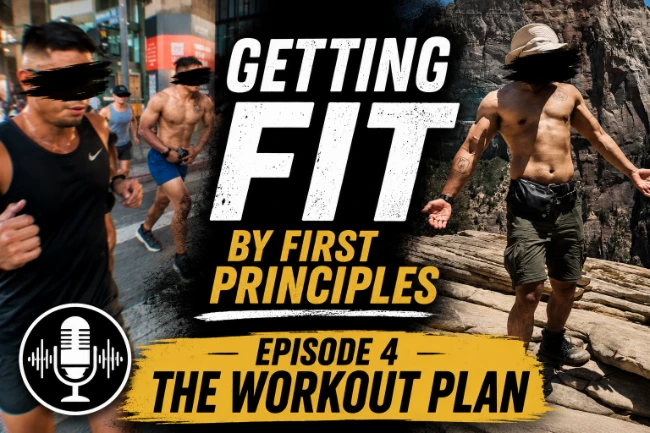

Getting Fit by First Principles - Part 4 - The Workout Plan
By Victor Wong | 08 Aug, 2026
Victor (00:00)
Okay, if you've made it this far, you have sat through about thirty plus minutes of me yapping about the philosophical backings behind working out. In this episode I want to discuss like more practical considerations. What is the actual work that I would do in the gym and what I would recommend?
Victor (00:22)
So there aren't that many exercises you really need to perform. I would say there are about six families of exercises that a complete holistic program will have included, with a seventh category being the bonus.
Victor (00:45)
To really simplify it, all you really need is a vertical push and pull movement, a horizontal push and a pull, a lower body push and a pull, which is defined as a hinge or a squat, and the bonus category will be forms of locomotion. Think sprinting, long distance running, walking, and the classic loaded carry.
Victor (01:16)
Now, going down the list of movements I have just defined, I will start to give examples and things that I choose as my personal favorites. Really, when constructing your own movement practice, I would recommend simply finding exercises that you find enjoyable before you think about what is the most optimal.
Victor (01:40)
At the end of the day, the human body is a complex and beautiful machine that responds to effort. And if you pick movements that you enjoy, then you will likely put more effort into your workout. And the more you enjoy your workout, the more likely you are going to stick with it for an extended period of time, giving your body time to adapt.
Victor (02:02)
So
starting off with probably my favorite class of movement, the vertical pull. This is going to be things like pull-ups or the lat pull-down machine at the gym.
Victor (02:18)
Weighted pull-ups are probably my favorite form of vertical pull. Now I understand that most trainees probably aren't strong enough to incorporate weighted pull-ups, but there is something to be said about doing a lot of sets of pull-ups for a low number of repetitions, say one to three.
Victor (02:42)
Vertical press will be something like your overhead barbell press or a dip. This is also a favorite movement class of mine. I am personally a big fan of weighted dips and overhead press.
Victor (03:00)
Next up, you have exercises in the horizontal plane. Imagine yourself being parallel to the floor. So you have your horizontal presses, which will be things like your flat dumbbell or barbell bench press, which is my personal least favorite type of exercise.
Victor (03:23)
And then you'll have a horizontal pulling movement, which will be things like your chest supported row and row and bent over row variations, which can be done with either a barbell or
Victor (03:38)
Finally, we move on to the lower body, which does have its own version of push pull, namely a squatting movement pattern and a hip hinge movement pattern, things like your deadlifts or just simply bending over and picking things off the floor.
Victor (03:55)
Now
I have to give an honorable mention to quadricep and hamstring isolation exercises such as the leg extension or the laying hamstring curl. While those are useful movements, I view them as supplemental to a squat or a heavy deadlift.
Victor (04:19)
Although one addendum to the hip hinge, I will comment that an exercise called the glute ham raise or the nordic curl is actually a very, very useful exercise when it comes to athletic development and the prevention of knee pain, but that can be for a different podcast entirely.
Victor (04:45)
Now the final class of lower body exercise. I classify these as locomotion, right? Think of your long distance running, your walking, your sprinting, and a loaded carry, meaning you are picking up a heavy object and then moving with it.
Victor (05:09)
I would say these are also very, very beneficial to do just one time per week, but I will go into that later.
Victor (05:21)
So backtracking through the classes of exercise, I will now go over my top picks for each category. As far as vertical pulling goes, you cannot go wrong with a simple pull-up and chin-up and all their variations. You can do them with different tempos such as slow eccentrics, you can do them explosively, you can work towards more skillful variations such as the muscle up or the one-armed variation, and you can also add weight to them.
to build up strength in the upper body. As far as exercises go, there you cannot go wrong with having a pull-up in your program.
Victor (06:07)
So as far as vertical pressing movements go, my picks are a toss-up between the barbell overhead press and the dip, and of course their variations.
Victor (06:21)
I will have to give a slight edge to the dip due to the ease of access when compared to movements such as the barbell overhead press, which requires a barbell and weights.
Victor (06:37)
So there are many paths you can take with the dips similar to the pull-up. You can do them weighted, you can do them with different tempos. The world is your oyster when it comes to these two calisthenic movements. And also eventually upgrading to ring dips, which again I would say is an infinitely scaling exercise.
Victor (07:00)
As a bonus, there is an exercise that combines the best of both worlds of a vertical pull and a vertical push, and that would be a ring muscle up.
Victor (07:12)
The ring muscle up is an explosive pull-up performed on rings that propels the athlete into a ring dip.
Victor (07:25)
I
will say anyone that can perform a ring muscle up has a very impressive looking upper body.
Victor (07:35)
I
will say the road to get to a ring muscle up is long and hard, but by embarking on this journey, it will absolutely change your upper body.
Victor (07:47)
Personally, I haven't embarked on my gymnastics ring muscle up journey as I am preoccupied with developing other physical attributes. But I will say that is on my personal fitness bucket list.
Victor (08:06)
Now it's time for my least favorite class of exercises, and that would be the horizontal push and pull.
Victor (08:12)
For a horizontal pulling movement, the best ones usually involve a barbell, so it would be variations of chest-supported barbell row or barbell or just normal barbell rows. There are body weight horizontal pulling motions, such as the Australian pull-ups, as they call it, or the inverted row.
Victor (08:43)
My main issue with inverted rows it comes from scalability. I find that most trainees reach a point of diminishing returns very quickly as they become strong in the movement. And to progress beyond the novice level, that involves a high degree of skill work. Personally, I'm working on what is called a front lever, which is a very, very huge jump from performing sets of ten inverted rows.
Victor (09:14)
All that being said, the best horizontal rowing movements will be locked behind equipment access as bent over barbell rows and chest supported rows are the king of horizontal pulling movements.
Victor (09:32)
Now for horizontal pushing, the best exercise is the classic barbell bench press and also variations such as the dumbbell bench press.
Victor (09:45)
Personally, I was always a poor horizontal presser and I don't really bench press. I do work on horizontal pushing through harder push-up variations such as the pseudo planch push-up and other horizontal pushing type skills such as the tuck planch, but again, these are very, very big jumps from the
Classic push-up and again similar to movements such as the inverted row, a push-up becomes very, very easy to perform after a short amount of time. So reaching failure point becomes harder and harder as trainees become more advanced.
Victor (10:36)
Now, my top picks for the lower body, right, have to are under the hinge and squat variations. And as such, the classical squat and deadlift will be the king of lower body exercises. Everything else is an accessory. Yes, you can technically perform things such as leg pressing rather than a squat.
However, I do believe that the path to learning how to squat and to squat with good form under load is a very valuable skill.
Victor (11:13)
A
funny anecdote, just the other day my friend had a flat tire in the parking lot, and what I had to do was I got into a very deep squat and operated the carjack in order to lift his car up and off the ground. So there is something to be said about being able to hold a deep squat.
Victor (11:37)
But anyway, I don't think you can go wrong with any type of squatting variation. Single leg squat, normal squats, barbell back squat, barbell front squat. I would say the barbell back squat is probably the most infinitely scalable direct leg exercise out of all the squat variations.
Victor (12:01)
Honorable mention would go to the front squat, however, there are some skill and mobility restrictions that will prevent a lot of people from front squatting unless they do the proper skill building work that it would take. Whereas most people can learn how to back squat in a relatively short amount of time.
Victor (12:24)
Now finally probably my favorite class of exercise is the hip hinge. Particularly the barbell deadlift is probably my favorite lift.
Victor (12:37)
As far as building raw, full body strength, I don't think I've seen any exercise ever come close to the deadlift as a standalone exercise.
Victor (12:51)
The only reason I don't currently practice my barbell deadlift is just due to a simple lack of equipment. At the moment, I haven't been able to train on a barbell consistently for a number of years, which is why I haven't really put much time into the deadlift recently. However, all the years I spent in my 20s practicing the deadlift has yielded great results for me.
Victor (13:17)
Course, now that I mention hip hinging, I do have to mention or list some honorable mentions when it comes to hip hinge exercises. Things like the barbell clean and jerk, the barbell snatch, kettlebell jerks, kettlebell snatches, kettlebell swings, kettlebell cleans, etc. etc. are all good exercises. However
I'll
say the barbell variations that you see in the Olympics, like the barbell clean and jerk and the barbell snatch, are very high skill movements. If you can find the time to master the skill of clean and jerking and snatching, you will develop very good rate of force production.
Victor (14:06)
But again, as I mentioned in previous episodes, if learning the Olympic lifts don't fit into your vision of what a capable body is, then you know you don't necessarily have to do it.
Victor (14:25)
Course I have to mention the things that I do personally, and at the moment, because of accessibility, I have been interested in the sport of kettlebell lifting, oftentimes referred to as kettlebell sport, and also sandbag lifting, which is a niche niche lifting practice.
kettlebell sport is similar to Olympic lifting, but rather than performing the clean and jerk and the snatch with a barbell, you perform them with two kettlebells and you perform sets for time rather than trying to load the most weight possible.
Victor (15:14)
kettlebell sport does take a long time. And also there is a pacing element to it. I can probably make another podcast about this, but I don't consider myself knowledgeable enough on the subject to.
I have made a lot of friends online in the Kettlebell Sport community, which has made learning this niche lifting practice very fun.
Victor (15:43)
Now
tangentially related to the lower body, I mentioned this idea of a locomotion, right? This is running, walking, and carrying.
Victor (15:58)
So
each of these forms of locomotion have their own benefits and I say that it is important for your body to be capable of all of them. And where it fits during your week is up for debate.
Victor (16:16)
I will say for the amount of benefits you get relative to the time invested, carrying or weighted locomotion as I like to call it and sprinting tend to be the most high in terms of again return on investment per time.
Victor (16:34)
Low
intensity variations of locomotion, right, such as light jogging and walking, I find need much more frequency for you to see any benefit, right? I find that if I only really run one time a week, it doesn't really benefit me as much as running, you know, two or three times per week.
Victor (16:53)
However, with sprinting, I've seen people gain benefits from as little as one time per week. And in myself as well, I've noticed massive benefits to my cardiovascular output from just sprinting one time per week. And in a lot of ways, sprinting just once per week is desirable because it is very high stress to the body.
Victor (17:18)
Weighted carries can be just as stressful as sprinting if you load up the weight and the pace to similar degrees.
Victor (17:26)
Even though locomotion has a lot of benefits, I typically consider it extra credit. most people can live a relatively healthy lifestyle without it so long as you follow the advice of earlier podcasts and walk your 10,000 steps per day.
Victor (17:46)
But I will have to say that only five all-out efforts on sprinting can have massive benefits. And the total amount of time that it takes to complete those is about less than a minute. Obviously, if you include a proper and thorough warm-up, the entire workout would take an hour. But again, it's just one hour.
Victor (18:11)
As far as my own personal exercise selection, I put a lot of emphasis on the weighted pull-up, the double kettlebell overhead press, and I use calisthenic skills such as the 90-degree hold and front lever to work on my horizontal pressing and pulling.
As far as my legs go, I like using movements such as the sandbag to shoulder and sandbag squat, as well as accessories such as the quad fallout and the glute ham raise.
Victor (18:51)
I've also started to run about three times per week. I have a three mile session, a six-mile session, and then a ten to thirteen mile session on the weekends.
Victor (19:03)
I've personally built up a lot of capacity through years of training, so this isn't something that I just dec rolled out of bed one day and decided to do.
Victor (19:12)
But to summarize my list of exercises, right? Get good at pull-ups, dips, bench press, bent over row, squat, deadlift, and maybe sprint one time per week. And you can't go wrong.
Victor (19:32)
Now I don't want to go into too much detail as far as programming goes because that can be another podcast in itself. But how I would structure a basic week of training off of these movements would be something like a dip, a bent over row, and a deadlift on one day, a squat pull-up.
and horizontal push like a bench press on your second day and then a third day of upper body so it could be any combination of your upper body pressing or pulling and then a fourth day that is dedicated to sprinting. So off the top of my head that is a very very basic outline of a program that will take many trainees
Far.
Victor (20:30)
In
the next installment I can go over my own personal thoughts on how to lay out a training program.
© 2026 by Asian Media Group Inc.
Recent Articles
- Hormuz Straight Talk Remains Elusive
- Is Rajeeb Hazra's Quantinuum the Quantum Computing Startup to Beat?
- Rajeeb Hazra Partners Quantinuum with Oracle to Bring Quantum Computing to Cloud
- Trump Media Quarterly Loss Jumped 11-Fold to $238 Million
- Cheap Meals No Longer Do the Trick for McD, Rivals
- Joby Acquires Defense Tech Company for $500 Million
- Disney Wins Global Streaming Rights for Formula E Races
- Bumble Eases Women-First Messaging Rule as Dating Apps Seek Engagement Boost
- Nvidia Is Developing Nemotron 4 Open-Source Models
- US Human Rights Groups Sue Trump over Anti-ICC Push
Other Asian Media Group Sites
- AsiaMs.net — Asian American Women's Resource
- AsianSports.net — Asian American Sports and Fitness
- VoxCali.com — Videos and Podcasts for Asian Americans
- MyGoldScene.com — Guide to Asian Entertainment
- AttheBanquet.com — Asian Fine Dining and Hospitality
- EastwardDrive.com — Asian Carbuying Intelligence
- EastTable.com — Modern Asian Food and Culture
- TadkaTable.com — Inside South Asian Cooking
- GoGenerational.com — Diaspora Families Building Wealth
- TransPacBound.com — Transpacific Traveler