

Is Rajeeb Hazra's Quantinuum the Quantum Computing Startup to Beat?
By JL Zhang | 12 Aug, 2026
His recent tieup with Oracle to bring quantum computing to a major enterprise computing platform is the latest in a series of aggressive first-moves in the loopiest of hi-tech spaces.
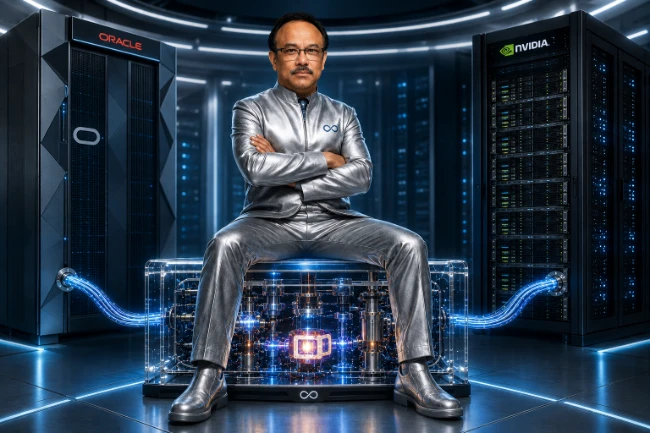
For three decades the quantum computing field has promised machines that would crack problems classical computers can't touch — molecular simulation, unbreakable-code-breaking, portfolio optimization at impossible scale — while delivering laboratory curiosities that mostly excelled at generating press releases. Rajeeb Hazra, the Intel and Micron veteran who took the helm of Quantinuum in 2023, has spent the last three years methodically attacking that credibility gap.
And this week, he landed his most consequential blow yet.
On August 11, Quantinuum and Oracle announced a multi-year strategic partnership that will place Helios, Quantinuum's flagship quantum computer, inside a US-based Oracle Cloud Infrastructure AI data center. OCI customers will be able to access the machine directly through a new OCI quantum service, sitting alongside Oracle's GPU clusters and high-performance computing infrastructure, governed by the same identity, security, and data controls enterprises already use. Oracle plans to preview the service in the coming months, blending Quantinuum's development stack with open-source hybrid programming frameworks.
The significance is less about the hardware than the plumbing. For the first time, a quantum computer will live natively inside one of the world's dominant enterprise cloud platforms, addressable the way a database or a GPU cluster is addressable. If quantum computing is ever going to escape the physics lab and become a line item in a CIO's budget, this is what the on-ramp looks like.
A Startup That's More Than a Startup
Call Quantinuum a startup and purists will wince. The company was born in 2021 from the merger of Honeywell's quantum hardware division and Cambridge Quantum, the UK software firm founded by Ilyas Khan, who remains chief product officer and the largest individual shareholder. Honeywell retains majority control, and Honeywell CEO Vimal Kapur chairs the board. This is a startup with a Fortune 100 parent, a corporate pedigree, and — as of June — a Nasdaq ticker.
Hazra's arrival marked a deliberate change of gear. A three-decade veteran of supercomputing at Intel and later Micron, he replaced Khan with a mandate to convert scientific bragging rights into repeatable enterprise revenue — a commercialization discipline the quantum industry has conspicuously lacked. Under his tenure the company raised $300 million in a JPMorgan-led round in 2024, then another $600 million in September 2025 at a $10 billion pre-money valuation, with NVIDIA's venture arm, Quanta Computer, Amgen, and Mitsui among the backers.
That June IPO was itself a first-move. Quantinuum priced an upsized offering of 28 million shares at $60, raising roughly $1.68 billion in what was billed as the first traditional IPO by a full-stack, pure-play quantum company — competitors like IonQ, Rigetti, and D-Wave all went public via SPAC during the blank-check frenzy. The debut valued the company north of $14 billion and left it with about $2.1 billion in cash and short-term investments at quarter's end. In a field where cash burn is the only universal constant, that war chest matters as much as any qubit count.
A Bet on Fidelity Over Flash
Quantinuum's technical strategy has always cut against the industry's marketing instincts. While rivals tout ever-larger qubit tallies, Quantinuum builds trapped-ion machines — charged atoms suspended in electromagnetic fields — that trade raw scale for accuracy. Helios, launched commercially in November 2025, packs just 98 physical qubits. But those qubits deliver an average two-qubit gate fidelity of 99.921 percent, the best figure any commercial system has posted, along with all-to-all connectivity that superconducting architectures can't match.
The payoff shows up in error correction, the field's central obsession. Because Quantinuum's physical qubits are so clean, the company can construct error-corrected "logical" qubits at a remarkably efficient ratio of roughly two physical qubits per logical one — where other approaches may need hundreds or thousands. Helios has demonstrated 48 fully error-corrected logical qubits, up to 94 in error-detected mode, and, per the company's latest quarterly report, near five-nines logical fidelity using a new family of error-correction codes. In February, Quantinuum published benchmarks showing encoded qubits outperforming unencoded ones — the break-even threshold that separates fault-tolerant computing from expensive noise.
A Pattern of Getting There First
The Oracle deal fits a now-familiar playbook: identify the next thing quantum computing needs to become a real industry, then be first to announce it with a marquee partner. Consider the run of moves. With NVIDIA, Quantinuum integrated GB200 Grace Blackwell superchips into Helios via the NVQLink interconnect, using GPU-accelerated decoders for real-time quantum error correction — an industry-first demonstration that improved logical fidelity by more than three percent.
With Microsoft, it demonstrated a dozen logical qubits with error rates far below the underlying hardware, work the partners branded "reliable quantum computing." With Hewlett Packard Enterprise, it struck a July framework for fusing quantum systems into HPC and AI environments. With SoftBank, it published a roadmap mapping specific enterprise problem classes to specific future machines.
The geographic expansion follows the same logic. Helios systems are deployed in the United States and at Japan's RIKEN institute, with a Singapore installation targeted for late 2026 and international offices stretching from Germany to Qatar. Early customers include JPMorgan Chase, Amgen, Mitsui, BMW, and SoftBank — the kind of blue-chip logos that let Hazra tell CNBC, on IPO day, that quantum computing "is not 10 to 15 years out," but "very much now."
Washington apparently agrees. In May, the Commerce Department signed a letter of intent to provide Quantinuum $100 million in CHIPS Act funding — part of a $2 billion federal initiative spanning nine quantum companies, with the government taking minority equity stakes — specifically aimed at the photonic interconnects and optical components that constrain the scaling of Helios's successors. Quantinuum also advanced to Stage B of DARPA's Quantum Benchmarking Initiative.
The Sobering Arithmetic
Then there are the financials, which demand the same scrutiny as the fidelity records. Quantinuum's revenue for all of 2025 was $30.9 million — against a net loss of $192.6 million and R&D spending of $165.4 million. First-quarter 2026 revenue cratered 73 percent year-over-year to $5.2 million, largely because a big hardware lease deal from the prior year didn't recur, with a quarterly net loss of $136.6 million. The second quarter looked better — revenue up 279 percent year-over-year to roughly $8 million, with full-year guidance of $28 to $32 million — but a company valued in the mid-teens of billions is trading at several hundred times sales, with lumpy, grant-heavy revenue and an accumulated deficit around $1.5 billion.
Neither Quantinuum nor Oracle disclosed financial terms of their partnership, and the honest answer is that nobody knows what enterprise demand for cloud-accessible quantum computing looks like, because it has never really existed. The Oracle deal creates a distribution channel; it does not create customers.
Tough Competition
Nor is Quantinuum's lead uncontested. IBM is building Kookaburra, a modular system with more than 4,000 physical qubits, and aims to demonstrate quantum advantage on a useful workload by year's end, backed by the anchor $1 billion of that federal quantum initiative. Google's Willow program keeps scaling. IonQ — a fellow trapped-ion player with a market cap north of $26 billion — hit 64 algorithmic qubits with its Tempo system and has been on an acquisition spree, swallowing Oxford Ionics, SkyWater, and Capella Space. Every cloud already offers some quantum access through marketplaces like Amazon Braket and Azure Quantum; Quantinuum's Oracle arrangement is deeper and more integrated, but the moat is execution speed, not exclusivity.
Apollo and Lumos
Which brings the story back to the roadmap that everything else serves. Helios is the present. Sol, targeted for 2027, is in trap-chip validation now. Apollo, promised for 2029, is the machine Hazra has staked the company on: what he describes in the IPO prospectus as the first commercial-scale, fully fault-tolerant quantum computer, arriving before the decade ends. A larger successor, Lumos, looms in the 2030s.
So is Quantinuum the quantum computing startup to beat?
On the evidence — best-in-class fidelity, the most convincing error-correction results in the industry, the biggest IPO, federal backing, and now a beachhead inside a major enterprise cloud — the answer is yes, for the moment. But "for the moment" is doing heavy lifting in a field where the physics is unforgiving, the revenue is embryonic, and rivals include three of the most powerful technology companies on earth. Hazra has won the race to look inevitable. The harder race — the one to actually be inevitable — runs through Apollo, and that's just getting started.
© 2026 by Asian Media Group Inc.
Recent Articles
- Cerebras Slump Tests AI Growth Narrative
- Where's that Promised Sex-Trafficking Crackdown?
- Starbucks Korea Swung to Q2 Operating Loss After Marketing Misstep
- BofA to Take 49.9% Stake in Jio Credit for $1.9 Billion in India Push
- China's Lenovo Posts 43% Q1 Revenue Jump on AI Demand
- Starlink Starts Taking Orders for Satellite Internet Service in Vietnam
- Anthropic in Talks to Buy Decart AI on Surging Demand
- GM EV Battery Production Restarts at Ohio Plant
- NFL Training Camp Battles Await Asian UDFA Prospects
- Tencent Q2 Revenue Climbs 11% on AI-driven Ad Gains, Profit Falls Short
Other Asian Media Group Sites
- AsiaMs.net — Asian American Women's Resource
- AsianSports.net — Asian American Sports and Fitness
- VoxCali.com — Videos and Podcasts for Asian Americans
- MyGoldScene.com — Guide to Asian Entertainment
- AttheBanquet.com — Asian Fine Dining and Hospitality
- EastwardDrive.com — Asian Carbuying Intelligence
- EastTable.com — Modern Asian Food and Culture
- TadkaTable.com — Inside South Asian Cooking
- GoGenerational.com — Diaspora Families Building Wealth
- TransPacBound.com — Transpacific Traveler