

How Insatiable Greed Blew Up Bill Hwang's Daring $36-Billion Market-Manipulation Scheme
By Ben Lee | 10 Aug, 2026
The Archegos founder fooled a half dozen global investment banks and the stock market but couldn't bring his impulses under control.
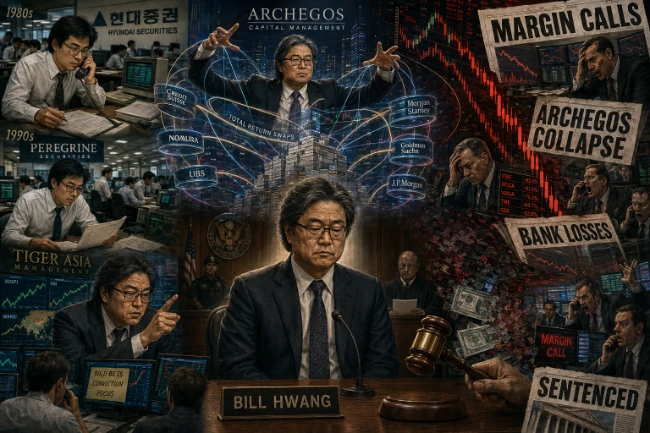
Bill Hwang didn’t begin his journey toward one of Wall Street’s most spectacular collapses as an obvious financial buccaneer.
Born Sung Kook Hwang in South Korea in 1964, he immigrated to the US as a teenager. After his father died, Hwang and his mother settled in Los Angeles, where he reportedly worked overnight shifts at McDonald’s while pursuing his education.
He earned an undergraduate degree from UCLA and later an MBA from Carnegie Mellon University. Those weren’t the credentials of a Wall Street aristocrat. Hwang wasn’t born into a banking dynasty, didn’t inherit a fortune and didn’t arrive in Manhattan carrying the social connections that traditionally open doors at elite investment firms.
What he possessed instead was confidence, intensity and an unusual appetite for concentrated risk.
A Gift For Seeing What Others Missed
After working at Hyundai Securities and the Asian investment bank Peregrine, Hwang caught the attention of Julian Robertson, the legendary founder of Tiger Management. Robertson became one of the most influential hedge-fund investors of his generation, and the managers trained under him became known as the “Tiger Cubs.”
Hwang joined their ranks.
Robertson’s approach emphasized deep research, strong convictions and large positions in companies a manager believed the market had misunderstood. Hwang absorbed that philosophy, but he eventually pushed it toward an extreme Robertson probably never intended.
A concentrated investor must possess enough conviction to act when others hesitate. He must also possess enough humility to recognize that conviction can become delusion.
Hwang mastered the first trait. His career would ultimately be destroyed by his shortage of the second.
The Rise Of Tiger Asia
With Robertson’s backing, Hwang founded Tiger Asia Management in 2001. The hedge fund focused primarily on Asian stocks, particularly companies in South Korea, China and Japan.
For years, Hwang appeared to be one of Robertson’s most successful protégés. Tiger Asia reportedly grew to manage billions of dollars, producing lucrative returns through bold bets on technology, media and financial companies.
Hwang developed a reputation as an investor willing to take positions much larger than most fund managers would tolerate. When he believed in a company, he didn’t merely buy enough shares to benefit from being right. He tried to make being right transformative.
That style could create extraordinary gains. It also made Hwang dependent on his own judgment to a dangerous degree.
The first major warning came in 2012, when Tiger Asia admitted misconduct involving Asian bank stocks. US regulators accused the firm of trading on confidential information and manipulating prices. The firm pleaded guilty to wire fraud, paid tens of millions of dollars in penalties and agreed to return outside investors’ money.
For many managers, such an episode would have ended the career.
For Hwang, it became a change in structure.
Because he could no longer comfortably operate a conventional hedge fund handling outside capital, he converted his remaining wealth into a private family office. He named it Archegos Capital Management, drawing on a Greek word associated with a leader, founder or originator.
As a family office investing largely Hwang’s own fortune, Archegos faced less disclosure than a public investment company or ordinary hedge fund. That privacy created room for Hwang to rebuild.
It also created the darkness in which his next and far larger scheme could grow.
The Billionaire’s Second Chance
Hwang could have treated Archegos as an opportunity for redemption.
He remained immensely wealthy after Tiger Asia closed. He had the training of a Tiger Cub, deep knowledge of Asian and American companies, access to senior Wall Street bankers and enough capital to compound into a lasting family fortune.
He also presented himself as a devout Christian and generous philanthropist. Through the Grace and Mercy Foundation, he donated heavily to religious organizations, charities and educational causes.
Those aspects of his life make the Archegos story more unsettling, not less. Hwang wasn’t a crude swindler whose only recognizable motivation was money. He seems to have viewed investing almost as a calling, combining religious conviction with a belief that wealth could be directed toward socially beneficial ends.
But moral aspiration can coexist with financial obsession. It can even help disguise it.
A person who believes his intentions are righteous may become unusually skilled at excusing his methods. Success can begin to feel like evidence of divine favor or personal virtue. Obstacles become failures of other people to recognize the truth.
Hwang had already been punished once for crossing legal lines. Yet instead of becoming more cautious, he eventually constructed a trading operation more secretive, leveraged and aggressive than Tiger Asia had ever been.
His second chance didn’t teach him restraint.
It convinced him that he could survive anything.
The Hidden Power Of Total-Return Swaps
Archegos’s most important tool was the total-return swap.
Rather than purchasing every share directly, Archegos entered into contracts with investment banks. The banks bought or hedged the stocks, while Archegos received the economic gains or losses generated by those positions.
The arrangement gave Hwang several advantages.
It allowed Archegos to obtain exposure to far more stock than it could have purchased with cash. It also allowed the firm to avoid appearing publicly as the direct owner of enormous shareholdings. Most importantly, Hwang could arrange similar swaps with multiple banks, none of which initially understood the complete size of his positions.
Credit Suisse might see its exposure to Archegos. Nomura might see its own. Goldman Sachs, Morgan Stanley, UBS and other institutions saw theirs.
What they didn’t clearly see was the combined portfolio.
Hwang exploited that fragmentation. Archegos allegedly provided counterparties with misleading descriptions of its liquidity, concentration and dealings with other banks. Each lender could be encouraged to believe it held a manageable portion of a wealthy client’s diversified portfolio.
In reality, several banks were financing variations of the same concentrated bets.
The deception was audacious because Hwang wasn’t fooling inexperienced investors. He was misleading some of the world’s largest financial institutions, each equipped with armies of risk officers, lawyers, analysts and compliance professionals.
But the banks had a weakness Hwang understood perfectly: greed.
Archegos generated enormous commissions and financing revenue. Every bank wanted more of its business. Any institution imposing stricter margin requirements risked watching Hwang move his trades to a more accommodating competitor.
Hwang turned Wall Street’s competitive instincts against itself.
A Fortune Built By Buying
By early 2020, Archegos had roughly $1.5 billion in capital. About a year later, its net asset value had soared to approximately $36 billion, supported by gross market exposure that prosecutors said reached roughly $160 billion.
It was one of the fastest creations of personal wealth in financial history.
Hwang concentrated on a limited group of media and technology companies, including ViacomCBS, Discovery, Baidu, Tencent Music Entertainment and several others. He claimed to be a long-term investor guided by corporate fundamentals.
But by late 2020, Archegos had become something very different.
The firm was trading constantly in its core holdings, using enormous purchases to create upward pressure. Rising stock prices increased the marked value of Archegos’s positions. That larger apparent fortune persuaded banks to provide more financing. Hwang then used the financing to acquire still more exposure.
The cycle was seductively powerful:
Buy shares.
Push prices higher.
Record larger paper gains.
Borrow against those gains.
Use the borrowed money to buy more shares.
Repeat.
The scheme didn’t require convincing ordinary investors with promotional emails or false rumors. Archegos’s buying itself became the advertisement. Rising prices attracted momentum traders, index funds and outside investors who assumed the market must be responding to genuine information.
In effect, Hwang was using borrowed money to manufacture evidence that his investment judgment had been correct.
The fortune was real in one sense. His holdings could be valued at market prices.
But it was dangerously artificial in another. Archegos couldn’t sell tens of billions of dollars in concentrated positions without depressing the same prices that made Hwang appear rich.
He had created a fortune that depended on remaining a buyer.
The Moment He Could Have Stopped
Hwang wasn’t doomed from the beginning.
At several points, he could have halted the portfolio’s expansion, reduced leverage and gradually converted his paper gains into permanent wealth. Even if selling weakened his stocks, a disciplined retreat might have left him with several billion dollars after the banks were repaid.
That would have been one of the greatest investment triumphs of the century.
But it wasn’t enough.
This is where boldness became greed.
Hwang didn’t merely want to be rich. He wanted the exhilaration of seeing his convictions affirmed on an ever-larger scale. Each increase in his fortune became the foundation for the next bet rather than an occasion to secure what he had won.
The defining character flaw wasn’t simple desire for money. Hwang already had more wealth than he could reasonably spend.
It was his inability to accept limits.
He couldn’t accept that some of the gains had resulted from his own market impact. He couldn’t accept that a $36-billion portfolio might not actually be liquidated for $36 billion. He couldn’t accept that the banks would eventually stop lending. And he couldn’t accept the ordinary possibility that one of his favorite stocks might decline.
Most dangerously, he couldn’t accept that the correct response to success was sometimes to stop.
For Hwang, stopping would have meant shrinking the arena in which he could demonstrate his brilliance. Deleveraging might preserve his wealth, but it would end the intoxicating cycle that was enlarging it.
His greed was therefore inseparable from ego.
He needed the machine to keep validating the man.
The ViacomCBS Shock
The immediate crisis began in March 2021 with ViacomCBS, one of Archegos’s largest positions.
The company’s stock had risen dramatically, aided in part by Archegos’s relentless buying. ViacomCBS attempted to take advantage of the elevated price by selling billions of dollars in new shares.
Instead of confirming the stock’s strength, the offering raised doubts about its valuation and created additional supply. The price began to fall.
For a normal unleveraged investor, the decline would have been painful but survivable. For Archegos, it was an emergency.
The falling price reduced the value of its collateral. Banks demanded more cash. Other stocks in the portfolio also weakened, magnifying the losses.
Hwang still had one final opportunity to behave like a prudent investor. He could have preserved liquidity, disclosed the entire situation and negotiated an orderly reduction of risk.
Instead, he reportedly directed Archegos to spend nearly $1 billion trying to support its collapsing stocks.
It was the purest expression of his flaw.
Even while the vehicle was skidding, Hwang pressed the accelerator because acceleration had always appeared to restore control.
The buying failed. Archegos couldn’t satisfy its margin calls. The banks realized that several of them held enormous claims against the same limited pool of assets.
A frantic race began.
Wall Street Runs For The Exit
Representatives of Archegos and its lenders attempted to discuss a coordinated liquidation. In theory, the banks could have sold gradually, avoiding a simultaneous fire sale that would punish everyone.
But cooperation was nearly impossible.
Each bank knew the first institutions to sell might recover most of their money. Those that waited would be left unloading shares after prices had collapsed.
Goldman Sachs and Morgan Stanley moved relatively quickly. Credit Suisse and Nomura were slower.
The result was one of the largest forced liquidations Wall Street had ever seen. Tens of billions of dollars in stock flooded the market. Archegos’s holdings plunged, destroying more than $100 billion in combined market capitalization.
Credit Suisse lost approximately $5.5 billion. Nomura lost roughly $2.9 billion. UBS and other firms suffered additional losses, bringing the damage to Archegos’s lenders above $10 billion.
Hwang’s $36-billion fortune effectively disappeared within days.
It wasn’t stolen from him by an outside criminal. It wasn’t destroyed by an unpredictable war or natural disaster.
It vanished because the strategy that created it contained no reliable method for preserving it.
The Banks’ Own Appetite
The banks were victims of deception, but they weren’t blameless.
Credit Suisse’s internal investigation later described serious failures of management and risk control. Warning signs had accumulated for months. Archegos repeatedly exceeded exposure limits, maintained a heavily long and concentrated portfolio and resisted efforts to provide greater transparency.
Yet lucrative fees encouraged employees to tolerate the danger.
This complicity was essential to Hwang’s rise. His scheme couldn’t have reached such proportions without institutions willing to overlook uncomfortable evidence in pursuit of revenue.
Hwang’s greed met the banks’ greed, and each strengthened the other.
He wanted more buying power. They wanted more business.
He concealed how much leverage he had obtained. They preferred not to ask questions that might drive away a profitable client.
He told them versions of what they wanted to hear. They accepted those answers because skepticism threatened their bonuses.
Archegos was therefore more than the story of one man losing control. It was a case study in how financial institutions can collectively abandon restraint while individually believing they’re managing risk.
The Reckoning
Federal prosecutors charged Hwang and several Archegos executives in 2022. Following a nine-week trial, a jury convicted him in 2024 of racketeering conspiracy, securities fraud, market manipulation and wire fraud.
He was sentenced to 18 years in prison and ordered to pay more than $9 billion in restitution.
The punishment reflected not merely the size of the losses but the deliberateness of the enterprise. Prosecutors argued that Hwang had used Archegos as a weapon, manipulating stock prices while deceiving the institutions financing his trades.
His earlier regulatory record made the collapse harder to dismiss as the innocent failure of an overconfident investor. Tiger Asia had already shown that Hwang was willing to cross legal boundaries when they obstructed his ambitions.
Archegos demonstrated that the lesson he drew from that episode wasn’t to respect the rules.
It was to operate more privately.
The Man Who Couldn’t Declare Victory
Bill Hwang’s tragedy is that he actually possessed much of what he believed he possessed.
He was intelligent. He had unusual investing instincts. He understood the behavior of banks, the mechanics of derivatives and the psychological power of rising markets. He built a fortune from relatively modest beginnings and recovered from a scandal that would have ended most careers.
What he lacked was the one quality necessary to make those gifts sustainable: self-command.
Had Hwang stopped earlier, Archegos might have become a story about a disgraced hedge-fund manager who quietly rebuilt himself into one of America’s richest investors and most generous philanthropists.
Instead, he became the man who turned $1.5 billion into $36 billion and then turned $36 billion into almost nothing.
His downfall wasn’t caused by insufficient daring. Few investors have ever demonstrated more.
It was caused by daring without discipline, faith without doubt and ambition without an endpoint.
Hwang fooled global banks. He fooled other investors. For a time, he even fooled the stock market into treating his purchases as proof of genuine value.
The one person he could never stop fooling was himself.
He came to believe that because greater leverage had repeatedly rescued and enriched him, still greater leverage would continue doing so. Every successful gamble reduced his willingness to leave the table. Every billion dollars made the next billion seem not merely possible but necessary.
By the time the prices turned against him, Hwang no longer controlled the machine he had built. The machine controlled his choices.
His $36-billion fortune didn’t collapse because he had failed to win.
It collapsed because he had already won beyond any reasonable expectation—and greed made him incapable of recognizing victory.
© 2026 by Asian Media Group Inc.
Recent Articles
- Hormuz Straight Talk Remains Elusive
- Is Rajeeb Hazra's Quantinuum the Quantum Computing Startup to Beat?
- Rajeeb Hazra Partners Quantinuum with Oracle to Bring Quantum Computing to Cloud
- Trump Media Quarterly Loss Jumped 11-Fold to $238 Million
- Cheap Meals No Longer Do the Trick for McD, Rivals
- Joby Acquires Defense Tech Company for $500 Million
- Disney Wins Global Streaming Rights for Formula E Races
- Bumble Eases Women-First Messaging Rule as Dating Apps Seek Engagement Boost
- Nvidia Is Developing Nemotron 4 Open-Source Models
- US Human Rights Groups Sue Trump over Anti-ICC Push
Other Asian Media Group Sites
- AsiaMs.net — Asian American Women's Resource
- AsianSports.net — Asian American Sports and Fitness
- VoxCali.com — Videos and Podcasts for Asian Americans
- MyGoldScene.com — Guide to Asian Entertainment
- AttheBanquet.com — Asian Fine Dining and Hospitality
- EastwardDrive.com — Asian Carbuying Intelligence
- EastTable.com — Modern Asian Food and Culture
- TadkaTable.com — Inside South Asian Cooking
- GoGenerational.com — Diaspora Families Building Wealth
- TransPacBound.com — Transpacific Traveler