

How Outmarriage Patterns of Under-30 Asian American Men and Women Differ
By Kavya Anand | 11 Jun, 2026
A combination of high college-attendance rates and acculturation are boosting both inter-racial and intra-ethnic marriage rates among the younger generation.
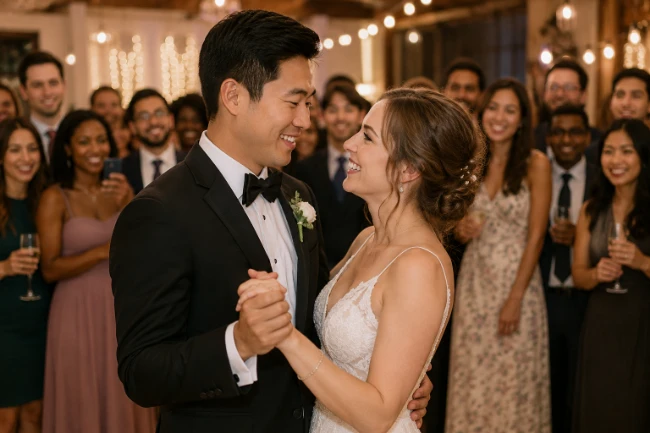
The marriage patterns of Asian Americans under 30 look noticeably different from those of their parents and grandparents.
Some of the trends that shaped older generations are still visible, but they're being modified by a new forces: higher educational attainment, growing multiracial populations, geographic dispersion, social media, dating apps, and the simple reality that millions of Asian Americans are now third- and fourth-generation Americans.
The result is a younger generation that's both more likely to marry outside its ethnic group and, paradoxically, more likely to find partners within the broader Asian American population. In other words, both inter-racial and intra-ethnic marriages are growing in importance, while some of the gender differences that once dominated discussions are gradually shrinking.
The Legacy Gap
To understand what's changing, it helps to understand what came before.
The first large post-1965 wave of Asian immigrants often arrived in communities where there were relatively few Asian Americans outside their own ethnic group. Chinese immigrants tended to marry Chinese. Korean immigrants married Korean. Indian immigrants married Indian.
In many cases these weren't preferences so much as a reflection of realities.
Language barriers, cultural familiarity, parental expectations, religious traditions and immigrant social networks all pushed people toward partners from their own ethnic background.
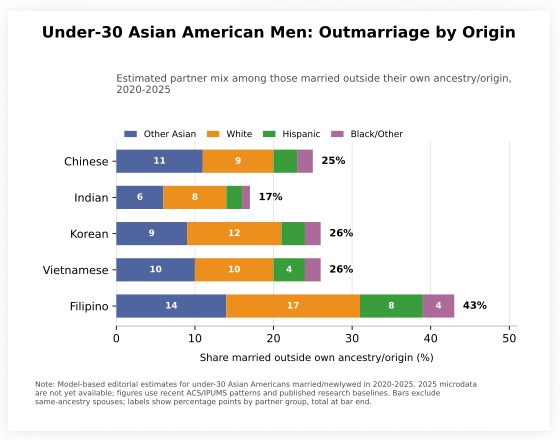
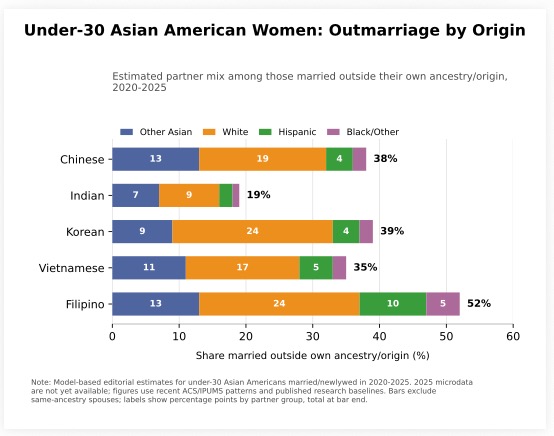
Meanwhile, among American-born Asians who came of age during the 1970s, 1980s and 1990s, a different pattern emerged. Asian American women increasingly married outside their race, particularly to white men. Asian American men also outmarried, but at substantially lower rates.
The reasons have been debated endlessly. Some point to media stereotypes, others to demographic imbalances, social acceptance, immigration patterns or broader cultural preferences.
Whatever the causes, the gap became one of the most discussed aspects of Asian American social life. Today that gap still exists, but younger generations are changing the equation.
Rise of Intra-Asian Pairings
One of the least appreciated trends among younger Asian Americans is the growth of pan-Asian marriages.
Thirty years ago a marriage between a Chinese American and a Korean American might have been viewed as an interracial relationship within some immigrant communities.
Today it's increasingly viewed simply as an Asian American couple.
Young Asian Americans often grow up attending the same schools, universities and workplaces regardless of ancestral origin. Their social circles are more likely to include Chinese, Korean, Vietnamese, Filipino, Indian and Japanese friends simultaneously.
As a result, many younger people don't draw sharp distinctions between Asian ethnicities when it comes to dating and marriage.
A Korean American software engineer marrying a Chinese American physician may technically be marrying outside their ethnicity, but culturally they often share similar educational experiences, immigrant family expectations, professional aspirations and social networks.
This has created a growing category that doesn't fit neatly into traditional discussions of outmarriage.
From the perspective of an older generation, such a marriage might be considered exogamous. From the perspective of many younger Asian Americans, it feels almost endogamous.
The College Effect
Higher education has become one of the strongest forces reshaping Asian American marriage patterns.
Asian Americans have among the highest college-attendance and college-completion rates of any racial group in America.
College campuses dramatically expand social networks. Students meet people from different ethnicities, races, religions and geographic regions. Friendships become relationships. Relationships become marriages. The effect is particularly strong because colleges tend to sort students according to educational achievement rather than ethnicity.
A Taiwanese American engineering student may spend more time with white, Indian, Korean, Black and Latino classmates than with members of their own ethnic community. This naturally increases the probability of interracial relationships. At the same time, colleges also create opportunities for Asian Americans from different backgrounds to meet one another. A Vietnamese American student from Texas and a Chinese American student from New Jersey might never have crossed paths in previous generations. Today they may attend the same university, join the same clubs and eventually marry.
That's one reason why both interracial and pan-Asian marriages can rise simultaneously.
Acculturation Changes Attitudes
Each generation born in America becomes more culturally American. That sounds obvious, but it has profound implications for marriage patterns.
First-generation immigrants often carry expectations from their countries of origin regarding family roles, religion, language and child-rearing. Their children may retain some of those traditions but generally become more flexible. Their grandchildren are usually even more integrated into mainstream American culture.
As acculturation increases, ethnic boundaries tend to become less rigid. For many under-30 Asian Americans, cultural compatibility matters more than ethnic compatibility. Questions such as educational goals, career ambitions, political outlook, personality and lifestyle often outweigh concerns about ancestry.
Many young Asian Americans who would have faced parental resistance to interracial dating a generation ago now encounter far less opposition. Some parents still strongly prefer same-ethnicity marriages, but many have adjusted their expectations to the realities of American society.
The Multiracial Generation
Another major factor is the rapid growth of multiracial Asian Americans. Children of interracial marriages now represent one of the fastest-growing segments of the Asian American population. For them, traditional categories often make less sense.
A young woman with a Chinese mother and white father may not view relationships through the same racial lens as someone whose family immigrated from China just one generation ago. Similarly, a young man with Korean and Filipino ancestry may already embody multiple ethnic identities.
As the multiracial population grows, distinctions between "inside" and "outside" marriage become increasingly blurred. The very definition of outmarriage becomes harder to pin down. Is a half-Japanese, half-white American marrying a Korean American engaging in intermarriage or intramarriage? The answer increasingly depends on who's doing the counting.
Why The Outmarriage Gender Gap Is Narrowing
One of the most interesting developments is evidence that younger Asian American men are experiencing greater social integration than previous generations.
Historically, Asian American men faced significant barriers in American dating culture. Negative media portrayals often depicted them as socially awkward, undesirable or lacking masculinity. Those stereotypes didn't disappear overnight, but they've weakened substantially.
Popular culture now includes highly visible Asian male actors, athletes, musicians, entrepreneurs and influencers. Young Asian American men have grown up with role models that previous generations lacked. The rise of global Asian cultural influence has also played a role. K-pop, Korean dramas, anime, Asian cinema, Asian fashion and Asian social-media personalities have broadened perceptions of Asian masculinity across American society.
Younger women of all racial backgrounds are growing up in a cultural environment where attractive, confident and successful Asian men are far more visible than they were twenty or thirty years ago. That doesn't eliminate all disparities, but it appears to be reducing some of the disadvantages that older generations experienced. As a result, younger Asian American men are participating more actively in both interracial and pan-Asian relationships than many of their fathers did.
Geography Matters Less
Historically, marriage patterns were heavily influenced by geography. If you grew up in a town with few Asians, your odds of marrying another Asian were relatively low. If you grew up in a large enclave such as parts of California, Hawaii or New York, the odds were much higher.
Technology has weakened those geographic constraints. Dating apps, social media and online communities allow people to connect across much wider networks. Someone living in Denver can meet a partner in Los Angeles. A student in Atlanta can build relationships with people in Seattle.
The effective dating pool has become national rather than local. This benefits Asian Americans in particular because the population remains geographically dispersed across much of the country.
The New Role Of Identity
Another surprising trend is the renewed interest many younger Asian Americans have in their heritage. Earlier generations sometimes viewed assimilation as the primary goal. Many younger adults take a more hybrid approach. They see themselves as fully American while also taking pride in their ethnic backgrounds. That stronger sense of identity doesn't necessarily reduce outmarriage.
In some cases it actually makes people more comfortable entering interracial relationships because they feel secure in their cultural identity. Instead of fearing cultural loss, they feel capable of preserving traditions regardless of whom they marry. This confidence allows ethnicity to become one factor among many rather than the defining factor.
What The Future May Look Like
Over the next two decades, the distinctions between traditional categories of marriage are likely to become increasingly blurred. Pan-Asian marriages will probably continue to rise as younger generations interact in highly integrated educational and professional environments.
Interracial marriages are also likely to remain common as Asian Americans become more geographically dispersed and culturally integrated. The old model that focused primarily on whether someone married inside or outside their ethnic group may gradually lose relevance. A future Asian American family might include Chinese, Korean, Indian, Filipino, white, Black and Latino ancestry all within a single extended family tree.
In many ways, that future is already arriving. The larger story isn't simply that Asian Americans are marrying outside their race more often. It's that younger Asian Americans are increasingly defining compatibility in broader terms than previous generations did.
Education, values, ambition, personality, lifestyle and shared experiences are becoming more important than rigid ethnic boundaries. That's changing marriage patterns for both men and women. And while differences remain, the younger generation appears to be moving toward a more integrated social landscape in which both interracial and pan-Asian marriages are commonplace, accepted and increasingly unremarkable.
The discussion over outmarriage rates isn't disappearing. But among Asian Americans under 30, it may no longer be the most interesting story. The bigger story may be the emergence of a generation that sees identity as expansive rather than restrictive, allowing them to build relationships across both racial and ethnic lines while remaining comfortably connected to their heritage.
© 2026 by Asian Media Group Inc.
Recent Articles
- Trump May Need to Allow Chinese Minerals as US Industry Struggles to Meet 2027 Deadline
- China Accuses US of 'AI Hegemonism' over Potential Probe, Threatens Retaliation
- China Calls for Cancellation of US 'Forced Labour' Tariffs
- US Core Capital Goods Orders Increased Strongly in June on AI Buildout
- Amazon Leo Proposes Over 5,000 Satellites for Direct-To-Phone Service
- Modi Faces Challenge over Surveillance at India Youth Protest
- Drone Strikes on Iran's Neighbours Suggest Tehran Testing Trump Resolve
- Takaichi's Approval Rating Slides as Inflation Bites, Yomiuri Poll Shows
- Singapore's Unique Monetary Policy Needed for Trade-Centered Nation
- Nvidia in Talks to Guarantee $250 Billion in OpenAI Data Center Financing