

How Raj Rajaratnam Made Billions Insider-Trading—and the Radical Methods Used to Nail Him
By Ben Lee | 13 Aug, 2026
Wall Street had never seen such an audacious insider-trading scheme like Galleon's and isn't likely ever to see another like it.
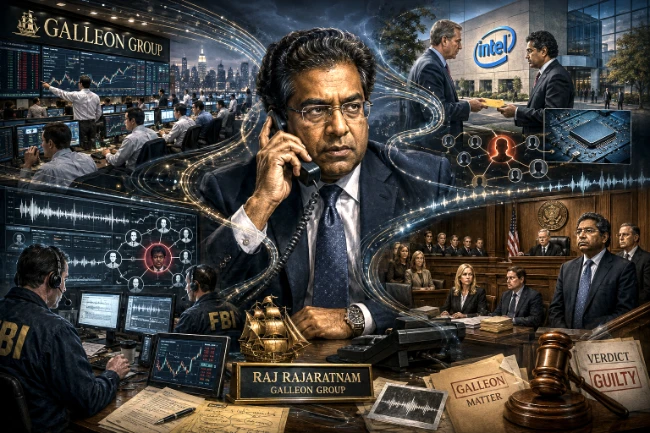
Raj Rajaratnam didn’t need insider trading to become a successful investor.
Born into a prosperous Tamil family in Colombo, Sri Lanka, in 1957, Rajaratnam moved to England as a teenager, studied engineering at the University of Sussex and earned an MBA from the University of Pennsylvania’s Wharton School in 1983.
He began his American financial career as a lending officer at Chase Manhattan Bank, specializing in technology companies. That experience gave him an unusually practical understanding of the young businesses transforming computing, communications and consumer electronics.
Talent For Finding An Edge
In 1985, he joined Needham & Co., a small but ambitious investment bank focused on technology. Rajaratnam proved to be an energetic analyst with a gift for cultivating executives and detecting shifts in fast-moving industries. He became Needham’s research chief in 1987 and president in 1991, when he was only 34.
Needham launched an investment partnership under his leadership in 1992. Rajaratnam later bought control of the operation and renamed it Galleon Group, evoking the heavily armed sailing ships that once carried fortunes across oceans. By the late 2000s, Galleon managed as much as $7 billion, while Rajaratnam’s personal wealth exceeded $1 billion. (Wikipedia)
The rise wasn’t built entirely on crime. Galleon employed talented analysts, conducted genuine research and made many legitimate trades. Its funds produced strong returns for years, and Rajaratnam possessed real knowledge of technology and healthcare companies.
But he developed an appetite for information so precise that ordinary analysis could no longer satisfy him.
He didn’t merely want an edge.
He wanted certainty.
Building Galleon Around Information
Most successful hedge funds attempt to understand companies better than competing investors. They examine financial statements, question suppliers, attend conferences, interview former employees and estimate demand for new products.
Rajaratnam turned that legitimate process into an industrial-scale intelligence operation.
Galleon’s culture revolved around becoming the “axe” on a stock—the person possessing the strongest information and the most authoritative opinion. Analysts were expected to maintain extensive industry contacts and report anything that might move a share price. Rajaratnam presided over morning meetings in which employees presented findings, defended recommendations and competed to demonstrate superior knowledge.
His personality suited the environment. He was demanding, gregarious and relentlessly curious. He called executives, consultants, traders and analysts throughout the day. He remembered details, challenged vague answers and moved enormous amounts of money when he believed he knew what was coming.
The line between aggressive research and insider trading can sometimes appear indistinct. Investors may legally assemble a “mosaic” from public facts, expert opinions and nonmaterial details that aren’t publicly known.
Rajaratnam exploited that ambiguity. If questioned, he could point to Galleon’s research staff, models and legitimate industry contacts. A trade based on an illegal tip could be surrounded by enough lawful analysis to make its true origin difficult to prove.
Inside Galleon, however, the most valuable information was often explicit: an earnings result before release, a takeover before announcement, a major investment before disclosure or a corporate forecast known only to executives and advisers.
Rajaratnam wasn’t simply assembling a mosaic.
He was obtaining pieces with the answer already written on them.
Turning Relationships Into Sources
Rajaratnam’s network grew from relationships accumulated during decades in technology and finance.
Some sources were former classmates. Rajiv Goel, an Intel Capital executive, and Anil Kumar, a senior McKinsey partner, had attended Wharton with him. Others were technology executives, investment bankers, consultants, investor-relations employees and traders connected to Galleon’s analysts.
Rajaratnam understood that people disclose secrets for different reasons. Some wanted money. Others wanted friendship, access, status, investment favors or the excitement of being useful to a billionaire.
Kumar became one of Rajaratnam’s most valuable informants. Through McKinsey’s consulting work, he gained access to confidential information about corporate clients and strategic transactions. Prosecutors said Rajaratnam paid him between $1.75 million and $2 million, routing some compensation through concealed accounts.
Goel supplied information obtained through his position at Intel, including details involving Intel’s financial performance and investments. Rajaratnam also traded for Goel’s benefit, turning the exchange of information into a mutually profitable partnership.
Roomy Khan, a former Intel employee who had briefly worked at Galleon, delivered tips from Silicon Valley contacts. Galleon portfolio manager Adam Smith obtained information through his own network. Danielle Chiesi, a trader at New Castle Partners, cultivated executives including IBM senior vice president Robert Moffat.
At the network’s most prestigious level stood Rajat Gupta, the celebrated former head of McKinsey and a director of Goldman Sachs. Prosecutors later proved that Gupta passed Rajaratnam confidential Goldman information, including news of Warren Buffett’s multibillion-dollar investment during the 2008 financial crisis.
The sources weren’t organized into a conventional hierarchy. Many didn’t know one another. Rajaratnam sat at the center, collecting secrets from separate circles and directing trades through Galleon’s enormous portfolio. (Department of Justice)
How The Network Produced Money
Advance knowledge gave Galleon the ability to profit in either direction.
When a source warned that earnings would disappoint, Rajaratnam could sell shares or establish a short position before the announcement. When a source revealed that results would exceed expectations, he could buy aggressively. A takeover tip could produce an especially quick windfall because acquisition announcements often caused immediate price jumps.
The network supplied information about companies including Intel, Google, AMD, Akamai Technologies, Polycom, Clearwire, Hilton Hotels, Goldman Sachs and PeopleSupport.
One especially valuable chain involved confidential information about Google’s quarterly earnings. Khan obtained the information through a contact and passed it to Rajaratnam, allowing Galleon to position itself before the market learned the results.
In another sequence, Goel tipped Rajaratnam about a planned transaction involving Clearwire and Sprint. Kumar provided confidential intelligence involving corporate deals and clients. Gupta called Rajaratnam shortly after Goldman board meetings with information capable of moving one of the world’s most closely watched financial stocks.
Prosecutors ultimately attributed well over $50 million in illegal gains or avoided losses to the conduct underlying Rajaratnam’s conviction. Later government descriptions put the total as high as approximately $63.8 million.
That was only a portion of Galleon’s overall profits and Rajaratnam’s billion-dollar fortune. It would be inaccurate to say every dollar he earned resulted from insider trading.
But the illegal network gave Galleon something its legitimate analysts couldn’t consistently provide: the ability to place large trades with advance knowledge of the event that would determine whether those trades succeeded. (FBI)
The Old Intel Clue
The investigation that destroyed Galleon began with a woman who had already created trouble for Rajaratnam years earlier.
In 1998, Intel security cameras caught Roomy Khan faxing confidential company information to Galleon. Khan pleaded guilty and received probation, but prosecutors couldn’t establish a sufficiently strong criminal case against Rajaratnam. The file was eventually closed.
Rajaratnam might have taken the episode as a warning.
Instead, he continued communicating with Khan.
Years later, the SEC was examining suspicious Galleon trading and collecting immense quantities of messages, telephone records and transaction data. During a deposition, Rajaratnam was questioned about Khan and acknowledged that she might have given him information.
Investigators then found a revealing instant-message exchange between Rajaratnam and Khan concerning Polycom. Khan advised him not to buy until she obtained guidance—language suggesting that she expected access to confidential earnings information.
The SEC compared the messages with telephone records and trading activity. Calls between Khan and Rajaratnam clustered around well-timed Galleon transactions.
Another breakthrough came in 2007, after unusually profitable purchases of Hilton options occurred shortly before Blackstone announced its acquisition of the hotel company. Both Khan and Rajaratnam had traded. The pattern connected the new inquiry to the old Intel case.
The SEC now had something more persuasive than a lucky trade.
It had a recurring relationship. (The New Yorker)
Roomy Khan Faces The FBI
FBI agents confronted Khan at her California home in November 2007.
She initially lied. But agents had accumulated instant messages, telephone records and trading evidence, and Khan understood that a second conviction could send her to prison.
She agreed to cooperate.
Khan identified sources who had supplied confidential information and began recording her telephone calls with Rajaratnam. Those consensual recordings gave investigators direct evidence that the two discussed nonpublic corporate intelligence.
This was crucial because insider-trading prosecutions had traditionally depended on circumstantial evidence. Regulators could show that a trader received a call and immediately bought a stock, but defendants could claim coincidence, research or an unrelated conversation.
A recording could reveal what was actually said.
Khan’s calls helped the government establish probable cause that Rajaratnam was committing crimes over the telephone. They also supported the argument that conventional techniques had reached their limit.
In March 2008, a federal judge authorized investigators to tap Rajaratnam’s cellphone.
Wall Street enforcement was about to enter a new era. (Justia Law)
Using Mafia Tactics On Wall Street
Court-authorized wiretaps had long been associated with investigations of organized crime, narcotics trafficking and public corruption. Their use as the centerpiece of a major insider-trading prosecution was radical.
White-collar defendants were accustomed to producing documents, enduring depositions and explaining suspicious trades after the fact. They generally weren’t prepared for federal agents to be listening in real time as tips were passed.
The initial authorization lasted 30 days, but investigators obtained renewals and expanded surveillance to additional telephones. Ultimately, the government intercepted thousands of conversations involving Rajaratnam, Chiesi and numerous associates.
The recordings captured the living network.
Rajaratnam could be heard discussing earnings, corporate deals and the reliability of sources. Call sequences showed him receiving information and directing trades. Other conversations exposed relationships that investigators hadn’t fully understood.
The taps also deprived the defense of its most effective traditional argument. Rajaratnam’s lawyers could point to Galleon’s research and claim its trades emerged from a mosaic of lawful information. But jurors could hear voices discussing details that hadn’t been publicly released.
The investigation combined old-fashioned informants with modern financial analysis. The SEC issued more than 230 subpoenas, examined thousands of telephone records and gathered millions of documents. The FBI used recordings, surveillance and cooperating witnesses. Prosecutors then confronted members of the network and persuaded several to plead guilty and testify.
It was a white-collar investigation conducted with the intensity of a racketeering case. (The New Yorker)
Flipping The Inner Circle
Once the government began arresting participants, Rajaratnam’s network became a liability.
Kumar pleaded guilty and described his secret arrangement with Rajaratnam. Goel admitted providing information. Adam Smith cooperated. Khan explained her role and the sources behind her tips.
Each witness understood a different part of the organization. Together, they translated the calls, trades and relationships for the jury.
This cooperation strategy magnified the wiretaps’ impact. A recording might contain coded or ambiguous language. A participant could explain what the speakers meant, where the information originated and what trades followed.
Rajaratnam tried to portray the cooperating witnesses as liars seeking reduced sentences. In many cases, they plainly had lied before. That made the recordings even more important. Jurors didn’t have to rely exclusively on their revised accounts.
They could listen to Rajaratnam himself.
The Arrest That Sank Galleon
FBI agents arrested Rajaratnam on October 16, 2009. The SEC simultaneously filed its civil action, initially alleging more than $25 million in illicit gains across a wide insider-trading scheme.
Galleon quickly unraveled. Investors sought withdrawals, and Rajaratnam announced that the funds would close. An investment empire that had survived the technology crash and the 2008 financial crisis couldn’t survive the realization that its founder’s telephone calls had been recorded for months.
Rajaratnam refused to plead guilty.
His trial began in March 2011 and lasted eight weeks. Prosecutors played wiretaps and presented testimony from former friends, employees and business associates. The defense argued that Galleon conducted exhaustive research and that Rajaratnam’s trades could be explained without illegal information.
The jury convicted him on all 14 counts: five counts of conspiracy and nine counts of securities fraud.
He received an 11-year prison sentence, then the longest ever imposed for insider trading, along with a $10 million criminal fine and more than $53 million in forfeiture. A separate civil judgment imposed additional financial consequences. (Department of Justice)
Why Galleon Is Unlikely To Be Repeated
Insider trading hasn’t disappeared. Executives, employees and investors will continue to misuse confidential information as long as money can be made from knowing tomorrow’s news today.
But another network resembling Galleon’s is less likely.
Rajaratnam operated during a transitional period. Hedge funds had become enormous and influential, yet many participants still assumed that insider-trading cases would be built mainly from trading records, emails and testimony. They believed a sophisticated fund could conceal illegal tips inside a mountain of legitimate research.
The Galleon prosecution destroyed that assumption.
Wall Street professionals now know that phones can be tapped, acquaintances can record conversations and investigators can combine digital communications with trading data almost instantly. Compliance departments monitor contacts more closely. Banks and consulting firms impose tighter restrictions on access to sensitive information. Employees are repeatedly warned that casual tips to friends can lead to prison.
The network was also a product of Rajaratnam himself. He possessed the charisma, wealth, industry knowledge and appetite for constant conversation needed to keep dozens of information channels flowing toward one desk.
His genius was constructing a human intelligence system that could outrun the market.
His fatal mistake was assuming the government could never build a better one.
© 2026 by Asian Media Group Inc.
Recent Articles
- Trump Tells Americans to Accept High Gasoline Prices As Iran Stays Defiant
- Hanwha Shares Rise After Trump Opens Navy Shipbuilding to Foreign Yards
- SK Group Chairman Chey Appeals $668 Mil. Divorce Settlement Ruling
- Anthropic IPO $2 Trillion Valuation Hinges on 2028 Revenue Forecast
- Anna Cathcart Shines in Hit Netflix Rom-Com
- Softbank Sells Most of Its TSMC Holdings, Initiates Stake in Capital One
- Chinese Drone Maker DJI Wins Fresh Chance to Escape Pentagon's Blacklist
- Consumer Sentiment Deteriorates Most Among Trump Base
- AI Boom Drives Fastest Growth for Taiwan's Economy in 4 Decades
- Alphabet's SpaceX Bet Grew 100-Fold over 10 Years
Other Asian Media Group Sites
- AsiaMs.net — Asian American Women's Resource
- AsianSports.net — Asian American Sports and Fitness
- VoxCali.com — Videos and Podcasts for Asian Americans
- MyGoldScene.com — Guide to Asian Entertainment
- AttheBanquet.com — Asian Fine Dining and Hospitality
- EastwardDrive.com — Asian Carbuying Intelligence
- EastTable.com — Modern Asian Food and Culture
- TadkaTable.com — Inside South Asian Cooking
- GoGenerational.com — Diaspora Families Building Wealth
- TransPacBound.com — Transpacific Traveler