

Japan's Sustained Struggles Provide Dire Warning for Trump's Anti-Immigrant Agenda
By Tom Kagy | 09 Aug, 2026
Despite its immense natural advantages, any significant extension of MAGA philosophy will send the US into the kind of social and technological stagnation that has made Japanese victims of investment flight and a plunging yen.
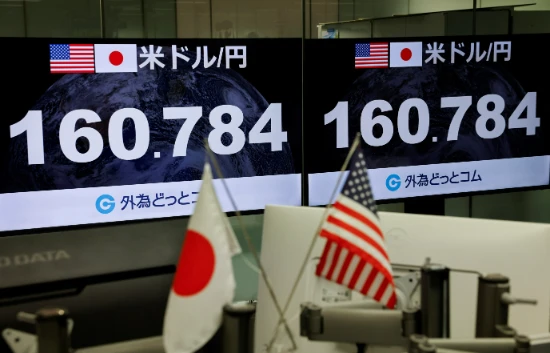
Monitors display the current Japanese Yen exchange rate against the U.S. dollar at a dealing room of the foreign exchange trading company Gaitame.com in Tokyo, Japan, July 31, 2026. REUTERS/Manami Yamada
Japan should have been nearly impossible to knock from the economic heights it occupied at the end of the 1980s. It had a superbly educated workforce, immense household savings, world-class infrastructure, globally admired manufacturers and privileged access to the US market.
Traffic signs in front of the Bank of Japan building in Tokyo, Japan, June 15, 2026. REUTERS/Kim Kyung-Hoon
Yet the country gradually turned many of those strengths into defenses against change. Its political system became better at protecting established constituencies than at renewing its population, business base and consumer economy.
People shop for snacks at a confectionery store in Tokyo, Japan, July 28, 2026. REUTERS/Manami Yamada
That’s the warning as Donald Trump’s movement defines immigration principally as a threat. An aging electorate demands protection, leaders restrict disruptive people and competition, growth slows, companies invest elsewhere, consumers feel poorer and the resulting insecurity produces demands for even more protection.
The Political Bargain That Outlived Its Usefulness
The Liberal Democratic Party has governed Japan for nearly all the period since 1955 through a durable bargain with rural communities, farmers, construction interests, small businesses and older voters. Agricultural protection, public works, regional transfers and social spending helped preserve communities steadily losing population and economic purpose.
Governments have legitimate reasons to protect vulnerable citizens. But Japan often rewarded preservation more generously than renewal. Rural districts were historically overrepresented, older people voted at higher rates and depopulating municipalities continued to deliver unusually strong support for the LDP-led coalition.
As young people left rural Japan, those communities became older and more dependent. That increased their need for government transfers while strengthening their resistance to consolidation, competition and cultural change.
Immigration sat near the center of that resistance. Japan admitted foreign workers gradually and often grudgingly, preferring tightly controlled, temporary or occupation-specific programs over a confident strategy for immigration, citizenship and integration.
Even amid severe labor shortages, foreign workers represented only about 3.7 percent of Japan’s labor force in late 2025. That was far too little to offset the country’s accelerating demographic contraction or to infuse its economy with the entrepreneurial churn common in more immigrant-friendly societies.
Demography Became Economic Destiny
Japan’s working-age population peaked in 1995 and has since been shrinking by roughly 0.6 percent annually. By 2025, people 65 and older accounted for nearly 30 percent of the population.
Greater employment of women and seniors, automation and low unemployment softened the damage but couldn’t replace a contracting base of workers, consumers, entrepreneurs and taxpayers.
A smaller population isn’t automatically poorer. But contraction changes investment calculations. A company deciding where to build a factory, laboratory, software platform or retail network naturally prefers a growing workforce and customer base to one where towns are emptying and household formation is slowing.
Japanese companies therefore became exceptionally accomplished at investing overseas, finding younger workers, faster-growing markets and better returns abroad. Japan accumulated an enormous stock of foreign assets, but much of the resulting income remained abroad or was reinvested there rather than becoming domestic wages, industries and consumer demand.
Japan’s net foreign assets had reached roughly $3.7 trillion by late 2025. Its current-account surplus was increasingly generated by dividends and investment income rather than the merchandise-trade surpluses that once reflected factories humming at home and created steady demand for yen.
That’s the underappreciated loop. Weak domestic prospects encourage capital to leave, and capital leaving weakens domestic prospects.
A weaker yen raises the value of overseas earnings when corporations report them in Japan, but it also increases the domestic price of imported food, fuel, software and travel. Corporate Japan can look richer while Japanese households feel poorer.
Protection Preserved Incumbents But Weakened Renewal
It would be simplistic to blame Japan’s relative decline entirely on immigration. The collapse of the asset bubble, banking paralysis, deflation, rigid corporate hierarchies, weak software capabilities and limited startup financing all mattered.
Japan also remains a leader in robotics, advanced materials, precision machinery, factory automation and specialized manufacturing equipment. Its decline is relative, not absolute.
But immigration interacts with all those weaknesses. New industries form where skilled people can move freely, change employers, create companies and collaborate across cultures. Japan’s protected employment structures, language barriers, cautious venture culture and reluctance to make foreigners full participants reduced the networks from which new technology firms emerge.
Japan didn’t stop inventing. It lost ground in turning invention into dominant global platforms as value shifted toward software, cloud computing, digital advertising, social media, advanced chip ecosystems and artificial intelligence.
Japan increasingly paid foreign companies for the digital infrastructure of modern life, creating what its own economy ministry calls a digital deficit. Payments for cloud services, software subscriptions, online advertising, streaming platforms and app stores became another channel through which domestic income flowed abroad.
This distinction matters because Japan remains exceptionally good at refining known technologies and producing difficult physical components. What it has struggled to create are the borderless entrepreneurial ecosystems that produced Google, Nvidia, Amazon, OpenAI and hundreds of smaller companies founded or strengthened by migrants moving among universities, laboratories, venture firms and global markets.
Japan now acknowledges that sustaining living standards will require more foreign workers, stronger business dynamism, greater innovation spillovers, more inward investment and fuller use of digital technology. That amounts to an admission that defending continuity for too long left the country without enough mechanisms for renewal.
MAGA Risks Accelerating The Same Sequence
The US isn’t Japan, and Trump’s coalition isn’t identical to the LDP’s. MAGA is more openly populist and racially polarized, while the LDP’s traditional coalition was more managerial and intertwined with local business associations.
Yet the family resemblance matters.
Both promise culturally anxious voters that national restoration can be achieved by protecting familiar communities from foreigners, cosmopolitan cities, global institutions and disruptive change. Both convert legitimate grievances about insecurity into pressure for exclusion rather than adaptation.
The Trump administration has gone beyond tightening the southern border. It has expanded immigration enforcement, restricted entry from numerous countries and tightened oversight of foreign workers, students and visa holders.
Whatever the merits of stopping illegal entry or correcting abuses of guest-worker programs, the cumulative message is that America is becoming less predictable for people deciding where to study, work, build a company or raise a family.
That matters because immigrants aren’t merely additional workers. Research based on US patent data has found that immigrants represented about 16 percent of inventors but produced roughly 23 percent of patents. When their spillover effects on US-born collaborators were included, immigrants were linked directly or indirectly to nearly one-third of aggregate US innovation.
The fiscal arithmetic also challenges the idea that fewer immigrants automatically make Americans richer. Recent immigration has imposed real costs on housing, schools, healthcare and local infrastructure, especially in communities receiving large numbers of newcomers.
But it has also enlarged the workforce, expanded the economy and increased federal revenue. Pressure on public services is an argument for investment, better administration and more orderly legal channels, not for deliberately shrinking the future population.
The US Has More To Lose
Japan’s retreat into caution began after it had already become rich and secure. It could live for decades on accumulated savings, excellent infrastructure and corporations built during its high-growth era.
The US is turning inward while fighting to retain leadership in artificial intelligence, biotechnology, quantum computing, aerospace, chip design and advanced manufacturing.
Those industries depend on attracting the best scientists, engineers, founders, technicians and graduate students from a global population vastly larger than America’s own. The US educates many of them and may then force them to leave just as they become most valuable.
The damage won’t arrive as one spectacular factory closure. It will accumulate through thousands of decisions.
A student chooses Toronto or Singapore. A founder incorporates elsewhere. A chip engineer accepts a position in Taiwan. A researcher joins a laboratory in Britain. A startup puts its engineering team in India because US visas are too uncertain.
Capital follows founders, suppliers follow laboratories and innovation clusters thicken somewhere else.
US corporations would then behave as Japanese corporations did: rationally. They would place more engineers, factories and executive attention in countries with accessible talent and expanding markets.
Politicians would denounce the offshoring they helped cause and answer with more tariffs, subsidies and restrictions.
That would complete the American version of Japan’s doom-loop. Immigration restrictions would weaken growth, slower growth would deepen resentment, resentment would generate more protectionism, and protectionism would push still more investment overseas.
Consumer Prosperity Is The Missing Link
Immigration opponents often describe the economy as a fixed pie. More workers supposedly mean smaller slices for those already here.
That can occur in particular occupations, especially when employers exploit vulnerable migrants or governments fail to build enough housing. But workers are also consumers, taxpayers, founders and creators of demand.
Japan shows what happens when that expanding consumer base disappears. Businesses invest less because the future market looks smaller. Public services become harder to finance. Young people inherit heavier burdens while older asset owners retain political power.
The country may remain pleasant, safe and civilized, yet its sense of possibility contracts.
Japan’s households now confront the irony of living in one of the world’s largest creditor nations while feeling increasingly constrained by food, energy and travel costs. Its largest corporations can earn enormous profits from factories and investments abroad without producing a comparable increase in purchasing power for the people living at home.
The US still possesses the opposite dynamic. Immigration replenishes the workforce, enlarges metropolitan markets and keeps universities and technology centers connected to the world.
Destroying that advantage for the emotional reassurance of cultural closure would be an extraordinary act of national self-sabotage.
Border Control Isn’t National Closure
None of this requires an open border. A serious country can control entry, remove dangerous offenders, verify asylum claims, stop trafficking and prevent employers from using undocumented labor to undercut wages.
The alternative to MAGA restrictionism isn’t administrative surrender.
The essential distinction is between enforcement and closure. A growth-oriented system would control unauthorized entry while expanding lawful channels tied to labor demand, giving international graduates clearer routes to residence, protecting workers from exploitation and helping communities absorb population growth.
Such a policy would also acknowledge that the costs and benefits of immigration aren’t distributed evenly. Federal revenue generated by a larger economy should help communities build housing, schools, transit and healthcare capacity where rapid population growth imposes the greatest strain.
Japan is moving cautiously in that direction because reality has left it little choice. Its government acknowledges severe labor shortages and intensifying global competition for foreign workers.
Yet it still imposes numerical ceilings and emphasizes preventing losses of employment opportunities for Japanese workers, illustrating how difficult openness becomes after decades of political caution.
America Can Still Avoid The Loop
Japan isn’t doomed. It remains wealthy, educated, technologically capable and socially resilient. With more open institutions, immigration reform and stronger productivity growth, it can regain momentum.
But its warning is urgent because America still has what Japan spent decades losing: favorable demographics, global magnetism, deep capital markets, research universities and a national identity flexible enough to turn newcomers into Americans.
MAGA asks the country to trade those renewable advantages for the comfort of cultural closure.
Japan’s experience suggests where that bargain leads—not to restored greatness, but to an older, more defensive society whose corporations prosper increasingly elsewhere while its consumers wonder why the future keeps getting smaller.
The first stage of national decline is often not visible ruin. It’s the political decision to protect the past from the people who could help create the future.
© 2026 by Asian Media Group Inc.
Recent Articles
- Hormuz Straight Talk Remains Elusive
- Is Rajeeb Hazra's Quantinuum the Quantum Computing Startup to Beat?
- Rajeeb Hazra Partners Quantinuum with Oracle to Bring Quantum Computing to Cloud
- Trump Media Quarterly Loss Jumped 11-Fold to $238 Million
- Cheap Meals No Longer Do the Trick for McD, Rivals
- Joby Acquires Defense Tech Company for $500 Million
- Disney Wins Global Streaming Rights for Formula E Races
- Bumble Eases Women-First Messaging Rule as Dating Apps Seek Engagement Boost
- Nvidia Is Developing Nemotron 4 Open-Source Models
- US Human Rights Groups Sue Trump over Anti-ICC Push
Other Asian Media Group Sites
- AsiaMs.net — Asian American Women's Resource
- AsianSports.net — Asian American Sports and Fitness
- VoxCali.com — Videos and Podcasts for Asian Americans
- MyGoldScene.com — Guide to Asian Entertainment
- AttheBanquet.com — Asian Fine Dining and Hospitality
- EastwardDrive.com — Asian Carbuying Intelligence
- EastTable.com — Modern Asian Food and Culture
- TadkaTable.com — Inside South Asian Cooking
- GoGenerational.com — Diaspora Families Building Wealth
- TransPacBound.com — Transpacific Traveler