

Only One US Strategy Turns Foes into Trusted Allies
By Tom Kagy | 03 Jul, 2026
Helping societies become prosperous members of the global economic community has always trumped a petty desire to dominate and isolate as the road to global harmony and prosperity.
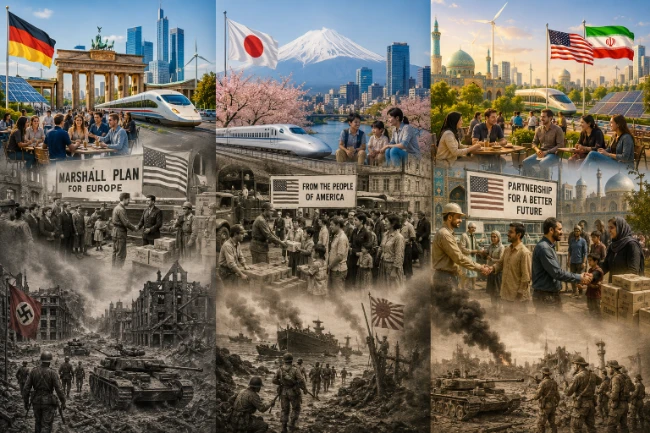
For all the strident talk about their love of America, and the desire to make it great, what the MAGA crowd and others of their ilk forget is that unprincipled use of force is anathema to the founding and guiding principle of the United States of America.
For me the principles and ethics that made the US a powerful and prosperous nation are embodied beautifully in some of the most moving lines of "America the Beautiful", one of our three national anthems.
Confirm thy soul in self-control,Thy liberty in law!
O beautiful for heroes proved
In liberating strife,
Who more than self their country loved
And mercy more than life!
America! America!
May God thy gold refine,
Till all success be nobleness,
And every gain divine!
Those lines contain the principles that guided our treatment of vanquished foes in the war to end all wars: Japan and Germany. By embracing former enemies with economic investment, institutional rebuilding, and genuine partnership we produced two of our staunchest and most important allies in our quest for global peace and prosperity— a result that punishment and isolation simply has never produced.
The transformation of postwar Germany and Japan from existential threats into America's most durable and productive allies remains the most instructive geopolitical experiment of the modern era. And yet, the lessons embedded in that achievement are still routinely ignored, dismissed in favor of sanctions, blockades, and the cold comfort of permanent enmity.
The stakes of forgetting those lessons grow higher with every passing decade, especially when the nation is led by an irascible and unprincipled president who sees war as the most convenient distraction from political turmoil.
The Temptation of Retribution
After World War II ended in 1945, no one would have criticized the United States and its allies for taking a punishing approach to the defeated Axis powers. Germany had plunged Europe into a war that killed tens of millions. Japan had launched a surprise attack on American soil, then conducted campaigns of brutality across the Pacific and Asia that shocked the conscience of the world. The moral case for retribution was overwhelming.
Indeed, early Allied planning leaned in precisely that direction. The Morgenthau Plan, seriously considered by the Roosevelt administration, proposed transforming Germany into a de-industrialized agrarian society — stripping it permanently of the economic and industrial capacity to wage war. Japan faced similar proposals for long-term subjugation.
Had either plan been fully implemented, the twentieth century might have looked very different — and not in a good way. Impoverished, humiliated, stripped of agency and dignity, Germany and Japan would have been fertile ground for exactly the kind of radicalism and resentment that had produced World War II in the first place. History had already provided that lesson: the punitive terms of the Treaty of Versailles after World War I had not secured peace. They had manufactured the conditions for an even more catastrophic war, by reducing Germany to economic desperation and national humiliation while handing demagogues a ready-made grievance to exploit.
The Marshall Plan and the Architecture of Partnership
Announced by Secretary of State George Marshall in 1947, the European Recovery Program offered something radical: not punishment for the past, but investment in the future. The United States channeled the equivalent of roughly $175 billion in today's dollars into rebuilding war-shattered European economies, including — critically — West Germany's. Rather than stripping German industrial capacity, American policy sought to rebuild it. Rather than excluding Germany from the international order, the U.S. helped integrate it into new institutions: NATO, the European Coal and Steel Community, and eventually the architecture that would become the European Union.
The results were not merely economic but civilizational. West Germany's postwar "economic miracle" produced not just prosperity but stability, democratic culture, and a political identity rebuilt around precisely the liberal values it had nearly destroyed. Within a generation, the country whose armies had marched on Moscow and Paris was one of America's most steadfast partners in defending the very order it had tried to overthrow.
Japan's transformation followed a parallel trajectory. Under the American occupation led by General Douglas MacArthur, Japan wasn't just disarmed and supervised — it was transformed for the better. A new democratic constitution was written. Land reform redistributed economic power more broadly. American markets were opened to Japanese goods, allowing export-driven growth to take hold. Educational and institutional reforms were supported and encouraged. As with Germany, the investment in Japanese prosperity paid compounding dividends. The nation that had attacked Pearl Harbor became a cornerstone of American security architecture in Asia, a democratic model for the region, and eventually one of the world's largest and most sophisticated economies.
Neither transformation happened overnight, nor without friction or moral complexity. But the strategic logic was vindicated beyond any reasonable doubt: giving former enemies a genuine stake in the global economic order gives them a reason to defend it.
The Logic of Economic Integration
Prosperity breeds stability. Societies that are economically integrated into global trade networks have something to lose from conflict. They develop commercial relationships, people-to-people ties, and interdependencies that create powerful constituencies for peace. Leaders who might otherwise deploy nationalism and external grievance as political tools find the tactic less useful when their populations are employed, growing wealthier, and engaging with the broader world.
Conversely, isolation breeds radicalism. Societies that are cut off from global commerce, subjected to prolonged sanctions, and denied the material and psychological benefits of international participation tend to turn inward. Authoritarian governments facing sanctions typically use them as propaganda gifts — evidence of external hostility that justifies internal repression and nationalist mobilization. The population suffers; the regime consolidates. Cuba after sixty years of embargo did not democratize. North Korea under comprehensive sanctions did not moderate. Iran after decades of economic warfare did not abandon its most destabilizing policies. Sanctions can constrain, but they rarely transform.
When you want to change a society's relationship to the international order, giving it a profitable place within that order is more likely to work than punishing it for standing outside.
What This Means Now
The United States today faces adversaries and problematic states that seem, to many observers, fundamentally different from postwar Germany and Japan — less amenable to transformation, more ideologically committed to conflict. But that would be a false notion derived from the immediacy of the moment. American leaders pondering options near the end of World War II would have felt a similar level of skepticism as to the likelihood of reshaping the deeply intransigent impulses that drove Japan and Germany to launch wars of conquest.
But the baseline assumption should be that economic partnership and integration are strategic tools of the first order — not naïve concessions or moral weakness, but historically validated instruments of national interest. The instinct to sanction, isolate, and punish should be treated with skepticism, not indulged as the obviously tough-minded response. Ironically, it's the elements of the pending Iran peace plan — relief from oil sanctions, $300 billion in private investments for reconstruction — that are getting the most pushback from American hawks that are most apt to create a lasting peace. Remember that Iran's fundamentalist extremism was born as a reaction against US and European support for a corrupt, sycophantic regime. No people wants to feel dominated or imposed upon by arrogant foreigners. Societies respond far better to opportunities provided to help them achieve prosperity.
America's greatest strategic achievements haven't come from grinding enemies into permanent subjugation. They came from transforming them into partners. The Cold War was won not simply through military deterrence but through the demonstrable superiority of an open economic order — one that, critically, the United States helped construct and invite others into.
The offer worth making is a place in a prosperous, rules-based global community in exchange for behavior consistent with its norms. The road to global harmony has never run through punitive isolation. It has always run through the patient, sometimes costly, always strategically wise work of building the conditions under which former enemies discover that peace pays better than war.
That lesson was learned from the deadliest conflict in human history, followed by a deliberate and visionary choice to do something that followed the moral principles of self-restraint and farsightedness in the founding and guiding principles of a nation destined for lasting greatness.
© 2026 by Asian Media Group Inc.
Recent Articles
- The Filipino American Quarterback Who Led the NFL in Touchdown Passes for Two Seasons
- Khamenei Funeral Attended by Three Sons but Not Successor
- Foxconn Q2 Revenues Jump on Heavy Demand for Nvidia Servers
- Taiwan Military Resumes 'Anti-Communist' Classes for Graduates
- S. Korea Uses Chip Windfall to Fund Growth, Tackle Inequality
- OPEC+ Approves Further Oil Output Increase as Hormuz Exports Start to Recover
- Trump Marks Nation's 250th Birthday with Campaign-Style Speech on National Mall
- Keiko Fujimori Declared Winner of Peru Presidential Race
- Mass Grief at Khamenei Funeral Suggests Hardline Grip Continues
- AI Turbocharged a Startup, Restructures the Economy