

The Filipino American Quarterback Who Led the NFL in Touchdown Passes for Two Seasons
By Wes Yamanoha | 05 Jul, 2026
Roman Gabriel remains the Rams’ all-time passing-touchdown leader.
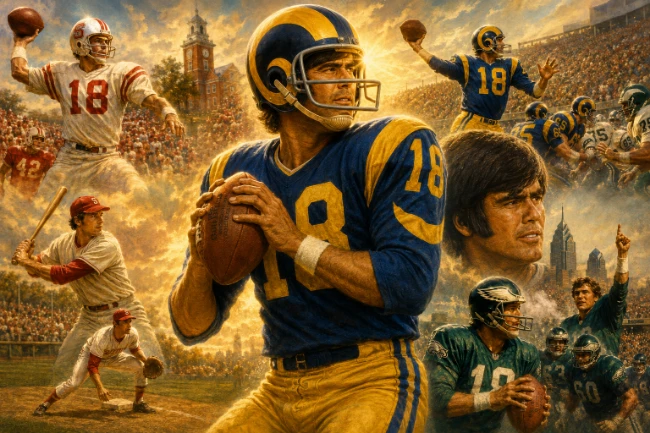
Roman Gabriel was built like the future before football knew what to do with him.
At 6-foot-4 or 6-foot-5, depending on the roster or the memory, and well over 220 pounds in an era when many quarterbacks looked more like defensive backs, Gabriel didn’t fit the mid-century mold. He could throw deep, stand in against the rush, shed tacklers and punish defenders who expected quarterbacks to fold neatly into the turf. Long before the NFL became obsessed with big, strong-armed passers, Gabriel made the position look less like a finesse job and more like a collision sport with a cannon attached.
He also carried a distinction that still matters: he was the NFL’s first Filipino American quarterback. More than six decades after he entered the league, he remains one of the most accomplished Asian American players in pro football history — a league MVP, a four-time Pro Bowler, a Comeback Player of the Year, and the Rams’ all-time leader in touchdown passes with 154. Even in an era when the Rams have had Kurt Warner, Matthew Stafford, Jim Everett, Marc Bulger, Jared Goff and Norm Van Brocklin, Gabriel’s touchdown mark still stands.
Son of a Filipino Immigrant
Gabriel’s story began far from the glamour of Los Angeles. Roman Ildonzo Gabriel Jr. was born on August 5, 1940, in Wilmington, North Carolina. His father, Roman Gabriel Sr., had come to the United States from the Philippines and worked on the railroad. His mother, Edna, was Irish American. In the South of the 1940s and 1950s, that made Gabriel unusual before he ever picked up a football. Looking back, he described himself with a touch of humor and pride as the “only Filipino-Irish quarterback to play in the league.”
His Filipino roots mattered to him, but in the world he grew up in, they also marked him as different. The Filipino community in North Carolina was tiny, and Gabriel later recalled that a family member helped make football seem possible. His cousin Emo Boado, he said, “was the first Filipino I knew to play college football.” That wasn’t a small thing. For a boy who didn’t see people like himself on football fields or in headlines, one relative in pads could become a map.
Gabriel also had to outgrow a body that didn’t always cooperate. As a child, he suffered from severe asthma. He later remembered having to stop on the way to school just to catch his breath. The irony is almost too neat: a boy once slowed by breathing trouble became one of the hardest quarterbacks in football to bring down.
At New Hanover High School in Wilmington, Gabriel became a three-sport athlete, starring in football, basketball and baseball. He didn’t come across as a narrow specialist. He was a big, coordinated athlete with a strong arm, the kind of player who could dominate high school competition simply by being bigger, stronger and more gifted than almost everyone else. His size made him a natural on the basketball court. His arm made baseball scouts pay attention. Football, though, gave him the stage on which he would become something close to a prototype.
NC State's 2-Time All-American
Gabriel stayed in-state for college, enrolling at North Carolina State. From 1959 through 1961, he became one of the most important players in Wolfpack history. He was a two-time first-team All-American, a two-time ACC Player of the Year and an Academic All-American. He set 22 school records and nine conference records, and NC State later retired his No. 18, making him the first athlete in school history to have his number retired.
His college numbers don’t look gaudy by modern standards because he played in a very different football world. Teams still leaned heavily on the run. Passing was riskier, rougher and less protected by rules. Even so, Gabriel became the first NC State player to lead the NCAA in a statistical category, topping the nation with a 60.4% completion rate in 1959. Over three seasons in Raleigh, he passed for 2,951 yards and 19 touchdowns, ran for 15 more scores and established an ACC record with 34 total touchdowns.
Wolfpack Homerun King
He was also a real baseball player, not merely a football star dabbling in spring. In 1961, he led NC State with five home runs and 18 RBIs as a junior first baseman. That detail helps explain the full Gabriel package. He wasn’t just a big quarterback. He was a full-spectrum athlete, strong enough for football, coordinated enough for baseball, mobile enough to run and tough enough to play defense in college.
By 1962, pro scouts were convinced. The Oakland Raiders made him the No. 1 pick in the AFL draft, while the Los Angeles Rams took him No. 2 overall in the NFL draft. Gabriel chose the Rams, stepping into one of the league’s glamour franchises at a time when Los Angeles football mixed Hollywood flash with old-school violence.
The beginning wasn’t easy. Gabriel didn’t immediately become a star. He shared time with Zeke Bratkowski and Bill Munson, and the Rams remained a frustrating team. He had the body, arm and athletic gifts, but he needed a coach willing to build around him. That coach arrived in 1966, when George Allen took over the Rams and made Gabriel his starting quarterback. The partnership changed both Gabriel’s career and the Rams’ trajectory.
Powering the Rams' Comeback
In 1966, Gabriel started all 14 games and led the Rams to their first winning season since 1958. In 1967, he threw for 2,779 yards and 25 touchdowns as Los Angeles went 11-1-2, won the Coastal Division and fielded the NFL’s highest-scoring offense. That season announced Gabriel as more than a curiosity or physical marvel. He was now a winning NFL quarterback.
His peak came in 1969. Gabriel threw 24 touchdown passes against only seven interceptions and won the NFL Most Valuable Player award. The Rams went 11-3, and for a time that season they looked like the best team in football. Gabriel led the league in touchdown passes, giving the NFL a Filipino American passing champion at a time when Asian American representation in major US sports was almost invisible.
The Rams didn’t win the championship, and that has always been the hole in Gabriel’s Hall of Fame case. The 1969 team started 11-0 before fading late and losing in the playoffs to the Minnesota Vikings. Gabriel never reached a Super Bowl. In an era when postseason success often became the shorthand for greatness, that absence helped push him into the category of “underappreciated” rather than universally celebrated.
But the numbers and honors remain substantial. From 1967 through 1970, Gabriel led the Rams to a 41-14-4 record. He made the Pro Bowl three straight seasons from 1967 through 1969, was named All-Pro in 1969 and became the NFL’s MVP. His style was rugged and modern at the same time. He wasn’t a scrambling magician, but he wasn’t a statue either. He could move, absorb hits and keep passing. Years later, he explained the foundation of his game simply: “my career was predicated on being strong.”
Flirting with Hollywood
Gabriel’s Los Angeles years also brought him into Hollywood’s orbit. He appeared in films and television shows, including “The Undefeated” with John Wayne and Rock Hudson, along with episodes of shows like “Gilligan’s Island,” “Perry Mason,” “Ironside” and “Wonder Woman.” His name sounded cinematic, his face fit the screen and his body looked like it had been cast for a western. But football remained the main act.
Injuries and coaching changes eventually strained his Rams tenure. After the 1972 season, Los Angeles acquired John Hadl and traded Gabriel to the Philadelphia Eagles. It looked like the end of his prime. Instead, Gabriel delivered one of the great late-career rebound seasons of the 1970s.
Late Glory with Eagles
In 1973, with Philadelphia, he led the NFL in completions, attempts, passing yards and touchdown passes. He threw for 3,219 yards and 23 touchdowns, both league highs, and won NFL Comeback Player of the Year. That season gave him his second year as the league’s touchdown-pass leader, four years after his MVP season with the Rams. The title of passing-touchdown king wasn’t a one-year fluke. Gabriel did it in Los Angeles at his peak and again in Philadelphia after many thought he was declining.
His Eagles years also stretched his career to 16 NFL seasons. By the time he retired after the 1977 season, Gabriel had thrown for 29,444 yards and 201 touchdowns, with a winning record as a starter. Those numbers were more impressive in context than they may look now. He played before the five-yard contact rule, before quarterbacks were protected as they are today, before receivers ran through wide-open passing spaces created by modern schemes and officiating. He played when defensive linemen could punish quarterbacks in ways that would now draw flags, fines and slow-motion debate.
CBS Broadcaster and Coach
After football, Gabriel worked as a broadcaster and coach. He called games for CBS, coached at Cal Poly Pomona, worked in the USFL and later coached in the World League of American Football. He also devoted years to charity work. NC State credits him with raising more than $7 million for various organizations over three decades after his playing career.
The one football honor that never came was induction into the Pro Football Hall of Fame. His supporters have long argued that he belongs in Canton, and the case isn’t frivolous. He was an NFL MVP, a four-time Pro Bowler, an All-Pro, a Comeback Player of the Year, a college Hall of Famer and a record-setting franchise quarterback. Former Dallas Cowboys great Bob Lilly once said Gabriel had “as good a set of numbers as anyone in there.”
Gabriel himself sounded more philosophical than bitter about it. He said Hall of Fame recognition wasn’t the most important thing. “It’s being who I am, who I represent,” he told NBC News in 2018. That line may be the cleanest summary of his larger meaning. He represented a football possibility most Americans hadn’t imagined in the 1960s: an Asian American quarterback not as a novelty, not as a backup gimmick, but as the best player in the league.
Roman Gabriel's Legacy
Late in life, Gabriel divided time between Wilmington, North Carolina, and Little River, South Carolina. He dealt with heart problems and arthritis but still projected a certain stubborn contentment. “I am retired with heart problems and arthritis but happy,” he told the Los Angeles Times in 2021. He died on April 20, 2024, at age 83.
Roman Gabriel’s football legacy can be told through the obvious achievements: two-time ACC Player of the Year, two-time All-American, 1969 NFL MVP, two seasons leading the NFL in touchdown passes, 201 career touchdown throws, 29,444 passing yards, College Football Hall of Fame, Rams all-time passing-touchdown leader. Those are the hard markers.
But the deeper legacy is that he made an unlikely figure central to the story of American football. The son of a Filipino immigrant and an Irish American mother, a boy with asthma from Wilmington, became the face of a Los Angeles franchise, the prototype for a bigger quarterback age and the only Asian American ever named NFL MVP.
The NFL eventually learned to celebrate big quarterbacks with strong arms and sturdy frames. Roman Gabriel was there before the league knew how much it needed them.
© 2026 by Asian Media Group Inc.
Recent Articles
- The Filipino American Quarterback Who Led the NFL in Touchdown Passes for Two Seasons
- Khamenei Funeral Attended by Three Sons but Not Successor
- Foxconn Q2 Revenues Jump on Heavy Demand for Nvidia Servers
- Taiwan Military Resumes 'Anti-Communist' Classes for Graduates
- S. Korea Uses Chip Windfall to Fund Growth, Tackle Inequality
- OPEC+ Approves Further Oil Output Increase as Hormuz Exports Start to Recover
- Trump Marks Nation's 250th Birthday with Campaign-Style Speech on National Mall
- Keiko Fujimori Declared Winner of Peru Presidential Race
- Mass Grief at Khamenei Funeral Suggests Hardline Grip Continues
- AI Turbocharged a Startup, Restructures the Economy