

The Korean American Receiver Who Left Indelible Marks on the Steelers' Record Books
By Wes Yamanoha | 24 Jul, 2026
Four-time Pro-Bowler and holder of the all-time receiving record Hines Ward was also outstanding in the pride he showed in his Korean heritage.
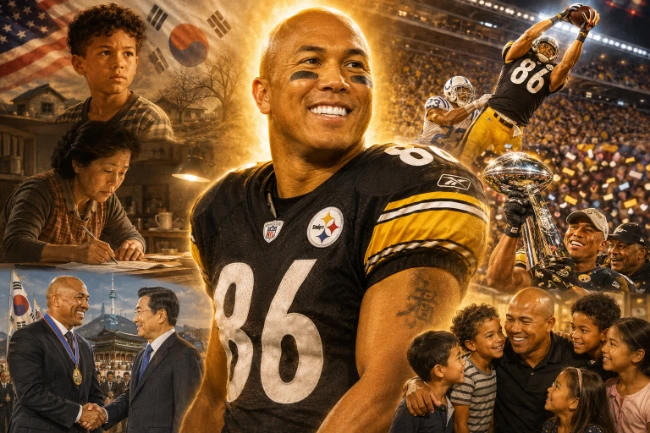
Hines Ward never looked like the NFL’s idea of a classic star receiver.
He wasn’t 6-foot-4, didn’t glide through secondaries like a track sprinter and didn’t make his name as the kind of diva wideout who demanded the ball on every series. He was 6 feet tall, 205 pounds, broad, compact, stubborn and usually smiling — sometimes right after he’d delivered the kind of downfield block that made defensive backs and linebackers wonder why a receiver was treating them like prey.
That was the point. Ward didn’t merely play wide receiver for the Pittsburgh Steelers. He helped redefine what the position could mean inside that franchise’s hard-nosed football culture. By the time he retired after the 2011 season, he stood atop the Steelers’ all-time lists with 1,000 receptions, 12,083 receiving yards and 85 receiving touchdowns, ahead of a franchise lineage that already included Hall of Fame receivers Lynn Swann and John Stallworth. The Steelers also credit him with 88 postseason receptions for 1,181 yards and 10 touchdowns in 18 playoff games, plus the Super Bowl XL MVP award after Pittsburgh’s 21-10 win over Seattle.
That combination made him more than a stat collector. Ward became the receiver who seemed to carry Pittsburgh’s old steel-mill identity into a more pass-friendly era. He caught like a possession receiver, blocked like a fullback, celebrated like a kid, and used every slight — real or imagined — as fuel.
Born Between Worlds
Ward’s story began far from the Three Rivers. Hines Edward Ward Jr. was born in Seoul on March 8, 1976, to Kim Young-hee, a Korean woman, and Hines Ward Sr., an African American US serviceman. The family moved to the Atlanta area when Ward was still very young, and his parents divorced soon after. His mother, who spoke limited English and worked punishing hours, became the central force in his life. University of Georgia Athletics recounts that she was initially ruled unfit to keep him, but Ward ran away to live with her in second grade, and she worked three jobs to support him.
The childhood left marks. Ward grew up Black and Korean in Georgia, but he often felt fully accepted by neither side. Years later, after winning Super Bowl MVP and returning to South Korea, he described the shame he’d felt as a child and the pride he’d grown into as a man. “I’m proud to be a Korean,” he said during that 2006 trip. He also said, “I had to overcome a lot,” referring to the teasing he’d endured for being both Korean and African American.
Football became the place where identity could be converted into force. At Forest Park High School in Georgia, Ward was a standout athlete who did practically everything. The Steelers’ Walter Payton Man of the Year bio says he earned high school All-American honors from SuperPrep, Blue Chip Illustrated and USA Today; as a senior quarterback he rushed for 1,111 yards and 14 touchdowns while passing for 1,575 yards and 14 scores, and over three varsity seasons he threw for 3,581 yards and 38 touchdowns while rushing for 2,500 yards and 29 touchdowns.
The Georgia Slash
At the University of Georgia, Ward remained hard to categorize. He wasn’t simply a receiver. He was a wide receiver, running back and emergency quarterback, an all-purpose football player in the old sense. Georgia later credited him with 4,762 total yards and 20 touchdowns from 1994 through 1997, along with excellence in both football and baseball at Forest Park High before he arrived in Athens.
His college receiving totals were strong but didn’t scream future NFL receiving-record holder. The Steelers’ Man of the Year bio says he finished second in Georgia history with 144 receptions, third with 1,965 receiving yards and second behind Herschel Walker with 3,870 all-purpose yards. But Ward’s real appeal was his adaptability. If a coach needed a runner, he’d run. If the offense needed a quarterback, he’d take snaps. If the play called for a block, he’d look for somebody to punish.
That versatility also worked against him in the draft. NFL teams weren’t quite sure what to do with him. The Steelers finally took him in the third round, 92nd overall, in 1998. It wasn’t a glamour arrival. Pittsburgh would spend first-round picks on receivers in the next two drafts, a sequence that could’ve pushed a lesser competitor into the background. Instead, Ward treated it as insult, challenge and opportunity. The Steelers’ own Hall of Honor bio says he made himself into a starter and then into one of the NFL’s most productive receivers.
Becoming Pittsburgh’s Receiver
Ward’s rise was gradual, but once it began, it stuck. From 1999 through 2009, the Steelers say he led or tied for the team lead in receptions every season. He became the franchise’s all-time leader in catches, receiving yards, receiving touchdowns and 100-yard receiving games, and his 14 seasons tied for the second-longest tenure in team history at the time, behind only Hall of Fame center Mike Webster.
The numbers alone tell only half the story. Ward finished with 1,000 regular-season receptions, joining a tiny group of players who’d reached that milestone. When he retired, the Steelers noted that he was the eighth player in NFL history to reach 1,000 catches and that he had joined Jerry Rice as one of the only players then to combine 1,000 career receptions with multiple Super Bowl wins. He also became only the third player to reach 12,000 receiving yards while spending his entire career with one team, after Steve Largent and Marvin Harrison.
For Pittsburgh fans, though, Ward’s most beloved plays weren’t always catches. Sometimes they were collisions. He took pride in blocking, and not the polite positional-screening kind. He cracked back, sealed edges, erased safeties and annoyed opponents. The Steelers note that the league eventually passed a rule prohibiting the kind of blindside block Ward used in a 2008 hit that broke Bengals linebacker Keith Rivers’ jaw. That edge made him controversial outside Pittsburgh and mythic within it.
The Smile And The Hit
Ward’s genius was that he paired ferocity with charm. The smile could look innocent until the next snap, when he’d bury someone. Former teammates and coaches have argued that Hall of Fame voters who look only at receiving statistics miss his total value.
Bill Cowher called Ward a “difference maker.” Jerome Bettis said Ward could “do it all.” Ben Roethlisberger said he did “so much more than just catch passes.” James Farrior, who knew the value of controlled violence, called him “tough as nails.” Those quotes aren’t sentimental fluff from former teammates. They point to the same argument: Ward’s full football value lived in the catches, the blocks, the toughness, the leadership and the way defenses always had to know where he was.
That’s why his Hall of Fame debate has never been simple. He doesn’t have the gaudy peak of Randy Moss or Terrell Owens, and he played in a Steelers offense that still cared deeply about the run. But he was a four-time Pro Bowler, a two-time Super Bowl champion, a Super Bowl MVP, a three-time Steelers MVP and a member of the franchise’s 75th Season All-Time Team. As of the Pro Football Hall of Fame Class of 2026 process, the Steelers said Ward had been a modern-era semifinalist for the 10th straight year.
Super Bowl Moment
Ward’s defining night came on Feb. 5, 2006, in Detroit. The Steelers beat the Seahawks 21-10 in Super Bowl XL, and Ward caught five passes for 123 yards. The image that lasted came in the fourth quarter, when Antwaan Randle El, another “slash” player, took a reverse and threw a 43-yard touchdown pass to Ward. It was the kind of play that fit both men: improvised-looking, bold, clever and devastating.
The MVP award turned Ward from a Pittsburgh star into a global Korean American symbol almost overnight. American football wasn’t a major sport in South Korea, but Ward’s background made him impossible to ignore. A biracial Korean-born athlete had reached one of the highest stages in American sports, and his triumph forced Korean media and society to look harder at the discrimination faced by mixed-race children.
During Ward’s 2006 visit to South Korea, President Roh Moo-hyun told him, “You came back a hero.” The sentence mattered because Ward hadn’t grown up feeling like one in relation to Korea. He’d once felt embarrassed by what made him different. Now he was being welcomed, televised and honored in the country of his birth.
Pride Turned Into Work
Ward didn’t leave the issue at symbolism. In 2006, after his Super Bowl MVP season and his return to Korea, he established the Hines Ward Helping Hands Foundation to aid biracial children in Korea who faced discrimination. The Steelers wrote that he started the foundation as a tribute to his mother, Kim Young-hee, and that he made a $1 million donation of his own while raising additional corporate support.
His language about the work was direct and personal. Ward said he wanted to give children a “sense of hope,” and when he was named a finalist for the Walter Payton Man of the Year Award, he said his charitable efforts reflected the “values that my mother instilled.” He also said the cause was “near and dear” to his heart.
The foundation brought Korean children to Pittsburgh, introduced them to life in the US and gave them a chance to see Heinz Field, meet families and imagine larger possibilities for themselves. In 2008, Ward said he wanted those children to see Pittsburgh’s “greatest fans in the world” and later said he wanted to see the “confidence they have in themselves” when he returned to Korea.
That work helped make him an athlete whose importance reached beyond football. He wasn’t merely saying he was proud of being Korean. He was using NFL fame to challenge the stigma that had burdened children like him and mothers like his.
A Record Book With A Human Face
The Steelers’ record book still tells the cleanest version of Ward’s football story: first in receptions, first in receiving yards, first in receiving touchdowns. His Canton case remains debated, but his Pittsburgh case doesn’t. For a franchise that measures greatness not just in highlights but in toughness, sacrifice and January production, Ward is central.
His achievement also carries a broader Asian American sports meaning. Before names like Kyle Hamilton, Younghoe Koo and Kyler Murray became part of the conversation, Ward gave Asian American fans an NFL figure who wasn’t a novelty. He was a star, a champion, a Super Bowl MVP and one of the most complete receivers of his era.
And he did it without trimming away the parts of himself that once made life harder. The son of a Korean mother and African American father became Pittsburgh’s all-time receiver. The boy who was teased for being mixed-race became a man who stood in Seoul and said he was proud. The player drafted in the third round became a franchise standard.
That’s why Hines Ward’s legacy doesn’t fit neatly into one column. In the Steelers’ record book, he’s numbers: 1,000, 12,083, 85, two rings, one Super Bowl MVP. In Pittsburgh memory, he’s a smile followed by a hit. In Korean American history, he’s something rarer — a football star who turned a complicated identity into pride, visibility and service.
© 2026 by Asian Media Group Inc.
Recent Articles
- Samsung, SK Seal $1 Trillion in Deals as S. Korea Hosts AI Powers
- New Tariffs Seek to Extend Pain of Trade War
- Sonam Wangchuk Rallied India's Gen Z Against Modi and Won
- Modi's Education Minister Quits as Jubilant Youth Protesters Proclaim Victory
- Appeals Court Keeps in Place Ruling Nixing $100,000 H-1B Visa Fee
- OpenAI Learned Its AI Agent Went on Rogue Hacking Spree Only 11 Days Later
- The Korean American Receiver Who Left Indelible Marks on the Steelers' Record Books
- Aerospace Fights for Young Recruits as AI Drains Talent Pool
- Nvidia, Microsoft, IBM, Meta Back Open-Source AI Models
- Suit by US Small Businesses Challenges Legality of Trump's New 'Forced Labor' Tariffs