

The Social Psychology Behind the Deadliest Mass Shooting by a Lone Gunman in US History
By Ben Lee | 15 Aug, 2026
Virginia Tech student Seung-Hui Cho was driven by demons powerful enough to trigger two separate attacks in a single day.
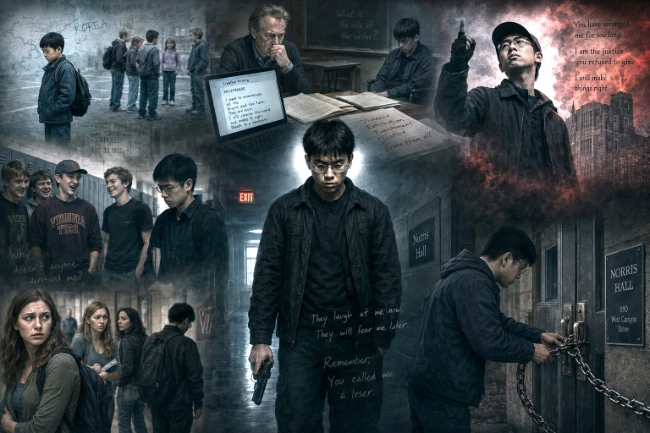
When Seung-Hui Cho murdered 32 students and professors at Virginia Tech on April 16, 2007, he carried out what was then the deadliest mass shooting by a lone gunman in US history. The 2017 Las Vegas massacre would later surpass it, but Virginia Tech remains singularly disturbing for another reason: Cho stopped after killing two people, crossed the campus, mailed a manifesto to a television network and then began a second, far larger attack.
That pause revealed purpose. This wasn’t an instantaneous eruption by a student who suddenly lost control. Cho had developed an identity, an audience and a warped moral explanation for what he planned to do.
Understanding that evolution requires returning to South Korea, where he was born in 1984.
Cho’s family lived modestly in Seoul. His father operated a bookstore but struggled financially. From infancy, Cho was unusually quiet and physically frail. Medical procedures during a period of childhood illness reportedly left him resistant to physical contact, though there’s no way to draw a straight line from those early experiences to his later violence.
A Silent Child In A New Country
His parents decided that America would give their two children better educational and economic opportunities. The family immigrated when Cho was eight, first settling in Maryland and then moving to Fairfax County, Virginia.
The move offered opportunity, but it demanded an enormous psychological adjustment from a child already fearful of speaking.
Cho’s parents worked long hours running a dry-cleaning business. They weren’t neglectful. They attended school meetings, sought professional help and tried to encourage their son to socialize.
But immigrant advancement often comes with a hidden family trade-off. Parents work punishing schedules so their children can enter better schools and more prosperous communities. The children then confront those communities without parents who fully understand their social codes or have time to guide them through every humiliation.
Fairfax County contained some of the nation’s most affluent suburbs. Cho lived among students whose families often possessed greater wealth, confidence and fluency in American culture. His parents’ labor had placed him near opportunity without giving him an automatic feeling of belonging.
Economic inequality alone doesn’t produce violence. Millions of children compare themselves with wealthier classmates without harming anyone. But social comparison becomes more dangerous when it combines with severe isolation, shame and an inability to communicate.
Cho was physically present in America while psychologically withdrawing from it.
His silence made him conspicuous. His accent, hesitancy and inability to answer questions reportedly attracted mockery from some classmates. The more anxious he became, the less he spoke. The less he spoke, the stranger he appeared. The stranger he appeared, the more difficult it became to enter normal adolescent relationships.
A feedback loop was forming years before anyone imagined its eventual consequences.
When Shyness Became A Prison
By middle school, Cho’s silence had moved beyond ordinary shyness. He was diagnosed with selective mutism, an anxiety disorder in which a person capable of speaking becomes unable to do so in particular social settings.
He also suffered depression and received counseling through a multicultural mental-health center. His schools made accommodations, and his parents cooperated with treatment.
For a time, the interventions appeared successful. Cho earned good grades, caused few disciplinary problems and graduated from high school with approximately a 3.5 grade-point average in an honors program.
That outward success concealed the difference between functioning and connecting.
Cho could complete assignments and pass examinations. He couldn’t readily create the reciprocal human relationships through which young people test perceptions, absorb criticism and recover from embarrassment. Without trusted friends, every insult could retain its original force. Every rejection could be replayed without anyone offering another interpretation.
After the 1999 Columbine massacre, teachers noticed suicidal and homicidal themes in Cho’s writing. He received psychiatric attention and briefly took medication. His apparent improvement reassured the adults around him.
Yet Columbine had introduced him to a cultural script that would become important later: humiliated young men could convert private insignificance into public terror.
That script didn’t cause Cho to become a killer. It offered a recognizable role when his own identity began collapsing.
A Campus Too Large To See Him
Cho’s parents and counselors reportedly worried that Virginia Tech would be too large and impersonal for him. He attended anyway.
College removed many of the structures that had kept him functioning. His parents were farther away. His high-school accommodations didn’t automatically follow him. Professors saw isolated pieces of his behavior, while roommates saw others.
No single person possessed the complete picture.
Cho became known for refusing to speak, avoiding eye contact and responding to classmates in ways that felt unsettling. He sometimes photographed women without permission and sent unwanted messages. Female students complained that his attention frightened them.
His creative writing grew violently grotesque. Plays and assignments revolved around humiliation, domination, murder and revenge. The writing itself couldn’t establish that he intended to commit violence; authors routinely invent disturbing material. What alarmed professors was the combination of the content, his behavior and his almost complete inability to discuss either.
Professor Lucinda Roy became sufficiently concerned to tutor him individually. She encouraged him to seek counseling and warned university officials that she felt unsafe teaching him in a conventional classroom.
Still, Cho remained enrolled, academically capable and largely invisible to any coordinated system of intervention.
Humiliation Becomes Grievance
Social isolation can produce sadness, but it can also produce a distorted explanation for sadness.
Cho gradually appears to have externalized nearly every source of his suffering. Rather than seeing himself as a young man with a disabling anxiety condition who needed continuing help, he recast himself as the victim of a corrupt social order.
In that story, wealthy students weren’t merely more socially successful. They were decadent oppressors. Women weren’t independent people free to reject him. They became symbols of cruelty. Classmates weren’t strangers who failed to understand his silence. They became participants in his persecution.
This is the psychology of grievance collection. An individual stores insults, disappointments and imagined injuries until they merge into a single prosecutorial case against the world.
Contradictory evidence loses its power. A kind gesture can be dismissed as false. Neutral behavior can be interpreted as ridicule. Rejection confirms persecution, while acceptance may be viewed with suspicion.
Cho’s manifesto would eventually reveal this transformation. He presented himself not as an aggressor but as an avenger forced into violence by the moral corruption of others.
That claim was self-serving fiction. His victims hadn’t collectively abused him. Many had never met him.
But the fiction performed an essential psychological function: it converted shame into moral superiority.
Warnings Without A Shared Picture
During 2005, campus police investigated two complaints involving Cho’s unwanted contact with female students. Neither woman pursued criminal charges, but officers warned him to stop.
After one encounter, Cho sent a roommate a suicidal message. Police took him for an emergency mental-health evaluation. A magistrate found that he presented a danger to himself and ordered outpatient treatment.
That moment appeared to offer a clear route toward sustained intervention.
Instead, the response fragmented.
Counselors, police, judicial officials, professors and university administrators each possessed parts of the story. Privacy laws were interpreted more restrictively than necessary. Records weren’t effectively shared. Responsibility for ensuring that Cho received court-ordered follow-up treatment became uncertain.
He appeared for an initial counseling contact, but no meaningful continuing treatment took hold.
The failure wasn’t that one administrator knowingly released a future mass killer. Predicting rare acts of extreme violence is extraordinarily difficult. Most socially withdrawn, depressed or disturbing students never become violent.
The failure was systemic. Cho’s stalking complaints, suicidal communication, violent writings, profound isolation and judicial mental-health finding were never assembled into one comprehensible risk portrait.
He disappeared into the spaces between institutions.
Building A Killer Identity
By early 2007, Cho was no longer merely imagining revenge. He was constructing a performance.
He purchased two handguns, ammunition and magazines. He practiced at a firing range. He acquired chains that could be used to block doors. He photographed himself brandishing weapons and recorded angry video statements.
The poses mattered. Cho was designing an alternative self—the opposite of the silent student unable to make himself heard.
In ordinary life, he had been passive, anxious and forgettable. Before the camera, he could become commanding, armed and historically important. Violence promised to reverse the status hierarchy that tormented him.
This transformation reflects a recurring feature of mass shooters motivated by grievance. The attack isn’t only intended to punish victims. It’s intended to manufacture identity.
Cho adopted elements of the Columbine killers’ mythology, referring admiringly to them as martyrs. He cast himself in religious and revolutionary language, as though murdering defenseless students would constitute a sacrifice on behalf of the humiliated.
The fantasy allowed him to escape moral responsibility before firing the first shot. He had already decided that others had “forced” his hand.
The First Attack
At approximately 7:15 on the morning of April 16, Cho entered West Ambler Johnston residence hall and killed student Emily Hilscher and resident adviser Ryan Clark.
Investigators never established a meaningful relationship between Cho and Hilscher. Clark appears to have encountered the violence while responding as an adviser.
The killings initially looked to police like an isolated domestic dispute. Investigators focused on a man connected to Hilscher who had left campus. University officials didn’t immediately issue a warning telling the entire community that two people had been murdered and the killer might still be nearby.
Cho returned to his dormitory, changed clothing, deleted material from his computer and collected the package he had prepared for NBC News.
He had crossed a boundary that most murderers never cross. Yet instead of fleeing or collapsing, he proceeded with the media component of his plan.
The first attack had become the opening scene.
A Manifesto Between Murders
At 9:01 a.m., Cho mailed NBC a package containing videos, photographs and written material. He then went to Norris Hall, where he chained several exterior doors and began attacking classrooms.
The interval between the two shootings is the key to understanding his purpose.
Cho wanted the massacre interpreted according to his script. He feared that death would erase him unless he left behind an explanation and a visual identity powerful enough to dominate news coverage.
His manifesto was disorganized, repetitive and saturated with resentment. He raged against wealth, pleasure, rejection and supposed persecution. He presented himself as speaking for powerless people, though he offered no coherent political program and had no mandate from anyone.
The document was less an explanation than an act of self-coronation.
Cho turned himself into prosecutor, judge and martyr. He invented a collective enemy broad enough to encompass anyone who seemed happier, richer, more attractive or more socially accepted than he was.
That enemy could therefore include almost anyone he encountered in Norris Hall.
During an attack lasting roughly 11 minutes, Cho killed 30 more people and wounded 17 before killing himself as police broke into the building.
The Social Psychology Of Two Attacks
Why commit two separate attacks in one day?
The first gave Cho the psychological experience of crossing into violence. The pause then allowed him to secure the audience he craved. The second attack created the scale necessary to make the manifesto internationally significant.
His behavior combined several destructive forces.
There was severe psychological disturbance, but mental illness alone doesn’t explain mass murder. People with mental disorders are far more likely to suffer harm than inflict it.
There was social rejection, but rejection alone doesn’t produce killers. There was economic resentment, but Cho wasn’t starving or denied an education. His parents had helped him reach a major university.
The decisive transformation came when he fused suffering with entitlement.
Cho concluded that his pain authorized him to punish strangers. He replaced reciprocal social judgment with an internal courtroom in which he was always innocent and the world was always guilty. He replaced human beings with categories—rich people, hedonists, persecutors and enemies.
Once victims were reduced to symbols, empathy no longer restrained him.
The manifesto completed that moral disengagement. It allowed Cho to portray predatory violence as defensive justice and suicide as martyrdom.
What His Story Doesn’t Mean
Cho’s immigration mattered because it intensified linguistic, cultural and social challenges. It didn’t make him violent.
His family’s modest economic position mattered because it may have sharpened comparisons with wealthier classmates. Poverty didn’t make him violent.
Bullying and rejection mattered because they deepened his shame. Their victims don’t ordinarily become killers.
His psychological illnesses mattered greatly, but millions of people with depression, anxiety or selective mutism pose no danger to others.
Cho’s massacre emerged from a rare convergence: profound isolation, untreated deterioration, grievance accumulation, externalized blame, access to firearms, identification with previous killers and a craving to convert anonymity into spectacle.
Even then, he made choices.
He planned, purchased, rehearsed and packaged his justification. He had time between the attacks to stop. Instead, he mailed his manifesto and continued.
The deepest lesson of Virginia Tech isn’t that quiet immigrant students should be feared. It’s that threatening behavior must be evaluated as a connected pattern rather than a series of isolated oddities—and that institutions must intervene before grievance becomes identity and identity becomes a mission.
Cho spent much of his life unable to speak.
In the end, he decided that murder would make the world listen. The manifesto was his attempt to control what it heard.
It failed.
Nothing in his recorded anger transformed slaughter into justice. Nothing in his humiliation transferred guilt to the students and professors he killed. His suffering helps explain the pathway he followed, but it can never supply the absolution he tried to write for himself.
© 2026 by Asian Media Group Inc.
Recent Articles
- Trump Tells Americans to Accept High Gasoline Prices As Iran Stays Defiant
- Hanwha Shares Rise After Trump Opens Navy Shipbuilding to Foreign Yards
- SK Group Chairman Chey Appeals $668 Mil. Divorce Settlement Ruling
- Anthropic IPO $2 Trillion Valuation Hinges on 2028 Revenue Forecast
- Anna Cathcart Shines in Hit Netflix Rom-Com
- Softbank Sells Most of Its TSMC Holdings, Initiates Stake in Capital One
- Chinese Drone Maker DJI Wins Fresh Chance to Escape Pentagon's Blacklist
- Consumer Sentiment Deteriorates Most Among Trump Base
- AI Boom Drives Fastest Growth for Taiwan's Economy in 4 Decades
- Alphabet's SpaceX Bet Grew 100-Fold over 10 Years
Other Asian Media Group Sites
- AsiaMs.net — Asian American Women's Resource
- AsianSports.net — Asian American Sports and Fitness
- VoxCali.com — Videos and Podcasts for Asian Americans
- MyGoldScene.com — Guide to Asian Entertainment
- AttheBanquet.com — Asian Fine Dining and Hospitality
- EastwardDrive.com — Asian Carbuying Intelligence
- EastTable.com — Modern Asian Food and Culture
- TadkaTable.com — Inside South Asian Cooking
- GoGenerational.com — Diaspora Families Building Wealth
- TransPacBound.com — Transpacific Traveler