

The Young Brown Alum Leading India's Top Tech Giant into the AI Era
By Ben Lee | 23 Jul, 2026
At 34 Akash Ambani has already led Reliance Industries' digital empire for over 4 years, effectively guiding India's AI adoption.
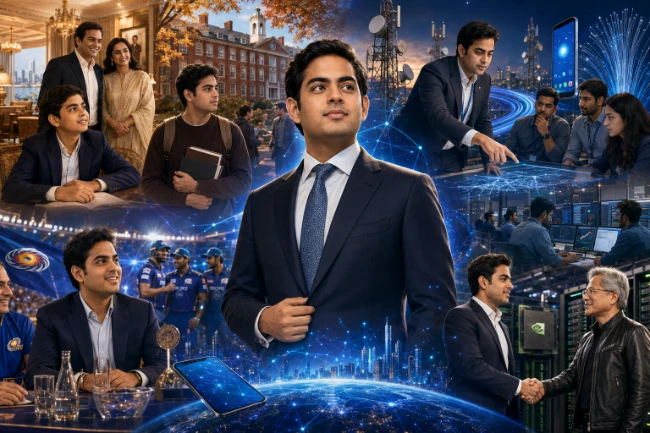
Akash Ambani’s ascent has followed a more demanding path than what some might imagine for the heir apparent to one of Asia's largest business empires. He hasn't been sheltered waiting for an aging patriarch to step aside before assuming a ceremonial position at the top.
At 69, his father Mukesh Ambani is very much active and firmly in charge of India's largest business empire which he still holds privately. Akash has been more of an apprentice since just after college, with real responsibility to learn and contribute to the business most closely tied to Reliance Industries’ future for the past dozen years.
And since June 2022, when he was just 30, Akash has served as chairman and managing director of Reliance Jio Infocomm after having been a director of the company since 2014. He had worked on Jio’s development before its spectacular commercial launch in 2016. Today he’s also managing director of Jio Platforms, the broader digital operation encompassing telecommunications, software, cloud services, entertainment and other technologies.
Jio now serves more than 524 million customers, giving Akash responsibility for a digital population larger than that of nearly every nation on earth.
The appointment wasn’t a generous father giving his son something important to do. Mukesh effectively put Akash in charge of the part of Reliance that must carry the conglomerate beyond its traditional dependence on petroleum refining, petrochemicals and other industrial assets. Jio is expected to become the platform through which Reliance reaches consumers, distributes entertainment, sells digital services and introduces artificial intelligence into Indian homes and businesses.
That makes Akash more than a corporate heir. It puts him in a position to influence how hundreds of millions of Indians first experience useful, affordable AI.
Born Into An Extraordinary Family
Akash was born in Mumbai on October 23, 1991, minutes before his twin sister Isha. Their younger brother, Anant, arrived in 1995. Their father was then building Reliance into an industrial giant, while their mother, Nita Ambani, would eventually create one of India’s most prominent philanthropic, educational, cultural and sporting organizations.
The twins grew up under circumstances almost unimaginably privileged by ordinary standards, but they also grew up inside a family whose identity revolved around building businesses. Their grandfather Dhirubhai Ambani had begun with modest means before creating Reliance, while Mukesh Ambani transformed that foundation into an energy, retail and telecommunications empire.
That family history created expectations that wealth alone couldn’t satisfy. Akash and his siblings weren’t merely expected to preserve a fortune. They were expected to identify businesses capable of sustaining Reliance through another generation.
Akash attended school in Mumbai before enrolling at Brown University in Rhode Island, where he earned a bachelor’s degree in economics in 2014. He has maintained his connection to the university and is a member of Brown’s President’s Leadership Council.
Brown wasn’t an obvious technical training ground for someone who would oversee a telecommunications and AI enterprise. Akash didn’t study electrical engineering, computer science or machine learning. Economics, however, may have been the more relevant preparation for the role he ultimately assumed. His challenge hasn’t been to personally design processors or train neural networks. It has been to understand how infrastructure, pricing, distribution and consumer behavior can turn technology into a mass-market utility.
Coming Home To Build Jio
Akash returned to India and joined Reliance in 2014, the same year he was appointed to the boards of Jio and Reliance Retail. Jio was still largely a private construction project at the time, absorbing enormous amounts of capital as Reliance assembled spectrum, fiber-optic networks, towers, data centers and an entirely new nationwide mobile system.
India already had major telecommunications companies, but data remained too costly or unreliable for many consumers. Reliance’s plan was to avoid competing cautiously for existing customers and instead transform the economics of the entire industry.
When Jio formally launched in 2016, it offered free voice service and extraordinarily inexpensive data. The response was overwhelming. The network passed 100 million subscribers in less than six months, forcing competitors to slash prices, consolidate or leave the market. Reliance credits Akash with playing a substantial role in the strategy, product development and service applications behind that expansion.
Jio’s impact can be measured in more than subscriptions. Affordable mobile data helped turn India into a nation of streaming-video viewers, app users, digital shoppers, online entrepreneurs and mobile-payment customers. Millions of people who’d previously used their phones mainly for calls gained dependable access to services that had been taken for granted in wealthier countries.
That history offers the clearest indication of how Akash may approach AI. Reliance didn’t invent mobile broadband, smartphones or internet video. It built the infrastructure and pricing model that placed them within reach of ordinary Indians. The company now wants to repeat that process with artificial intelligence.
A Personal Life Rooted In Familiar Circles
Akash’s private life also reflects the close-knit world in which he was raised. In 2019 he married Shloka Mehta, whose family controls the international diamond company Rosy Blue. They had known each other since their school years in Mumbai, and Shloka was also a close friend of Akash’s twin sister, Isha.
Although their wedding drew global business leaders, Bollywood celebrities and extensive media coverage, the marriage represented more than the union of two affluent families. Shloka had established an independent interest in social causes, co-founding ConnectFor, a platform intended to match volunteers with nonprofit organizations needing their skills and time.
The couple have two children, a son named Prithvi, born in 2020, and a daughter named Veda, born in 2023. Shloka has spoken publicly about wanting her children to see both parents pursuing purposeful work rather than associating privilege with passivity.
Akash generally reveals little about his family life in interviews. His public appearances tend to be associated with Reliance, cricket, major cultural events or extended-family occasions rather than the steady cultivation of a personal celebrity brand. That reserve distinguishes him from many heirs who attempt to establish public identities through social media long before demonstrating an aptitude for running complex organizations.
His marriage, children and continued proximity to his parents and siblings also reinforce the collaborative succession structure Mukesh Ambani appears to be constructing. Reliance isn’t being divided into three disconnected inheritances. Instead, Akash, Isha and Anant are being positioned to run complementary pillars while the family retains control of the whole.
Cricket As A Management Education
Well before Akash became chairman of Jio, he was gaining unusually public experience in another Reliance asset: the Mumbai Indians cricket franchise. The family acquired the team when the Indian Premier League was created in 2008, and Akash has said he became increasingly involved after the league’s second season and was fully engaged by its third.
His role hasn’t been limited to appearing in the owner’s box and celebrating victories. He has participated in player auctions, retention decisions, trades and long-term roster planning alongside his mother, coaches and cricket executives. At auctions he can frequently be seen studying spreadsheets, consulting advisers and raising the bidding paddle himself.
The Mumbai Indians have become one of the IPL’s most successful and valuable franchises. Their rise has been built not only around famous veterans but also around identifying players before they became international stars. Jasprit Bumrah and the Pandya brothers were among the relatively unheralded talents developed within the Mumbai system before becoming central figures in Indian cricket.
Akash’s comments at successive auctions show a consistent focus on maintaining a strong core, defining each player’s role and investing in people who can produce “longevity and lifetime value.” Those phrases could just as easily come from a technology executive discussing platforms and customer relationships.
Cricket also gave Akash an early lesson in operating under relentless public scrutiny. Every auction decision is debated in real time, every expensive player becomes a potential embarrassment and every losing streak generates demands for changes. Unlike many corporate projects, the results can’t be softened by accounting language or delayed until the next investor presentation.
Managing an IPL franchise requires balancing data with instinct, star personalities with team chemistry and immediate performance with long-range development. Those are relevant skills for leading a technology business whose partnerships, products and capital commitments must be evaluated years before their ultimate success becomes clear.
The Mumbai Indians have since expanded into a wider international cricket network, giving Reliance teams and investments in multiple leagues. Akash remains officially identified as an owner and continues to participate directly in Mumbai’s auction and roster strategy. In December 2025, for example, he discussed how the franchise entered an auction with an unusually small spending allowance but still acquired the players it had targeted because management had planned carefully around clearly defined roles.
The Digital Crown Jewel
Reliance’s older energy businesses remain enormous cash generators, but Jio may be the company’s most important long-term asset. It combines more than half a billion customer relationships with mobile service, home broadband, cloud storage, television, streaming entertainment, payments and connected devices.
That combination makes Jio fundamentally different from a traditional telephone company. A conventional carrier makes money moving calls and data. A digital platform becomes the environment in which customers communicate, watch entertainment, store files, shop, study, work and interact with businesses.
Each additional service gives Reliance another opportunity to insert AI into ordinary routines. A family using a Jio set-top box might gain a voice-controlled home interface. A small retailer could use AI to prepare advertisements or manage inventory. A student could receive explanations in a regional language. A physician or clinic might use AI-assisted systems to organize patient information.
The importance of Jio’s scale is difficult to exaggerate. An AI product introduced through an unfamiliar startup must persuade users to find it, trust it and pay for it. Jio can place new capabilities inside services already being used daily by hundreds of millions of people.
Building India’s AI Backbone
Reliance doesn’t appear determined to defeat OpenAI, Google or Anthropic in a contest to train the world’s largest general-purpose model. Its strategy is more practical: construct the computing, cloud and distribution infrastructure that will allow global and Indian AI models to operate cheaply at national scale.
The company has begun developing gigawatt-scale AI-ready data centers in Jamnagar, the Gujarat industrial complex historically associated with Reliance’s refining operations. It has deepened its partnership with Google around cloud and AI technology and established an India-focused enterprise AI venture with Meta that will use Meta’s open-source Llama models. Reliance has also emphasized partnerships with NVIDIA and other leading technology suppliers rather than trying to manufacture every component itself.
This infrastructure-first approach suits Akash’s experience. Jio’s telecommunications revolution didn’t depend on inventing an entirely new internet. It succeeded by building an advanced network, eliminating price barriers and packaging existing technologies in a form accessible to the Indian mass market.
AI may follow the same pattern. India doesn’t necessarily need every important model to be invented domestically. It does need enough computing capacity, localized software, affordable access and competitive distribution to prevent AI from remaining a luxury for large corporations and wealthy English-speaking consumers.
The Challenge Of India’s Languages
India’s linguistic diversity creates both a barrier and an opportunity. Hundreds of millions of people are more comfortable speaking Hindi, Bengali, Marathi, Telugu, Tamil, Gujarati, Kannada, Malayalam, Punjabi or other languages than typing formal English instructions into a chatbot.
Many Indians also shift naturally among languages in the same conversation. They may speak to family members in a regional language, use English terminology at work and combine the two in messages or searches. Effective Indian AI must therefore do more than translate polished English sentences. It must recognize accents, understand code-switching, respond to spoken commands and grasp cultural references that rarely appear in Western training data.
Akash has said Jio’s newer technologies are intended to bring generational changes to commerce, education and healthcare. Those changes won’t occur if people must reshape their language and behavior to accommodate the machine. The machine will have to accommodate them.
Jio’s customer reach gives it a powerful advantage in developing and distributing such services. It has experience designing inexpensive phones, simplified interfaces and voice-driven features for consumers who weren’t previously heavy internet users. The same capabilities can help turn AI from an intimidating foreign technology into a familiar assistant.
Making AI Almost Invisible
The most successful AI services may not look like standalone chatbots at all. They’ll be embedded inside phones, televisions, cars, stores, payment systems, customer-service centers and business applications.
That appears to be Reliance’s direction. The company has been developing JioBrain and other AI services, offering AI-enabled cloud storage and integrating voice and intelligent features into its home and entertainment platforms. Its stated ambition is to lower the cost of AI inference and make the technology available “everywhere for everyone.”
For most Indians, that may be the preferred route to adoption. Consumers don’t particularly care which model generates a useful answer, just as they rarely care where an online application stores its data. They care whether the service speaks their language, works on their device, responds quickly and costs little enough to use freely.
Akash doesn’t need to become India’s answer to Sam Altman or Demis Hassabis. His opportunity is to become the executive who takes inventions created by many different laboratories and turns them into a national utility.
A Carefully Structured Succession
Mukesh Ambani has divided major responsibilities among his three children without breaking Reliance into separate family fiefdoms. Isha plays a central role in retail, consumer brands and other customer-facing businesses. Anant is closely associated with energy and Reliance’s transition toward renewables and advanced manufacturing. Akash controls the digital network that can connect nearly every part of the empire.
That division may eventually create powerful overlaps. Isha’s retail operation can use Akash’s AI systems for logistics, recommendations and customer service. Anant’s energy businesses can provide electricity for data centers while using AI to improve industrial operations. Jio’s networks can connect factories, homes, stores and entertainment services.
Akash’s position is particularly consequential because digital intelligence is becoming the connective tissue among all those businesses. AI isn’t merely another Reliance division comparable to refining or fashion retail. It can increase the efficiency and reach of nearly every division the family controls.
There’s no guarantee the sibling structure will remain harmonious or that Reliance’s size will translate automatically into innovation. Large conglomerates can become bureaucratic, overconfident and slow, while family succession can produce tensions that remain invisible until the founding patriarch is no longer present.
Still, Mukesh Ambani has given Akash something more valuable than a future title. He has given him years in which to demonstrate whether he can manage a strategic empire while his father is still available to advise, evaluate and intervene.
The Billion-Person Opportunity
The global AI conversation remains preoccupied with which company has the smartest model. India’s more important question may be who can put sufficiently capable AI into the hands of the greatest number of people.
Akash Ambani is unusually well positioned to answer it. He combines youth, international education and familiarity with global technology leaders with more than a decade of experience inside a distinctly Indian mass-market business. His cricket involvement has exposed him to talent evaluation and highly visible competition, while his work at Jio has shown him how quickly consumer behavior can change when technology becomes affordable.
He has inherited every imaginable advantage, including wealth, access, family control and a platform few entrepreneurs could ever hope to build. Those advantages don’t guarantee success. They make the scale of possible success much larger—and make failure harder to excuse.
If Akash can help Reliance deliver inexpensive, multilingual and genuinely useful AI through services Indians already trust, he won’t need to invent the world’s most advanced model. His achievement will be turning artificial intelligence from an elite novelty into an ordinary tool of education, commerce, communication and creativity.
That may be the role for which his entire career has prepared him. The Brown economics graduate, cricket strategist and young father now leads the digital enterprise that first brought affordable data to much of India. His next task is to make intelligence itself nearly as accessible.
© 2026 by Asian Media Group Inc.
Recent Articles
- Aerospace Fights for Young Recruits as AI Drains Talent Pool
- Nvidia, Microsoft, IBM, Meta Back Open-Source AI Models
- Suit by US Small Businesses Challenges Legality of Trump's New 'Forced Labor' Tariffs
- Asian Men Get to Be Fun and Sexual in New Hulu Series
- Lee to Visit SF to Meet Tech Bosses, Unveil Major Samsung, SK Hynix Chip Deals
- AI Shortens Drug Discovery to Around 1 Year in China, Insilico CEO Says
- Weapons Tech Firm Anduril Raises Valuation to Lockheed, Northrop Levels
- Verizon Lifts Annual Forecasts as New Mobile Plans Spur Subscriber Gains
- Volkswagen Sees Need for Deep Price Cuts as Chinese Competitors Close in on Europe
- AmEx Raises 2026 Revenue Growth Forecast as Affluent Cardholders Keep Spending