

Venus, Not Mars, Is the Visionary 2nd Earth Play
By Tom Kagy | 24 Jun, 2026
Elon Musk is being unchracteristically shortsighted by ignoring the critical role of mass and gravity in engineering a sustainable atmosphere on the solar system's once and future Eden.
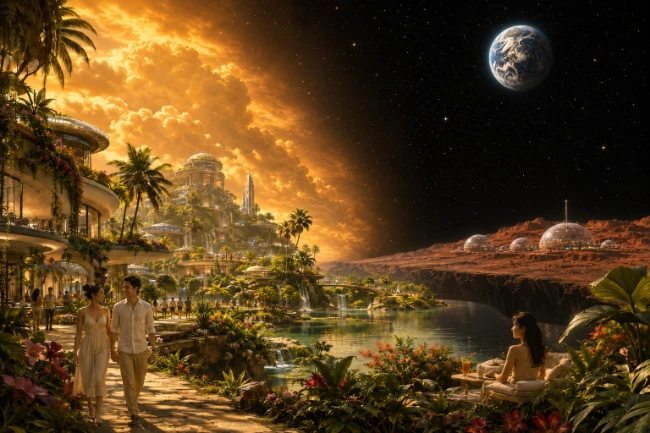
An artist's rendering of post-engineering Venus with a Mars-scape in the background and the earth in the sky. (Image by ChatGPT)
Everyone knows Elon Musk wants to die on Mars. He's said it himself, in those exact words, with the gleaming conviction of a man who's already bought the plot. SpaceX's entire interplanetary architecture is built around the Red Planet — the Starship, the colony designs, the daydreams about a self-sustaining city of a million souls shivering beneath a pink Martian sky. It's a bold vision. It's also the wrong planet.
Frankly, I've bee a bit disappointed by this odd fixation on Mars. Everyone knows the better planet is Venus!
Venus is more than the romantic option — it's an engineering dream. On the other hand, a close look at Mars reveals it for what it actually is: a costly dead end that, in the long run, would certainly bleed NASA and SpaceX dry.
The Gravity Problem Nobody Wants to Talk About
Here's what Mars fantasists gloss over: Mars has about 38% of Earth's surface gravity. This creates inevitable and insurmountable problems.
First, we don't know with certainty what that does to the human body over years or decades, because no human has ever lived in it. We do have solid data on microgravity from the International Space Station, and it's not encouraging — bone density loss, muscle atrophy, cardiovascular deconditioning, vision problems caused by fluid shifts toward the head. Mars's partial gravity will likely be better than zero-g, but we genuinely don't know if it's enough. There's a floor somewhere between 0% and 100% of Earth gravity below which the human body simply can't thrive long-term. Mars might be above that floor. It might not be.
Venus, by contrast, has 90% of Earth's surface gravity. That's close enough to home that it almost certainly clears any biological threshold. Children born there wouldn't grow up with weakened bones. Hearts wouldn't have to be re-engineered by evolution. The most fundamental biological problem of off-world colonization — the problem we're not even sure Mars solves — Venus solves definitively.
Inescapable Mass-Atmosphere Link
Mars's atmosphere is a whisper. At roughly 0.6% of Earth's sea-level pressure, it offers essentially no radiation shielding, no weather to speak of, and no hope of growing food in the open air. Terraforming Mars to Earth-like conditions would require importing or generating an enormous quantity of gas — estimates range from centuries to millennia, and the planet's low gravity means any atmosphere we build will slowly bleed into space anyway. Mars doesn't have enough mass to hold a thick atmosphere for geological timescales. It lost most of its original one for exactly this reason.
This is the part where Venus looks almost perversely ideal. Venus has too much atmosphere — a crushing 92 atmospheres of pressure at the surface, mostly CO₂, with sulfuric acid clouds for good measure. The surface is hellish, yes—for now. But the atmosphere itself is a resource as well as a short-term obstacle. In the near term we would certainly exploit the fact that at about 50 kilometers of altitude, the pressure drops to roughly one Earth atmosphere, the temperature settles into a balmy 0 to 50 degrees Celsius, and the radiation environment becomes significantly more benign than the Martian surface, thanks to all that cloud cover above.
We wouldn't start by trying to terraform Venus at the ground level. Instead the smart play is to start by colonizing the clouds as floating bases of operation. Floating cities — aerostats, essentially — are well within the reach of foreseeable engineering. They'd be buoyed by breathable air itself, since an atmosphere of nitrogen and oxygen is actually a lifting gas in Venus's CO₂ skies. The stage 1 colony structure is the balloon. It's an elegant closed loop that Mars simply can't offer.
But the Venus case isn't merely clever; it's genuinely thrilling. That massive, noxious CO₂ atmosphere isn't a permanent condition. It's a feedstock. Researchers have already identified extremophile bacteria capable of surviving in acidic, high-CO₂ environments on Earth. The logical extension — one that synthetic biology is rapidly making plausible — is engineering microbial strains specifically optimized to thrive in Venus's cloud layer, metabolizing CO₂ and sulfuric acid and exhaling oxygen and nitrogen as a byproduct. You'd be seeding the atmosphere the way Earth's own early cyanobacteria seeded ours, except with intent and direction instead of blind evolutionary accident.
The scale of Venus's atmosphere that needs processing is enormous, but bacteria are good at working at scale — that's essentially what they've been doing on Earth for three billion years. Engineered strains with optimized metabolic rates, deployed across a planetary atmosphere, could plausibly reduce Venus's CO₂ load from 92 atmospheres toward something Earth-like not over millennia but over decades. Some models suggest the transformation could be meaningfully underway within a human lifetime. That's terraforming as an economically feasible engineering project we could fund, staff, and live to see completed.
The Distance Dividend
Venus is also closer. Not always, because orbital mechanics are dynamic, but on average Venus is nearer to Earth than Mars is, and at its closest approach it's dramatically so. That matters for supply chains, communication lag, and emergency response windows in the early phases of any colony. Mars at its closest is about 54 million kilometers away; Venus gets within 38 million. More importantly, launch windows to Venus occur more frequently and the transit times are shorter. For the bootstrapping phase of any interplanetary civilization — the phase where you're most dependent on Earth — proximity is a genuine strategic asset.
Solar Power Is Practical There
One persistent critique of a Venus cloud colony is solar power: Venus is closer to the Sun, but that thick cloud deck blocks most sunlight. In practice, cloud-top colonies would sit above most of the cloud layers, receiving roughly twice the solar irradiance of Earth. Mars, being farther from the Sun, receives less than half. If you're building a civilization that runs on solar energy — and any long-term space colony will — Venus's position in the solar system is a feature, not a bug.
So Why Mars?
The only advantage Mars has over Venus is a solid surface. Admittedly that's a simpler sell than a floating archipelago above Venus. Many earthlings would be discomfited by picturing themselves living aboard floating platforms in an acid-wreathed sky. They'd rather walk on red dirt even if it is in a spacesuit or inside an airlocked greenhouse.
But "easier to sell" isn't the same as more suitable for planetary engineering. Mars's gravity deficit may make it permanently unsuitable for multi-generational human habitation. Its atmospheric deficit makes terraforming a project that requires building an unimaginably massive amount of atmosphere from nearly nothing — then hoping a low-gravity, magnetosphere-free planet can hold onto what you've built. V enus's day-one problems are severe, sure, but they're the problems of too much, and humanity has always been better at working with excess than with absence. When your problem is too much atmosphere, you can eat it. Literally. At least the bacteria can eat it and turn it into something we can breathe.
The Once and Future Eden
Here's what the endgame actually looks like. Venus, billions of years ago, was genuinely habitable — with liquid water oceans and clement temperatures before a brightening Sun tipped it into runaway greenhouse hell. The planet's underlying bones are Earth-like in almost every way that matters: mass, gravity, diameter, composition. What went wrong was atmospheric, and what went wrong atmospherically can, in principle, be fixed atmospherically.
Strip out enough of that CO₂ through generations of engineered microbes doing what microbes do best — converting one gas into another at staggering scale — and Venus doesn't just become habitable. It becomes expansive. Venus has no oceans. That's usually listed as a deficiency, but flip the perspective: it means the entire surface is land. Once temperatures and pressures normalize, you're not looking at an Earth-sized planet with 30% usable surface area. You're looking at a world with multiples of Earth's habitable land mass, all of it solid ground, all of it sitting in near-Earth gravity, bathed in abundant solar energy, and held securely by a planet massive enough to keep its air for billions of years.
That's not a colony. That's a second Earth — a bigger one, on a practical level.
Mars, at the end of its most optimistic terraforming arc, gives you a cold, low-gravity world with a thin atmosphere you're never quite sure will stay put, offering less habitable area than Earth. Venus, at the end of its biological terraforming arc — achievable not in millennia but potentially within decades of serious effort — gives you more room than humanity has ever had. The math isn't subtle.
Musk deserves credit for making interplanetary ambition feel concrete and near-term rather than the exclusive province of science fiction. But ambition pointed at the wrong target is just an epic waste. T he far-sighted play — the one that takes mass, gravity, biological engineering, and sheer habitable potential seriously — points not toward the pale red dot but toward the brilliant white one. We've been staring at Mars when the real prize has been blazing in our evening sky all along.
© 2026 by Asian Media Group Inc.
Recent Articles
- Venus, Not Mars, Is the Visionary 2nd Earth Play
- Keiko Fujimori's Victory Returns Divisive Dynasty to Peru
- SK Hynix Targets $29 Billion US Listing as AI Demand Surges
- Global Crude Markets Mired in Discounts as Oil Begins Pouring Through Hormuz
- OpenAI Unveils Custom Chip It Designed with Broadcom to Boost Its AI Infrastructure
- US Q1 Current Account Deficit Widened More Than Expected
- Alibaba Sues US for Being Linked to Chinese Military
- Zohran Mamdani Sends Message to Democratic Establishment
- Oil Prices Extend Decline on Smoother Crude Flows via Hormuz
- Anthropic's Mythos Took Only Hours to Find Weaknesses in Every Classified US Government System