

What IBM's Latest Quantum Advantage Claim Means and Doesn't Mean for a Quantum Computing ETA
By JL Zhang | 31 Jul, 2026
The horse race to groom quantum chips for industrially useful processors took a meaningful step forward, but is likely to continue for the next several years.
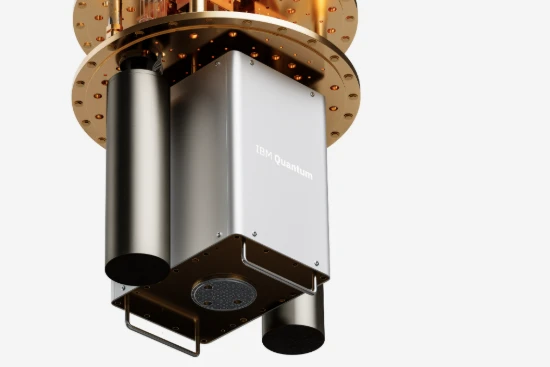
This gold-plated 'chandelier' chills IBM's quantum processor to near absolute zero and routes the microwave signals that control its qubits. The actual Heron chip is attached to the bottom of the chandelier. (Courtesy IBM)
On July 30, IBM did something unusual even by the standards of an industry that thrives on bold announcements: it declared quantum advantage three times in a single day. In coordinated releases with the Israeli software firm Qedma, the Finnish-founded startup Algorithmiq, and researchers at the University of Chicago, the company presented three separate demonstrations that, it argues, meet the fundamental criteria for quantum advantage — computations beyond the reach of the best classical simulation methods, delivered with enough verification that the results can actually be trusted.
The announcements are genuinely significant. They are also easy to misread. Understanding what was demonstrated, and what was conspicuously not demonstrated, is the key to forming a realistic estimate of when quantum computing will matter to anyone outside a physics department.
Three Claims, One Day
The three demonstrations attack the problem from different angles. The collaboration with Qedma used error-mitigation software running on IBM's Heron processor to track quantum dynamics in systems of up to 74 qubits, resolving the behavior of a two-dimensional driven magnetic model — the kind of periodically pulsed spin system that becomes exponentially harder to simulate classically as it grows. The results were checked against supercomputing resources, including those at RIKEN, home of the Fugaku machine, and held up.
The Algorithmiq work simulated a heterogeneous quantum material — one whose irregular structure defeats the symmetry shortcuts classical simulation methods depend on. Notably, the underlying problem had been posted publicly on IBM's Quantum Advantage Tracker for months, an open invitation for classical algorithm designers to knock it down. None reliably did across the full problem regime.
The University of Chicago demonstration is the most technically striking. Researchers encoded 70 logical qubits using a new error-correction construction and ran a circuit-sampling computation involving 2,415 logical two-qubit operations and 468 logical T gates — complexity metrics that place the run among the largest logical quantum computations ever performed. The circuit was built by lacing hard-to-simulate T gates into an otherwise classically checkable framework, so the computation could effectively certify its own fidelity. The quantum machine finished in about fifteen minutes; leading classical methods would need infeasible amounts of time.
A Higher Bar Than Supremacy
Veterans of quantum hype cycles will remember Google's 2019 "quantum supremacy" claim, which was contested almost immediately when classical algorithm designers found faster simulation tricks. The lesson the field absorbed was that a quantum advantage claim is only as strong as its verification. A computer that produces an answer no other machine can check is, for practical purposes, producing an answer no one can trust.
That is why the common thread across all three IBM demonstrations is not speed but trust. The Qedma and Algorithmiq work leaned on noise manipulation — deliberately injecting errors, altering gate calibrations, and running across multiple processors to show the answers stayed stable. The Chicago work went further, making verification part of the computation itself: a classically simulable reference circuit establishes a trusted baseline, and syndrome checks carry that trust into the classically intractable regime. This shift, from claiming advantage to certifying it, is arguably the real news. It converts quantum advantage from a debating point into something closer to a reproducible laboratory standard, and it sets a template competitors will now be pressed to match. Future advantage claims that arrive without a comparable trust framework will look weaker by comparison, whatever their raw performance numbers say.
What It Does Not Mean
Here is what none of the three demonstrations did: break encryption, discover a drug, optimize a supply chain, price a derivative, or train a machine-learning model. The computations that crossed the classical frontier fall into two categories — simulations of quantum physics, and structured sampling tasks designed to be both hard and checkable.
The physics simulations have genuine scientific value. A quantum processor resolving material dynamics that no supercomputer can reach is producing new data for condensed-matter physicists, and it is fair to call that useful. But it is useful in the way a new telescope is useful — to researchers, on home turf. Quantum systems are naturally good at simulating quantum systems. That is the one arena where today's noisy, modest-sized machines were always expected to win first, and it says little about their readiness for the commercial workloads that dominate quantum investment theses.
The sampling demonstration, meanwhile, has no application at all. Its value is as a proof point: it shows that error-corrected logical qubits can sustain deep circuits with verified fidelity, a prerequisite for everything useful that comes later. Nobody needs the output. Everybody building toward fault tolerance needs the capability.
The scale gap remains vast. Factoring RSA-2048 with Shor's algorithm is estimated to require thousands of logical qubits — millions of physical ones — executing billions of gates. The Chicago demonstration ran 70 logical qubits through a few thousand logical operations. IBM's own published gate-count targets climb from roughly five thousand two-qubit gates today to ten thousand in 2027. Those are meaningful engineering milestones, and they also quantify, with unusual honesty, how far the trajectory still has to travel.
The State of the Horse Race
IBM's announcements land in a field that has produced more real milestones in eighteen months than in the previous five years, and the useful way to handicap it is to notice that different contenders lead on different bottlenecks rather than any one company leading outright.
Google's 105-qubit Willow chip holds what many consider the single most important result of the era: the December 2024 demonstration of below-threshold error correction, in which adding physical qubits made the logical error rate fall exponentially rather than rise. Google followed in late 2025 with its own verifiable-advantage claim, running a physics benchmark thousands of times faster than the best classical alternative. Willow proved that scaling works; IBM's new results prove the outputs can be trusted and, in narrow domains, used. They are complementary halves of the same problem.
Quantinuum's trapped-ion machines run slower than superconducting chips but with cleaner qubits, record fidelities, and full connectivity, making the company a leading contender for high-quality logical qubits at smaller scale. Neutral-atom platforms from Atom Computing and QuEra have pushed raw qubit counts past a thousand and demonstrated fault-tolerant operations. And a set of architectural wildcards — Microsoft's topological qubits, Amazon's cat qubits, PsiQuantum's photonic bet — could leapfrog the field if their physics pans out, though all remain earlier-stage.
IBM's distinctive asset is less any single chip than the machinery around its chips: the most explicit published roadmap in the industry, a modular scaling strategy that links processors through cryogenic connections, an error-correction approach designed to need roughly an order of magnitude fewer physical qubits than the surface code, and a cloud ecosystem of more than five hundred organizations already running experiments. A roadmap that detailed is also that easy to judge, which cuts both ways.
Reading the Timelines
So when does any of this become industrially useful? The convergence among the serious players is telling. IBM has targeted quantum advantage in a commercially relevant computation by the end of 2026, with its full fault-tolerant system slated for 2029; its chief executive has pointed to 2028 or 2029 for measurable business impact. Google frames Willow as a step on the road to a million-qubit fault-tolerant machine. Quantinuum's logical-qubit roadmap points to the same late-decade window. Nobody credible is promising commercial transformation next year, and nobody credible is pushing it past the early 2030s either.
That clustering suggests a reasonable reading of this week's news. The July 30 demonstrations mark the moment quantum advantage stopped being a contested claim and started becoming a verified, repeatable scientific fact — in the narrow domains where quantum hardware plays on home turf. They de-risk the roadmaps without shortening them. The honest ETA for industrially consequential quantum computing remains roughly 2028 to 2030 for early, narrow commercial value, with cryptographically relevant machines further out still.
The horse race, in other words, has passed a real marker on the track, and IBM currently holds a credible claim to the rail position. But the finish line — processors that earn their keep in factories, pharma labs, and trading floors — is still several laps away, and the field is close enough that the order could change more than once before anyone crosses it.
© 2026 by Asian Media Group Inc.
Recent Articles
- Chinese Military Researchers Tap US AI Models to Train Defense Systems
- Arizona, California, Nevada Hit Hard in Proposal for Deep Colorado River Water Cuts
- Nvidia Regains Market-Cap Crown After Weak Apple Forecast
- What IBM's Latest Quantum Advantage Claim Means and Doesn't Mean for a Quantum Computing ETA
- Air Taxi Developers Pivot to Military Market Amid Civil Certification Delays
- What Is AI Model Distillation and Why Is It Becoming a US-China Flashpoint?
- Musk Dismisses Report of Tesla's Potential China Business Sale
- China Tightens Exit Rules of Citizens Involved in Tech
- S. Korea Records Highest-Ever Temperature of 107 F as Heatwave Intensifies
- Worst Is Over As Travel Bookings Improve from Iran War Hit
Other Asian Media Group Sites
- AsiaMs.net — Asian American Women's Resource
- AsianSports.net — Asian American Sports and Fitness
- VoxCali.com — Videos and Podcasts for Asian Americans
- MyGoldScene.com — Guide to Asian Entertainment
- AttheBanquet.com — Asian Fine Dining and Hospitality
- EastwardDrive.com — Asian Carbuying Intelligence
- EastTable.com — Modern Asian Food and Culture