

Why Trump Paints China As an Existential Threat to the US
By Tom Kagy | 08 Aug, 2026
His repeated efforts to portray China as the source of all evil in the world is actually rooted in a calculated stratagem to exploit for political gain his base's deep-seated atavistic dread of Asians.
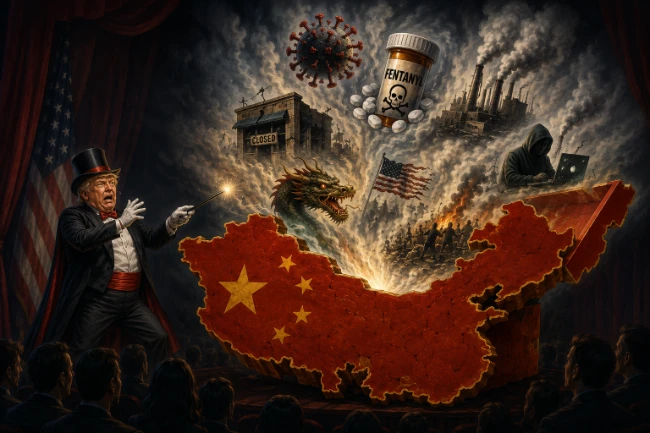
To hear Donald Trump talk, China is a Pandora's Box of every bad thing from drug addiction, to Covid ("kung flu") to industrial decline to a malign conspiracy to end American democracy.
Is this merely the xenophobia of a semi-literate man or is there some deep psychological principle he's looking to tap for political gain?
The answer, on close inspection, is that the two aren't mutually exclusive—and that the second explanation deserves far more attention than it usually gets. Trump's China rhetoric isn't a tic or a stray prejudice that escapes his lips in unguarded moments. It's a system, refined over a decade of rallies and press conferences, and it works on his audience precisely because it plugs into one of the oldest and most reliable circuits in American political psychology: the fear of the inscrutable East.
The Oldest Trick in the Book
Every demagogue in history has understood that a frightened public is a governable public, and that the most useful fear is fear of an external enemy. The enemy must be powerful enough to seem genuinely menacing, alien enough that empathy never complicates the picture, and distant enough that the audience will never test the caricature against lived experience.
China checks every box. It's a nuclear-armed superpower with an economy rivaling America's, run by a Communist Party, populated by 1.4 billion people most Americans will never meet, speaking a language most Americans will never learn, and practicing customs that can be made to seem exotic or sinister with a mere curl of the lip.
Trump didn't invent this playbook. He inherited it, but added a salesman's instinct for which fears move product.
When he descended the golden escalator in 2015, his opening act featured Mexico; China was the co-star, the country that was "killing us" on trade. Over time, the billing reversed. Mexican migrants could be walled off, at least rhetorically. But China offered something better: an enemy that could never be defeated, only endlessly fought—a perpetual-motion machine of grievance. A threat that can be solved is a threat that expires. An existential threat, by definition, never does.
Yellow Peril, Redux
The reason this rhetoric lands so effortlessly is that the groove was carved long before Trump was born. T he United States has a 150-year tradition of anti-Asian panic that most Americans have never been taught to recognize as such. The Chinese Exclusion Act of 1882 was the first federal law to bar immigration on the basis of nationality, passed amid newspaper screeds about opium dens, disease, and coolies stealing white men's wages. The "Yellow Peril" literature of the early twentieth century gave America Fu Manchu, the diabolical genius scheming to subjugate the West.
World War II gave it internment camps for citizens whose only crime was Japanese ancestry. The 1980s gave it the ritual smashing of Toyotas by laid-off autoworkers, and the murder of Vincent Chin by two Detroit men who mistook a Chinese-American for a Japanese one—as if the distinction would have justified the crime.
This is the atavistic substrate Trump drills into. When he leans into the microphone and pronounces "Chy-na" with theatrical menace, when he jokes about "kung flu" and insists on "the Chinese virus," he isn't coining new prejudices; he is reciting a catechism his audience absorbed from a century of pulp fiction, war propaganda, and economic panic. The laughter at his rallies is the laughter of recognition.
Psychologists who study intergroup threat distinguish between realistic threats (they will take our jobs) and symbolic threats (they will erase our way of life). Trump's genius, if that is the word, is to fuse the two into a single package: China is coming for your paycheck and your civilization. Fused fears are exponentially more potent than either alone.
The Alchemy of Blame
Consider what the China narrative does for Trump internally, as domestic politics. Every failure acquires a foreign author. Deindustrialization, which was driven as much by automation, corporate offshoring decisions, and forty years of bipartisan trade policy as by anything Beijing did, becomes a story of Chinese theft. A pandemic that his own administration managed catastrophically becomes a Chinese bioweapon, or at minimum a Chinese cover-up—shifting the ledger of half a million preventable American deaths onto a foreign account. Fentanyl deaths, which implicate American pharmaceutical companies, American prescribing practices, and American despair, become a story of Chinese precursor chemicals. Even his election loss in 2020 was, in various tellings amplified by his allies, somehow a Chinese operation.
This alchemy of scapegoating transmutes accountability into grievance. A leader who blames himself must change; a leader who blames China need only rage. And the base, offered a choice between the painful complexity of self-examination and the anesthetic simplicity of blame, will choose the anesthetic every time. That is not a defect peculiar to Trump voters—it is human nature—but Trump exploits it with unusual shamelessness.
Fear as a Business Model
There is also the crude commercial logic. Fear is the most reliable engagement engine ever discovered. It fills arenas, opens wallets, and keeps eyeballs fixed on the screen. Trump's fundraising emails are a fever chart of manufactured emergencies, and China is the emergency that never needs restocking. Every fresh headline—a spy balloon, a TikTok hearing, a naval maneuver near Taiwan—is raw material. The threat inflation serves cable bookers, defense contractors, and think-tank hawks as well, which is why so few powerful institutions have an incentive to deflate it. Trump sits atop a fear economy in which he is both the chief manufacturer and the chief beneficiary.
Notice, too, how selectively the menace is invoked. The same Trump who calls China an existential threat has lavished praise on Xi Jinping as a "brilliant" leader who rules with an "iron fist," sought his help for political favors, and boasted of their beautiful friendship over chocolate cake. If Trump genuinely believed China was an apocalyptic danger, this coziness would be inexplicable. As theater, it's perfectly coherent: the villain is a prop, to be brandished or embraced as the scene requires. The inconsistency is the tell. Ideologues are consistent; salesmen read the room.
Asian American Collateral
This low stratagem has a body count. In the year after "Chinese virus" entered the presidential vocabulary, reported hate incidents against Asian Americans surged into the thousands—elders shoved to the pavement in San Francisco, women assaulted on New York subway platforms, six Asian women murdered in Atlanta spas. Researchers tracked measurable spikes in anti-Asian rhetoric online in the hours after Trump's tweets.
Chinese-American scientists, many of them naturalized citizens who chose this country, found themselves investigated under initiatives that treated ethnicity as probable cause, and began leaving American universities in a quiet brain drain that damages the very competitiveness Trump claims to champion. When you summon a century-old demon for applause lines, it does not politely confine itself to the rally hall. It walks out into the streets and finds a grandmother.
None of This Absolves Beijing
Even most Asian Americans would agree that the People's Republic of China is an authoritarian state that persecutes Uyghurs, smothered Hong Kong, steals intellectual property on an industrial scale, and menaces Taiwan, as well as laying out an outsize claim over virtually the entire South China Sea. A serious China policy is not only defensible but necessary, and serious people across the political spectrum are trying to build one.
But the existence of a real strategic competitor makes the demagogic caricature more dangerous, not less, because it launders atavistic fear as hardheaded realism. The measure of the difference is simple. A policy addresses conduct; a stratagem targets a people. A policy distinguishes the Chinese Communist Party from Chinese civilization and from Americans of Chinese descent; a stratagem profits from blurring them. Trump's rhetoric fails this test constantly, and the failure is not sloppiness. The blur is the desired end product.
The Fear That Outlives Its Author
The deepest cost of Trump's stratagem may arrive after he's gone. Moral panics, once summoned, are hard to dismiss; they become bipartisan reflexes, institutional budgets, and cultural default settings. A generation of politicians is learning that China-bashing is free money, and a generation of Asian Americans is learning that their belonging is conditional on the day's headlines.
Meanwhile the actual challenges China poses—which demand alliances, investment, patience, and precision—are drowned out by a carnival barker's roar. That's the final irony of painting China as the source of all evil: it leaves America less capable of confronting the evils that are real, and more captive to the ones that live only in the dark basement where the fear of the stranger has always been kept, waiting for someone cynical enough to exploit it.
© 2026 by Asian Media Group Inc.
Recent Articles
- Hormuz Straight Talk Remains Elusive
- Is Rajeeb Hazra's Quantinuum the Quantum Computing Startup to Beat?
- Rajeeb Hazra Partners Quantinuum with Oracle to Bring Quantum Computing to Cloud
- Trump Media Quarterly Loss Jumped 11-Fold to $238 Million
- Cheap Meals No Longer Do the Trick for McD, Rivals
- Joby Acquires Defense Tech Company for $500 Million
- Disney Wins Global Streaming Rights for Formula E Races
- Bumble Eases Women-First Messaging Rule as Dating Apps Seek Engagement Boost
- Nvidia Is Developing Nemotron 4 Open-Source Models
- US Human Rights Groups Sue Trump over Anti-ICC Push
Other Asian Media Group Sites
- AsiaMs.net — Asian American Women's Resource
- AsianSports.net — Asian American Sports and Fitness
- VoxCali.com — Videos and Podcasts for Asian Americans
- MyGoldScene.com — Guide to Asian Entertainment
- AttheBanquet.com — Asian Fine Dining and Hospitality
- EastwardDrive.com — Asian Carbuying Intelligence
- EastTable.com — Modern Asian Food and Culture
- TadkaTable.com — Inside South Asian Cooking
- GoGenerational.com — Diaspora Families Building Wealth
- TransPacBound.com — Transpacific Traveler